On July 15 the New York Times ran an opinion piece by David Leonhardt on “A Better Way to Run Schools: The New Orleans turnaround shows the power of giving more freedom to teachers and principals — and then holding them accountable for their performance” (https://www.nytimes.com/2018/07/15/opinion/columnists/new-orleans-charter-schools-education-reform.html). At the risk of oversimplifying, the article noted the success after the Katrina Hurricane of setting up each of the New Orleans schools as a somewhat autonomous charter school, and then argued that this model might possibly be applied to all schools across the country. There is also a current book with a very similar theme, Reinventing America’s Schools: Creating a 21st Century Education System by David Osborne (https://www.bloomsbury.com/us/reinventing-americas-schools-9781632869913). Osborne also uses New Orleans and a few similar sites as examples, and then like Leonhardt concludes that our simple answer is to make every school in the U.S. a charter school.
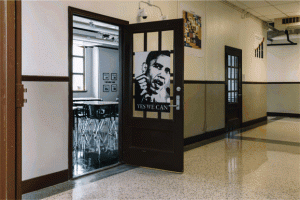 (New York Times)
All we need to do is X?
Certainly there are valuable lessons to be learned from the experiences of the New Orleans schools. But we need to be very careful of taking that next step and saying, “Hey, this has always been easier than we thought—all we need to do is X!” A particular danger of this article is it implies that one of those “all we need to do” things to improve our schools is to eliminate those bureaucratic district offices. This is kind of like teenagers saying my life would be so cool if only I could divorce my parents. District offices do the hard work of helping to implement curriculum and the related resources, so schools can be freed from having to do this individually and possibly not doing it well. That doesn’t mean principals and teachers shouldn’t ALSO be involved, and in fact you get the best results when everyone is engaged in this work and it is done in both a top-down and bottom-up way. I believe this is particularly true when using technology to bring about improvement, as I argue in “We Must Manage Technology Both Top-Down and Bottom-Up” (https://managingtechnologyink12.wordpress.com/blog-posts/we-must-manage-technology-both-top-down-and-bottom-up).
We need everyone – schools, teachers, and the district office
Maybe the best example of the positive influence of the district office is with the implementation of technology to enable new teaching models such as personalized learning. In 30 plus years since the days of the Apple II we really haven’t gotten much value from the use of technology in our schools. That’s finally starting to change, except that won’t work well if implementation of technology can’t be done efficiently from the district level and instead is expected to be taken on by individual schools and already-overworked teachers. And I suspect that isn’t what’s going on in New Orleans.
For example, one of the principals quoted in the article is from KIPP Renaissance High School. KIPP is a nationwide charter school chain with 224 schools, as big a “district” as almost any public school district in the country. This principal, Ms. Towana Pierre-Floyd, says “decisions (are) really close to the school site and the students.” That’s great, but I’m certain she also gets valuable services from the KIPP “district.” So let’s not draw the wrong conclusion from the New Orleans experience that we’ll get the best experience if we set up each school in the U.S. as some sort of little island.
 Managing Technology in K-12 Learning