Charters Seem to Work Well in New Orleans – So Should ALL Schools Be Charter Schools?

On July 15 the New York Times ran an opinion piece by David Leonhardt on “A Better Way to Run Schools: The New Orleans turnaround shows the power of giving more freedom to teachers and principals — and then holding them accountable for their performance” (https://www.nytimes.com/2018/07/15/opinion/columnists/new-orleans-charter-schools-education-reform.html). At the risk of oversimplifying, the article noted the success after the Katrina Hurricane of setting up each of the New Orleans schools as a somewhat autonomous charter school, and then argued that this model might possibly be applied to all schools across the country. There is also a current book with a very similar theme, Reinventing America’s Schools: Creating a 21st Century Education System by David Osborne (https://www.bloomsbury.com/us/reinventing-americas-schools-9781632869913). Osborne also uses New Orleans and a few similar sites as examples, and then like Leonhardt concludes that our simple answer is to make every school in the U.S. a charter school.
(New York Times)

All we need to do is X?

Certainly there are valuable lessons to be learned from the experiences of the New Orleans schools. But we need to be very careful of taking that next step and saying, “Hey, this has always been easier than we thought—all we need to do is X!” A particular danger of this article is it implies that one of those “all we need to do” things to improve our schools is to eliminate those bureaucratic district offices. This is kind of like teenagers saying my life would be so cool if only I could divorce my parents. District offices do the hard work of helping to implement curriculum and the related resources, so schools can be freed from having to do this individually and possibly not doing it well. That doesn’t mean principals and teachers shouldn’t ALSO be involved, and in fact you get the best results when everyone is engaged in this work and it is done in both a top-down and bottom-up way. I believe this is particularly true when using technology to bring about improvement, as I argue in “We Must Manage Technology Both Top-Down and Bottom-Up” (https://managingtechnologyink12.wordpress.com/blog-posts/we-must-manage-technology-both-top-down-and-bottom-up).

We need everyone – schools, teachers, and the district office

Maybe the best example of the positive influence of the district office is with the implementation of technology to enable new teaching models such as personalized learning. In 30 plus years since the days of the Apple II we really haven’t gotten much value from the use of technology in our schools. That’s finally starting to change, except that won’t work well if implementation of technology can’t be done efficiently from the district level and instead is expected to be taken on by individual schools and already-overworked teachers. And I suspect that isn’t what’s going on in New Orleans.

For example, one of the principals quoted in the article is from KIPP Renaissance High School. KIPP is a nationwide charter school chain with 224 schools, as big a “district” as almost any public school district in the country. This principal, Ms. Towana Pierre-Floyd, says “decisions (are) really close to the school site and the students.” That’s great, but I’m certain she also gets valuable services from the KIPP “district.” So let’s not draw the wrong conclusion from the New Orleans experience that we’ll get the best experience if we set up each school in the U.S. as some sort of little island.

We Must Manage Technology Both Top-Down and Bottom-Up

We have been using technology in our schools since the Apple II days of the 1980s. Yet for decades our use of technology seemed to be doing little to help improve how well our children learned.

In recent years we finally seem to be enjoying more success in using technology to improve learning. One thing that enables this, of course, is that mobile devices are now so inexpensive that each student can have ready access to one.

But another reason for this success lies in how districts are managing technology—they are managing the use of technology in both a top-down and a bottom-up way.

Photo by rawpixel on Unsplash

Private sector businesses use top-down management—but the nature of their work is different

When private sector businesses use technology to improve how well they work they tend to manage their efforts in a mostly top-down way. So when a bank works to improve their data systems these efforts are planned and implemented top-down. The line workers simply adhere to new procedures for how the new system works—and in fact they must, because tellers and other workers can’t interact with the system in other than a standard way.

That’s what makes education so different. In education the work of the line workers—the teachers—is very complex, and it can’t be reduced to simple common procedures. And, different teachers need to have the latitude to do their work in somewhat different ways. We can’t simply “automate” the work of our teachers in the way that industries like banking or manufacturing can.

Bottom-up “technology integration” has been slow in bringing about improvement in learning

Partly for these reasons, for many years education has mostly taken the opposite approach of private sector industries. We have tended to manage our use of technology not in a top-down but in a bottom-up way, through a strategy of “technology integration.”

With technology integration, we called on individual teachers to keep doing what they were doing but to each find ways to employ technology in their own ways of working. But this simply hasn’t produced the kinds of results we need.

A problem with the technology integration strategy is that it dumped most of the burden of implementing technology on the already-overworked teachers. And although over the years many teachers produced great results, most did not have the time or the resources to accomplish what was needed.

Districts are now managing technology in more of a top-down way

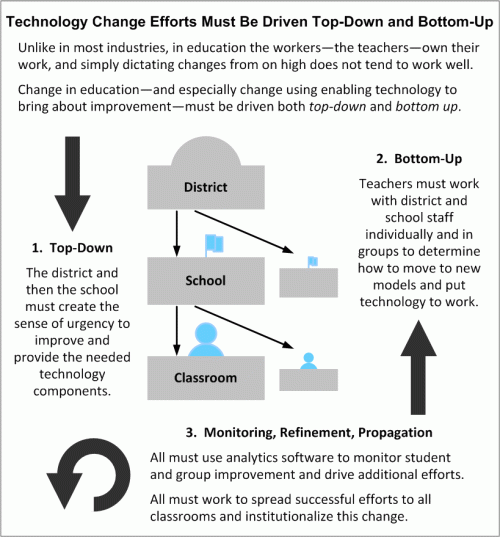
We now realize that if we want technology to bring about major improvements in learning we must manage our activity in a top-down way as well as bottom-up.

In our book on Managing the New Tools in K-12 Teaching and Learning: How Technology Can Enable School Improvement we looked at case studies of five school districts. Each district was managing their use of technology in both a top-down and a bottom-up way.

What does top-down management include?

The top-down aspect of technology management in these districts typically included these components:

  • Developing and evolving a district-wide vision of how technology can improve learning.
  • Creating a sense of urgency to improve learning and to determine how technology can help make this happen.
  • Identifying new learning models such as personalized learning and the technology that can enable these.
  • Ensuring that students and staff have the needed technology devices and network connectivity.
  • Providing a standard set of electronic texts and online resources that support the district’s curriculum.
  • Providing a standard set of student productivity tools, such as Google Apps.
  • Providing a learning management system, such as Canvas or Schoology.
  • Providing professional development and other resources.
  • And providing various forms of technology support, and to doing so in ways that remove this burden from teachers.

But we must simultaneously also manage in a bottom-up way

Yet even if we manage technology in such a top-down way this still won’t work if teachers don’t embrace the need for the change and aren’t able to use technology to change how they teach. And so each of our case study districts also worked with principals and teachers in a bottom-up way.

What does bottom-up management include?

Bottom-up management typically includes these components:

  • Involving teachers in setting the district’s vision and planning the technology initiatives.
  • Calling on teachers to adopt new models of learning, such as personalized learning.
  • Mandating that teachers implement some critical initiatives, but giving them latitude on whether to implement other initiatives.
  • Helping teachers to put the district’s standard electronic resources and tools to work.
  • Providing full-time technology coaches to work individually with teachers to help them adopt the new models and technology into their teaching practices.
  • Establishing a team dynamic to allow teachers to support each other.
  • Gaining feedback from individual teachers and groups and working with them to improve practices and refine the mix of district-wide resources.

Then we must keep refining the system

Teachers must then use assessment and analytics tools to measure student progress and provide the students with appropriate resources.

Ongoing management efforts include monitoring student progress, evolving the technology vision, refining practices and resources, propagating successful efforts to all classrooms, and institutionalizing these changes.

The chart below on Technology Change Efforts Must Be Driven Top-Down and Bottom-Up provides a high-level view of these concepts.

What do you think?

But how is this working in your district? Are you successfully using a combination of top-down and bottom-up management? Or, are you managing the use of technology in a somewhat different way? What have been your successes? What have been your frustrations? What would you advise others? Please share any thoughts you might have.