In our last blog post on “The Power and Peril of Phones – Part 1: The Power,” we discussed the great power that our modern smartphones give to the users of the phones. And nowadays, those users are almost everyone.
But we also discussed how the power of the phones is causing negative impacts across our society. One example is how the increased use of phones by kids is a major cause of their worsening mental health.
And the kids cannot help but bring their problems to school. The compulsion of the students to use their phones throughout the school day can cause disruption to normal class activities. And on a higher level, the phones are a contributor to decreasing engagement with school and worsening attendance.
In this blog post, let’s consider how districts and schools are working to address the challenges presented by our kids’ use of phones. And in particular, let’s focus on the efforts of schools to control disruption through the use of various forms of bans on the use of phones at school.
* * * * * * * * *
Kids use their phones a lot—and they have been for a long time.
It is not news that our kids use their phones a lot. A 2023 study by Common Sense found that:
On a typical day, the participants in our study (11-to 17 -year-olds) used their smartphones for a median of almost four and a half hours. However, simply showing average daily smartphone duration across our sample doesn’t tell the whole story. Some participants used their phones for only a few minutes per day, while others averaged over 16 hours a day. [i]
The use of phones by kids is not new. It began with the introduction of the first smartphone, the Apple iPhone, in 2007. But as kids have come to carry their phones along with them wherever they go, and as they feel compelled to use their phones throughout the day, the phones have come to have an increasingly disruptive impact on normal classroom activities.
Banning phones at school is not a new idea, but it is suddenly getting new interest.
One way that districts and schools have sought to deal with this challenge is to implement a variety of types of “bans” on the use of phones in schools. One example is the nation’s largest school district, the New York City Schools.
New York had instituted a ban over a decade ago, but the district found it to be ineffective. The ban was lifted in 2015. Lifting the ban was a campaign promise for Mayor Bill de Blasio, who argued parents needed the phones to be able to contact their children. [ii]
Our Milwaukee Public Schools also once had a similar ban, but also lifted it, as New York did.
But interestingly, in recent months there has been a greatly renewed interest in bans on phones. The New York City Schools are now one of many districts implementing bans or considering doing so. [iii]
And at the state level, a recent analysis by Education Week found that, “As of July 2024, at least 7 states have passed laws or enacted policies that ban or restrict students’ use of cellphones in schools statewide or recommend local districts enact their own bans or restrictive policies.” [iv]
Has the book The Anxious Generation possibly focused attention on phones?
What is it that has sparked this sudden interest in this problem and the partial remedy of banning phones in schools? Part of the answer may simply be that the problem has continued to worsen, and the interest in taking needed measures to finally address the problem in an effective way has finally reached a critical mass. But part of the reason may also be the impact of a recent book, The Anxious Generation, by Jonathan Haidt.

The Anxious Generation is currently #1 on the New York Times Best Sellers Combined Print & E-Book Nonfiction List, and it has been on the list for 16 weeks. [v]
In The Anxious Generation, Jonathan Haidt discusses the forces that have led to the worsening mental health of our children. He identifies the use of phones as one of these forces, and he presents a persuasive argument for banning phones during school hours. He also presents suggestions for how families can manage the use of phones outside of school.
Phone bans can vary in intensity, and some forms of bans are more effective than others.
As we mentioned above, a district may implement a district-wide ban. And some states are even considering statewide bans. But in some situations, such as with a private school, the ban could be only for a single school.
There are several issues with bans on phones in school. These issues include:
- Whether the bans are being decreed by the state, district, or school
- The extent of the ban (e.g., Can the student keep their phone in their locker?)
- How the bans are being implemented
Our table below identifies five potential extents of a ban, in descending order of strictness.
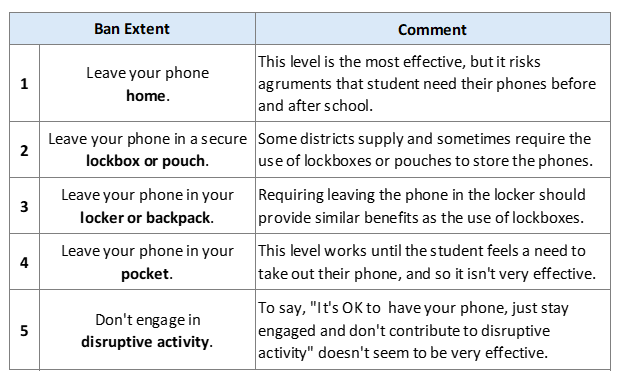
Level 1, prohibiting students from even bringing their phones onto school premises, would seem to be the most effective ban. But a ban of this extent may face the most opposition from parents.
Level 2, the option of allowing a student to bring their phone to school but then to be required to store it in a lockbox during the school day, seems to be more of a compromise. An interesting technology to support this type of ban is a lockable pouch or “sock” to store the phone. Yondr is one vendor that provides these pouches.

Level 3, requiring students to simply leave their phones in their lockers seems less complicated, and probably works well for private schools and smaller campuses.
Level 4, asking students to leave their phones in their pockets probably works less well, especially since students will be tempted to take their phones out in the bathroom, etc.
And Level 5, allowing students to carry their phones about but appealing to them not to disrupt class seems hopeless—the power of the phones is simply too great.
Calling on teachers to somehow suppress the disruptive impact of the use of phones with little or no help from on high seems futile. A recent Education Week article was the tale of “Cellphones Turned My Teaching Career From ‘Awesome’ to Exhausting,” in which a veteran teacher told how his constant battles with phones wore him down and eventually motivated him to quit the profession. [vi]
Of course, the growing use of smartwatches and earbuds and the increasing “wiring” of our students will make the use of bans even more challenging.
Districts and schools have taken creative approaches to bans, and implementing these approaches requires the involvement of teachers, parents, and students.
Implementing a policy to manage the use of phones by students is a challenging undertaking. And to be successful it requires much more effort than merely announcing, “We are now banning phones.”
A recent Edutopia article on “3 Schools, 3 Principals, 3 Cell Phone Bans” provided three excellent case studies and how some schools reconsidered their policies on phones – https://www.edutopia.org/article/cell-phone-bans-schools-principals-weigh-in. [vii]
- Newburgh Free Academy High School in Newburgh, NY found their Level 3 policy of asking students to keep their phones in their lockers or backpacks wasn’t working well, and the school moved to a Level 2 policy involving the use of pouches.
- Rogers Park Middle School in Danbury, CT found that leaving the management of phones to teachers was working poorly, and the phones were enabling behavior such as using phones to instigate fights. Rogers Park also moved to a Level 2 policy using pouches.
- Luxemburg-Casco Middle School in Luxemburg, WI moved to a Level 3 policy of asking students to keep their phones in their lockers.
A common theme to the stories of all three schools is that the principals and school staff members put a lot of energy into involving teachers, parents, and students into planning and implementing the new policies.
One issue they had to address was anxious parents who were concerned about their ability to communicate with their kids during the school day. A partial remedy offered by many schools is simply to ask the kids to come to the office and use the office phone if they need to reach their parents, and to invite the parents to call the office if there is an urgent need to reach the kids.

Students at Rogers Park Middle School (Laurel Golio for Edutopia)
Districts and schools need to think through and implement their policies on phones.
Districts and schools should also think through and publish a policy related to phones. Issues the policy should address include:
- Define which devices are covered, possibly using the broad category of “personal electronic devices.”
- Explain how the policy works, and what students need to do with their phones (e.g., Lock the phone in their lockers upon arriving).
- Reassure students and parents of how they can handle emergencies. (e.g., Use the phone in the office.)
- Present the consequences of not following the policy.
- Open the door to exceptions such as using phones in class activities.
- Provide some regulation of behavior when phones are used, such as not engaging in harassment.
- Appeal to students to notify staff if they receive inappropriate messages.
- Require students to not disclose personal information, or user IDs and passwords.
But what else should schools be doing to address our kids’ phone challenges?
But what should schools be doing beyond bans to address our kids’ phone addiction and other challenges with their use of phones?
In the coming days we will do another follow-up blog post – “The Power and Peril of Phones – Part 3: Addressing SEL and Phone Use at Home.” It’s possible you have some ideas. Or, better yet, it’s possible your district or school is already having success with helping kids and their families with their use of phones. If so, please share your ideas or experiences with me at schulzj@jerryschulz.com. Or leave a comment on our blog post.
I hope you have found this valuable, and I’m looking forward to continuing this discussion!
[i] https://www.commonsensemedia.org/research/constant-companion-a-week-in-the-life-of-a-young-persons-smartphone-use
[ii] https://www.nytimes.com/2015/01/07/nyregion/ban-on-cellphones-in-new-york-city-schools-to-be-lifted.html
[iii] https://www.edweek.org/technology/school-cellphone-ban-is-critical-for-addicted-students-nyc-chancellor-says/2024/06
[iv] https://www.edweek.org/technology/which-states-ban-or-restrict-cellphones-in-schools/2024/06
[v] https://www.nytimes.com/books/best-sellers/combined-print-and-e-book-nonfiction
[vi] https://www.edweek.org/teaching-learning/cellphones-turned-my-teaching-career-from-awesome-to-exhausting/2024/06
[vii] https://www.edutopia.org/article/cell-phone-bans-schools-principals-weigh-in.
 Managing Technology in K-12 Learning