Tag Archives: "Education Week"

School Attendance Has Become a Crisis. Technology Is Part of the Cause, and It Can Also Be Part of the Cure

In the wake of the Covid-19 pandemic we have seen a very disturbing increase in student absences in our K-12 schools. It would be comforting to believe this trend is just a lingering impact of the pandemic, and that attendance will get back to the old normal over time.

Except this won’t happen, at least not all on its own. The reason is that the pandemic accelerated forces that had already been in motion for some time. And these forces are if anything intensifying, especially the increased use of devices by students and the related “disengagement” of students and parents from the life of the school. Poor attendance is the biggest symptom of this larger problem of disengagement.

Remember how in the days of the pandemic we used the phrase “the new normal?” Well, disengagement and the related increase in absences is part of that new normal. And we are now stuck with this problem—unless we work proactively to fix it.

Except our focus here is technology. So, what does battling absences have to do with technology? Well, the powerful forces the pandemic accelerated were partly related to technology, such as our kids’ increasing attachment to devices. And, some of the solutions we need to apply to address this problem also make use of technology.

Let’s briefly consider how technology helped cause this problem, and then concentrate on how technology can begin to help to fix it.

Increased “disengagement” has brought about poor attendance.

There has been plenty of attention paid to the problem of attendance in a variety of media. Education-oriented media such as Education Week have been working for some time to draw attention to this problem. And on March 29 The New York Times had a great article on “Why School Absences Have ‘Exploded’ Almost Everywhere.” [i]

Kaylee Greenlee for The New York Times

The Times reported that since the 2019-20 school year the percentage of “chronically absent” students in K-12 school nationwide has doubled, from 13% to 26%. This problem is much worse in districts serving disadvantaged populations. In our Milwaukee Public Schools (MPS), the Times reported that between 2019 and 2023 the chronically absent rate went from 37% to 50%.

The Times noted that states use different definitions of chronically absent. For example, the State of Wisconsin defines students as being chronically absent “if they miss more than 10% of school days out of the total number of school days during which they were enrolled.” [ii]

In December, Alan Borsuk and the Milwaukee Journal Sentinel featured an article on “What Are We Willing to Do about Low-Performing Schools in Milwaukee Public Schools and Beyond? Right Now, There’s No Real Plan for Change.” This article discussed the impact of disengagement and the related challenge of poor attendance. Alan used MPS’s Madison High School as a case study. [iii] 

Many kids have simply stopped going to school.

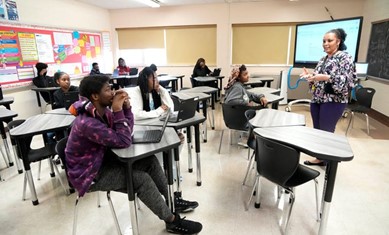
What did Alan find at Madison? He found the school was orderly, and the administrators and teachers were highly motivated. And there were attractive programs in vocational areas, something too few schools offer.

Except there were far too many students in the building. At that point in the school year (mid-December) the average daily attendance so far was 58.6%, which meant that on an average day more than four out of ten students were not in school. In recent years more than 80% of the students at Madison have been labeled chronically absent.
Mike De Sisti – Milwaukee Journal Sentinel

He also reported that enrollment at Madison had fallen from 892 in 2014-15 to 625 in November of the 2023-24 school year.

There is also quite a bit of attrition as students get older:

  • 224 of the Madison students were ninth graders, including 94 repeating their ninth-grade year.
  • 180 were tenth graders.
  • 134 were eleventh graders.
  • 86 were twelfth graders.

What are the causes of this drop in attendance?

So, what is going wrong at Madison and at too many of our districts and schools across the nation? Part of the problem is families and students are often dealing with issues at home that become a barrier to school attendance, as we will discuss below in the case of the School District of Plano, Texas.

But a big part of our challenge is that many students and their parents have lost a basic force that success in school requires. This is the compulsion to simply make yourself physically come to school each day, as part of your larger daily—and lifelong—routine. Those on the education scene use the term “engagement” to describe a traditional connection to school, and the term “disengagement” to describe the loss of this connection.

As we noted above, this disengagement preceded the Covid-19 pandemic, although the pandemic intensified it in a variety of ways. Obviously, our kids can’t be successful in school if they aren’t in the building. We need to bring all our students and their families to once again be engaged in their school experience, and part of this effort is to bring about near-perfect attendance.

But this is a complex undertaking. Let’s focus on the challenge of addressing poor attendance.

Technology can address the problem of poor attendance in three ways.

Technology can help improve attendance in three major ways:

  • The use of data analytics to help school staff and parents identify attendance problems.
  • Top-down automated communication at the district and school level to alert parents of problems and encourage better attendance.
  • Bottom-up one-on-one communication by teachers and other school staff, to intervene with parents of students with attendance problems.

Analytics can identify problem students and trends.

Student information systems (e.g., Infinite Campus, PowerSchool) contain reporting capabilities that allow districts and schools to obtain reporting on different aspects of the attendance challenge.

Examples would include:

  • Students absent today at our school, both excused and unexcused.
  • Students absent today for a second day.
  • Students who are displaying more problematic patterns of attendance.

Districts and schools also need to develop data systems to track interventions that have been attempted with problem students and analyze the effectiveness of those interventions.

Top-down communication sends automated mass alerts to parents.

Top-down automated communication has been used for many years by districts to help manage attendance issues. This communication usually uses a combination of the district’s student information system and notification system software (e.g., BrightArrow, SwiftK12).

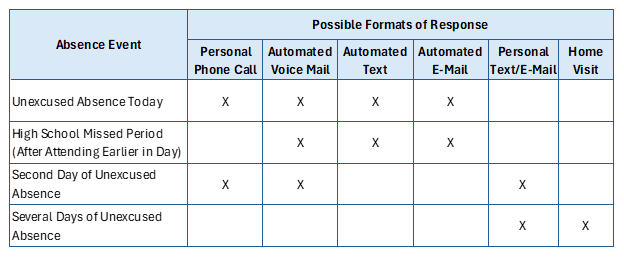
An example is that early each morning the notification system will extract data from the student information system on students with unexcused absences. The notification system will then send some combination of text, voice mail, and e-mail messages to the parents of these students. Note that these messages are generally sent in a single batch for the entire district.

Another example is to send alerts to the parents of high school students who initially were at school but have been marked absent in subsequent periods.

Additional types of alerts would include addressing multi-day absences. The chart below on “Possible Formats of Response” outlines some of these possibilities.
Bottom-up efforts make use of interpersonal communication.

But an effective solution to absences must go beyond alerting parents that their child is absent. The solution must also employ personal contacts with parents.

Such a contact may begin on the morning of the first absence, with a personal phone call from the school office in addition to the automated alerts. If attendance problems continue, calls from the child’s teacher would tend to be especially effective, due to the teacher’s personal relationship with the family. Families with persistent problems would benefit from a home visit.

Districts benefit from a comprehensive approach – Plano, Texas.

And districts would clearly benefit from a comprehensive approach to absenteeism and a unified overall management of the challenges. A good example would be the Plano Independent School District in Plano, Texas. Plano is a racially diverse district with almost 50,000 students. A recent Education Week article on “This Leader Takes a Compassionate Approach to Truancy. It’s Transforming Students’ Lives” profiled the district’s efforts to improve attendance. [iv]

Plano had been relying on the efforts of a truancy court to manage attendance. But sending families to such a court did little to address the problems underlying serious attendance issues. Sharon Bradley, a new Director of Family and Social Services, led the shift to the use of “tiered intervention strategies…to reengage students” and a shift to an attendance review board that would work with families to identify underlying causes for the absences and if needed develop a family support plan.

But there’s a larger problem, disengagement.

As the experience in Plano showed, there are often larger problems behind the attendance challenges of a family. As we noted above, part of the problem often includes a disengagement from the life of the school, and disengagement has gotten much worse in the aftermath of the pandemic.

In our next blog entry, we will try to tackle the challenge of disengagement. And as we work to maintain our technology focus, we will explore how technology contributes to disengagement, but how it may also help us in our efforts to reengage our students.

Have you had any success? What are your thoughts?

If you have any thoughts or contributions on the challenge of attendance, or on the upcoming topic of engagement, please hit “Leave a Reply” above to add a comment, or contact me at schulzj@jerryschulz.com.

And thanks to all for everything you do for our kids in these challenging times!

Jerry Schulz


[i]     Mervosh, S., and Paris, F., “Why School Absences Have ‘Exploded’ Almost Everywhere,” The New York Times, March 29, 2024 – https://www.nytimes.com/interactive/2024/03/29/us/chronic-absences.html

[ii]     https://dpi.wi.gov/wisedash/about-data/chronic-absenteeism#:~:text=Students%20are%20considered%20to%20be,through%20their%20Student%20Information%20Systems

[iii]    Borsuk, A., ““What Are We Willing to Do about Low-Performing Schools in Milwaukee Public Schools and Beyond? Right Now, There’s No Real Plan for Change,” Milwaukee Journal Sentinel, December 15, 2023 – https://www.jsonline.com/story/news/education/2023/12/15/no-apparent-play-to-help-improve-low-performing-mps-schools/71569628007

[iv]    Will, Madeline, “This Leader Takes a Compassionate Approach to Truancy. It’s Transforming Students’ Lives,” Education Week, February 5, 2024 – https://www.edweek.org/leaders/leadership/this-leader-takes-a-compassionate-approach-to-truancy-its-transforming-students-lives/2024/02

Fix Learning Loss? A Better “New Normal?” Let’s Have Both!

K-12 districts and schools must repair what we call the “learning loss” suffered by students as a result of the Covid-19 pandemic. And we still must find our way to the “new normal” of how learning will now work. But couldn’t both these challenges have a common solution?

The month of March marks the three-year anniversary of the COVID-19 pandemic. But in K-12 education, we are still struggling to address two COVID-related challenges.

Courtesy of Education Week and iStock / Getty Images Plus

The first challenge is what we have come to call learning loss. Learning loss is the problem created when the attainment of skills by our students wasn’t on its usual pace during the pandemic. And this “loss” was even more pronounced for the kids who could least afford it, those from disadvantaged families, many of whom were already struggling in school.

Now, we feel we must fix what we view as a one-time problem, that our students are behind the traditional pace for their learning, and they need to do a one-time catching up.

The second challenge is to adjust to the disruption of the K-12 system caused by the pandemic, and to migrate to what we have called a “new normal” of how K-12 learning will now work.

The COVID-19 pandemic disrupted our traditional ways of doing business in K-12 learning. But some of the disruption came in the form of beneficial transformation. At long last we were able to move to one-to-one device coverage for our students. And we introduced new technology for virtual learning (e.g., “Zoom”) and the related skills and technology. Students, teachers, and parents all gained the needed technology and skills in how to participate in virtual sessions.

Except now we are struggling with where we are at and how to get to where we want to go, that new normal. There’s some sentiment to go back to where we were in the good-old pre-2020 days of how we used to learn. And that’s not all bad—there were a lot of things we did very well in our old way of doing business.

Except we now have a wonderful opportunity to implement methods of learning that are much better than the old ones we had. Most of these new methods are enabled by technology.

But how do we address the problem of learning loss? And how do we progress to a new normal that provides our kids with better learning?

Here’s a helpful idea—the solution to both these problems might be the same.

Do we have it in our power to provide new accelerated ways of learning? If so, wouldn’t we want our learning loss kids to continue to learn in these new ways even after they catch up? And wouldn’t we want to extend these improved methods to everyone?

If the answer is yes, this simplifies the problem. The solution is to quickly move everyone and everything to the improved new normal, which should do double duty as our learning loss solution.

In a recent Education Week article, Denise Forte of The Education Trust and Thomas J. Kane of Harvard University advise that, “Districts, Now Is Not the Time To ‘Get Back to Normal.” [i] (I snitched the graphic above from Denise and Tom’s article.)

Denise and Tom suggest that as our districts address pandemic learning loss, they should invest in three key areas:

  • Tutoring
  • Summer learning
  • Core instruction

The challenge of tutoring is a great example of why we might want to fold in current learning loss solutions into our long-term progression to the new normal. A recent Associated Press article on “Many Kids Need Tutoring Help, Only a Small Fraction Get It” reported that districts are struggling to supply tutoring at anywhere near the volume that would be beneficial. So as we figure out how to best provide this tutoring in various ways, we might as well be thinking long term. [ii]

Forte’s and Kane’s suggested investments in core instruction include, “Replacing a weak reading curriculum…with one that reflects the best research on the importance of systematic phonics instruction.” And, “Professional development for current and incoming teachers on the science of reading.”

As part of replacing the reading and possibly also math curriculum, I would add what in my opinion is the single biggest thing we can do to improve learning in K-12. This is moving to a personalized learning (a.k.a. individualized learning) approach, which we would partly enable through the use of personalized learning software.

Personalized learning would address a larger issue that led to the pandemic “learning loss.” Our current system for teaching reading and math assumes all our kids march forward together in the graded structure as they acquire reading and math skills—and they never fall off the pace. Yet some kids, especially those from disadvantaged backgrounds, have trouble keeping up, and once they fall behind they are doomed.

A personalized learning approach allows each student to march forward at their own pace. This enables those who march a bit more slowly from being left at the wayside. And, it also enables the faster kids to zoom ahead instead of being doomed to stare out the window.

A personalized learning approach also addresses another important ingredient of a new normal, which is a shift to mastery learning, using a standards-based approach. A mastery approach works off a list of skills our kids need to attain, and systematically checks off their mastery of them. Of course, in the process it also draws attention to skills a student may not be mastering, so they can attain special help in this area.

The personalized learning software is in a great position to also help with the mastery approach. As it helps student learn their skills it also checks off the skills they have mastered and the standards they have met. It then either moves the students on to new skills or slows down the pace and provides extra help until the skill is attained. It may also alert the teacher to what’s going on in case extra help such as tutoring is required.

This all sounds great—so why haven’t we been using personalized learning for the last 200 years? The big reason is that once kids get onto different wavelengths it quickly becomes almost impossible for a human being teacher working with paper materials to provide each student with individualized lessons. But if we can automate the learning, the teacher is now free to spend their valuable time directing traffic and providing individual and small group help.

Forte and Kane also reference a recent report from The Education Trust on “Promising Practices: A School District Guide to Advocating for Equity in the American Rescue Plan Spending.” The report identifies five components the authors believe are the most important for district spending plans:

  • Accelerating student learning, including targeted intensive tutoring and expanded learning time
  • Student, family, and community engagement
  • Safe and equitable learning environments
  • Teacher recruitment and retention
  • Data equity and reporting transparency [iii]

Let’s consider how technology can support improved core instruction, tutoring, and other components of a new normal—many of which are also the things we need to address learning loss.

So yes, we should take the needed steps to repair learning loss. This will enable all our students to learn faster and more effectively.

But again, if these measures work well, why not implement them in a way in which we can start using them now and continue using them, well, forever? Or until we devise ways of learning that are even better.

This will work best if our district and school leaders work with our classroom teachers to quickly develop a vision for how this will work, and then develop and begin to implement a plan for this transformation.

This will all be tougher to do when the federal ESSER funds run out. But we must find ways to keep moving into that much-better new normal. The alternative is to revert back to those good old days that were not that good for our kids.


[i]     Forte, D., and Kane, T., “Districts, Now Is Not the Time To ‘Get Back to Normal’,” Education Week, February 1, 2023.

[ii]       Wall, P., and Pak-Harvey, A., “Many Kids Need Tutoring Help. Only a Small Fraction Get It.,” Associated Press, 2023.

[iii]     “Promising Practices: A School District Guide to Advocating for Equity in the American Rescue Plan Spending,” The Education Trust, 2022

To Be Synchronous, or to Be Asynchronous—or, Maybe, to Be Neither. That Is the Question.

This fall we should all finally be able to return to a “new normal” school experience, in the traditional in-person way.

Except one way we were changed by the pandemic is almost all students and their parents have been exposed to some sort of virtual school experience. And some parents will want their districts to continue to offer virtual options for attending school.

(Thanks to Education Week and Andrew Rus/Pittsburgh Post-Gazette via AP.)

For some, this will be because of lingering concerns of infection from COVID-19. But other parents may have come to feel that attending virtually is simply a better way for their children to go to school.

And so, districts will need to make decisions on which models they will—or will not—choose to offer. These decisions won’t be easy. Districts may need to decide not to offer virtual models that students and parents prefer but which the districts determine to not be in the best interest of the students seeking these options, plus also their teachers and the other students.

The biggest issue has to do with the concurrent model.

Alternatives for Providing a Virtual Option

Districts seem to have at least four alternative ways to address expectations for virtual school:

  • Continue to offer a synchronous concurrent option, in which online students can attend in-person classes along with the students who are at school and in the classroom. Synchronous means the class is live. Concurrent means online and in-person students both attend at the same time.
  • Offer special synchronous classes for virtual learners only, grouping together online learners from across the district. So, everyone in the class is virtual.
  • Offer an “asynchronous” virtual option, in which students use technology to access learning materials but don’t necessarily join together at the same time with fellow students in an online class.
  • Decline to offer any virtual option, either synchronous or asynchronous.

Only a year ago, most districts did not offer a virtual option. But with the explosion of the pandemic in March of 2020 districts had to quickly work to keep school going, despite not being able to allow students to be in the building.

Some districts distributed paper texts and materials to their students—kind of “asynchronous,” but without the technology. But most districts adopted virtual solutions. What helped is that many districts had already implemented 1-to-1 device coverage, and others were well on the road there. And districts worked quickly to issue devices to any students who needed them.

This enabled a conversion of existing classes to virtual classes. There was some use of asynchronous virtual classes. But most districts went to synchronous classes—students attended virtually from home, using products such as Google Meet or Zoom, interacting with their teachers who also joined remotely.

In the fall of 2020, most districts returned to face-to-face classes. But many districts also provided a synchronous concurrent option, in which some students could join the class virtually. This accommodated situations such as students having to be out temporarily due to COVID-19 exposure.

But how about the fall of 2021? Why not just continue to allow a synchronous concurrent option?

Not a Good Idea?

There are several reasons why continuing to offer the synchronous concurrent option may not be a good idea.

  • For most students, attending school virtually is just not as effective as attending face-to-face. With traditional schools, students enjoy the structure imposed by the facility and the scheduled school day. And their teachers are on the scene and can more easily ensure that students are engaged throughout the day.
  • The synchronous virtual option requires extra work from our already-overworked teachers, who among other things must ensure there is a virtual alternative for at least some lessons. And they must manage the technology for the virtual sessions.
  • Concurrent classes also provide distractions and possible lost time for everyone—the in-person students, the virtual students, and especially the teachers, as they work to orchestrate the whole scene.
  • And, trying to learn through a virtual session works the most poorly for disadvantaged students and those with special needs.

This is not to say we shouldn’t use technology. The pandemic greatly increased our technology expertise. And providing every student with their own device has opened the door to many effective uses of technology. These uses include supporting personalized learning through the use of powerful adaptive learning software.

And so, the pandemic will hopefully advance our use of technology in learning—except this will work best for children in structured in-school settings.

But if it is not wise to continue synchronous concurrent classes, how can districts satisfy parents seeking a virtual option for their children? One alternative is to group virtual students together into special synchronous-only classes.

Asynchronous Classes—The Most Manageable Option?

But possibly the most manageable alternative is to offer an asynchronous virtual option.

Asynchronous online courses had their start at the college level in the 1990s. Some K-12 districts then began to offer asynchronous virtual programs to appeal to parents who wanted to home school their children, or to accommodate students who were uncomfortable in the traditional school setting. An example is the School District of Waukesha Wisconsin’s eAchieve Academy, which was founded in 2004.

In the 2019-20 school year, 34 of the 50 states allowed districts and charter schools to offer asynchronous virtual school options. And 293,717 of the 50,453,111 students in the U.S., about 0.6%, attended school programs that were fully virtual. [i]

Districts currently without an asynchronous program might be wise to not attempt to build their own program from scratch. An alternative would be to partner with a commercial provider. An example is the School District of Greenfield Wisconsin, which is partnering with the Edmentum provider while also using a district teacher as a digital learning coach. Another alternative would be to collaborate with another district.

Students in Wisconsin also have the option to attend a virtual school in another district through the State’s Open Enrollment program. But they must apply by April 30 for an upcoming school year.

Let’s Think This Through

Some parents and students will reasonably expect their school districts to continue to offer virtual options like those they enjoyed during the pandemic. But districts would be wise to think through which options would be best for all their students.

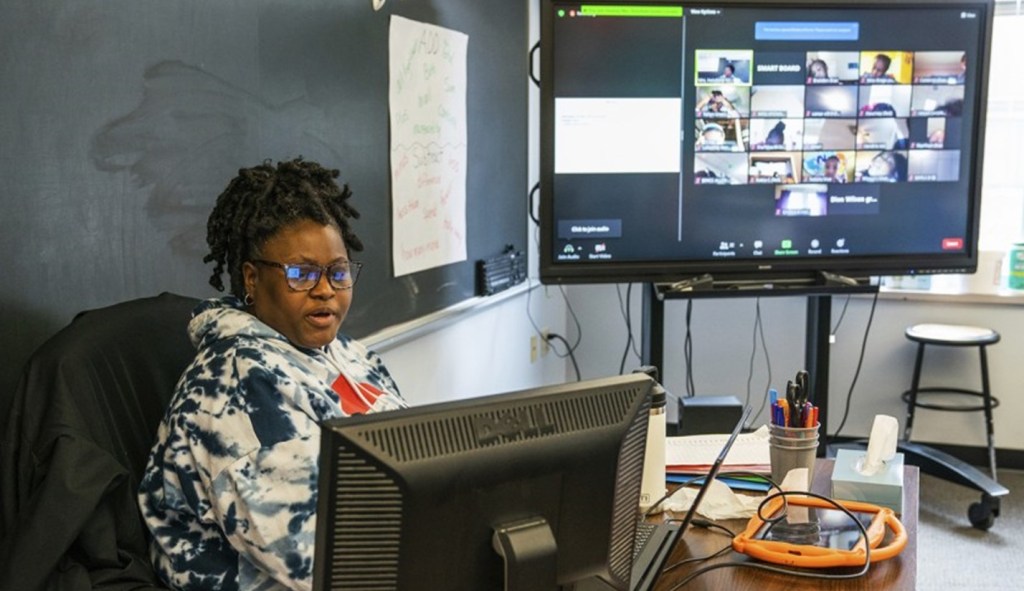
See also the Education Week article on “Forbidding Remote Learning: Why Some Schools Won’t Offer a Virtual Option This Fall,” at https://www.edweek.org/leadership/forbidding-remote-learning-why-some-schools-wont-offer-a-virtual-option-this-fall/2021/06. The photo above of Tanya Holyfield, a 2nd grade teacher at Manchester Academic Charter School in Pittsburgh, is from this article.


[i]           https://nces.ed.gov/ccd/tables/201920_Virtual_Schools_table_3.asp