The COVID-19 pandemic brought about great advances in the use of technology to support virtual learning. And the pandemic also increased interest by parents in homeschooling. The pandemic is now easing, but many parents are for now continuing to choose homeschooling as an option for their children.
Homeschooling is beneficial for some students, but it is not the best form of schooling for most kids. Districts need to support parents who choose homeschooling. But they also must work now to get most students back into their school buildings, because most students simply learn better in in-person settings.
The quick shift to virtual learning during the pandemic is an example of what is called “the disruptive impact of technology.” Often disruption is necessary, as it was for the need to use virtual learning in the pandemic. And we expect it to have a positive impact, as much of our use of virtual learning did.
But technology-driven change can often also be disruptive to a world that previously existed. A good example was how the universal adoption of word processing put typewriter companies out of business. This couldn’t have been helped.
But sometimes these disruptions create unintended impacts we would like to avoid or at least mitigate. For example, the near-universal adoption of smartphones benefits us in many ways. Except the power of our phones has also brought about disruptive negative impacts, such as device addiction.
Of course, homeschooling predates the pandemic. Homeschooling was once rare, but interest in homeschooling has increased since the 1970s, partly driven by a national homeschooling movement. A U.S. Census Bureau study found that for the years prior to the COVID-19 pandemic, homeschooling across the U.S. “remained steady at around 3.3%” of students.” But by the fall of 2020, 11.1% of households surveyed by the Census Bureau reported that they were homeschooling their children. The Census Bureau worded the survey carefully “to make sure households were reporting true homeschooling rather than virtual learning through a public or private school.” [i] And of course, most students have experienced virtual learning in that way during the pandemic.
A related trend that predates the pandemic is an increase in students attending virtual schools. Students may attend virtual schools sponsored by their own districts, or even those sponsored by other districts if their states allow this. Again, this type of virtual school is something different that the virtual schooling that was used during the pandemic.
Most virtual schools offer “asynchronous” classes in which students do not need to be continually interacting online with their teachers and fellow students. These are unlike the “synchronous” online classes most districts used during the pandemic.
Parents considering homeschooling for their child have tough decisions to make. Two big questions regarding homeschooling are:
- Why should students participate in homeschooling?
- How can parents provide their homeschooled children with the needed curriculum and oversight?
As for why parents and students would prefer homeschooling, some reasons are:
- Students are struggling with the overall school environment, due to problems such as bullying.
- Students have health issues, especially being immunocompromised during the pandemic.
- Parents prefer homeschooling for religious reasons.
- Parents are unhappy with the school alternatives in their district.
And how can and/or should parents provide their homeschooled children with the needed curriculum and oversight? One alternative is to participate in a virtual school program. For many families seeking to provide homeschooling this would be a good idea. Yet during the pandemic one more reason some parents chose to homeschool was they felt the daylong virtual learning programs that districts has shifted to involved too much screentime and/or were unable to provide enough content.
An interesting case study of one family’s experience with homeschooling over the course of the pandemic was recently published in the Milwaukee Journal Sentinel. [ii] The author, Amy Schwabe, is a reporter for the paper on family issues. She told of the experience of her own middle school-aged daughter, Wendy. Prior to the pandemic, Wendy “begged to stay home from school. She cried nearly every morning, and she seemed to have constant stomachaches and nausea.” Her parents sought medical help, but to no avail.

Her parents considered their options, and they decided to homeschool Amy for her eighth-grade year.
We should note two things about how Wendy’s story provides an example of how parents address the two big questions on homeschooling. As to why should a student seek homeschooling, Wendy’s story is an example of how parents may choose homeschooling because their student is struggling with the school environment, for reasons that are not easily fixed.
And as for how to provide for the student’s instruction, it’s interesting that in the middle of our boom in virtual learning Wendy’s parents decided not to take advantage of a virtual learning program. Instead, Amy reports that, “Reading and writing are my strengths, so I’ve become Wendy’s history and English teacher. My engineer husband excels at math and science, so he’s taken on those subjects.” So, Wendy found herself in a very beneficial situation.
Here is a link to this article – https://www.jsonline.com/story/life/wisconsin-family/2022/01/28/wisconsin-mom-homeschools-child-during-covid-pandemic/6559691001. And here is a link to a follow-up article, with an emphasis on children’s mental health – https://www.jsonline.com/story/life/wisconsin-family/2022/02/23/childrens-mental-health-suffering-during-pandemic/6872425001.
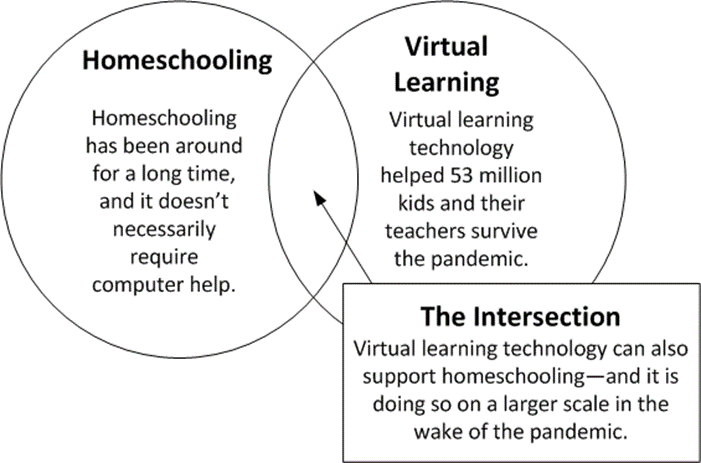
Where homeschooling and virtual learning intersect is when parents determine that they will have their children learn at home, but they also will seek the help of a virtual learning program, possibly through their own school district, another district, a charter school, or a commercial provider. Should this be classified as homeschooling? Clarifying this fuzzy boundary is a one of the challenges school districts must address.
Homeschooling and Virtual Learning Intersect When Homeschool Parents Enroll in Virtual Learning Programs
In a previous blog post on June 27, 2021, we discussed several ways to provide virtual learning. (“To Be Synchronous, or to Be Asynchronous—or, Maybe, to Be Neither. That Is the Question.” – https://managingtechnologyink12.wordpress.com/2021/06/27/to-be-synchronous-or-to-be-asynchronous-or-maybe-to-be-neither-that-is-the-question.)
We discussed how districts seem to have at least four alternative ways to support homeschooling using virtual learning technology:
- Continue to offer a synchronous concurrent option, in which online students can attend in-person classes along with the students who are at school and in the classroom. Synchronous means the class is live. Concurrent means online and in-person students both attend at the same time.
- Offer special synchronous classes for virtual learners only, grouping together online learners from across the district. So, everyone in the class is virtual.
- Offer an “asynchronous” virtual option, in which students use technology to access learning materials but don’t necessarily join together at the same time with fellow students in an online class.
- Decline to offer any virtual option, either synchronous or asynchronous.
Except we’re arguing that in-person schooling is better for most students. Why is this? In-person schooling:
- Provides normal in-person social interaction with fellow students and caring adults.
- Structures the student’s school day and provides oversight of their activity.
- Controls and limits device time, while also hopefully ensuring an optimal use of the most effective current and emerging technology.
Our school districts have been experiencing the impact of technology-driven disruption. This was happening anyway, but it was expedited and was made more pronounced by the impact of the pandemic.
- Work energetically to bring students back into in-person classroom settings, and diplomatically discourage homeschooling for most students.
- But address the demand for homeschooling by providing either or both of two options: synchronous classes for virtual learners only and/or an asynchronous virtual program. These programs could serve only the district’s students, they could be offered through a partnership with other districts, or they could be contracted out to providers.
- And, to the extent that the district sponsors homeschool and virtual learning programs, work to ensure that these programs are high quality and are comparable to the programs for in-person learning.
- Work to include homeschool students within the larger student population. For example, welcome homeschool students to participate on sports teams and in other school activities.
- Possibly provide a synchronous concurrent option so students who must temporarily attend from home can continue with their regular teacher and in-person classmates, but…
- For the most part, avoid using synchronous concurrent classes that mix full-time homeschool and in-person students.
- Provide homeschool parents with virtual and in-person services, and energetically monitor homeschool students to ensure that they are enjoying success.
- Monitor all students in the district to ensure that all are successfully attending in some way.
Technology-driven disruption has complicated our world in other ways. Although we have put beneficial technology to work to improve the learning of our children, this has created situations in which students arguably spend too much of their school days working with computer devices. And so they spend too little of their time interacting with their fellow human beings and being involved in ways to learn that are more hands-on, such as simply using traditional paper books.
How do we cope this disruption? What are some ways to balance virtual and traditional learning? We’ll discuss this in our next blog posting. Until then, let me know if you have any thoughts on this, or post a comment below.
[i] Eggleson, C., and Fields, J., “Census Bureau’s Household Pulse Survey Shows Significant Increase in Homeschooling Rates in Fall 2020,” United States Census Bureau, 2021.
[ii] Schwabe, A., “My husband and I have been homeschooling our eighth grader this school year. She’s taught us some important lessons.,” Milwaukee Journal Sentinel, 2022
 Managing Technology in K-12 Learning