Our modern smartphones provide tremendous power. The little device we carry in our pocket that costs a few hundred dollars gives us access to all the world’s knowledge. And it enables us to communicate with all the world’s people in a variety of ways.
This seems wonderful, and of course it is. But the power of our phones also creates great peril, in that their power lures us into destructive behaviors. And these behaviors can have an especially harmful impact on our young people. One especially harmful impact is our phones interfere with the ability of our young people to participate in school and be successful in a normal way. Maybe worse yet, our phones are so powerful they are creating mental health issues for our kids.
(We’re using “phones” here as a catch-all term to talk about our modern computer and communications technology as it is used by ordinary people. Our personal “devices” include laptop computers, tablets, and desktop units. But for many, especially kids, the main mode of access is their smartphones.)
Concern About the Impact of Phones Has Been Growing
Our problems with phones kind of snuck up on us over the years. But recently the awareness of these problems has come to center stage. And just within the last few months our education sector at the state, district, and school levels has been putting unprecedented energy into addressing the problems that phones present. The efforts being taken include instituting bans on phones in schools.
So, what are some measures our parents and educators—and our kids themselves—can take to gain control of our devices, so our phones will help and not hurt us? In a subsequent blog posting we will look at the positive experiences some schools are having in dealing with this challenge. But first, let’s back up and consider why the power of our phones creates such challenges.
Consider the knowledge thing. When I attended Cornell University starting in the late 1960s, our university had two main library buildings. Our original library was from the mid-1800s. It had about 350,000 books, and it was a fun place to hang out and study. But in the early 1960s the university needed to build a second library building. It was more like a warehouse, and it held two million books. I was always fascinated by that number. The university worked to buy every book that was published each year, and the libraries provided the students and staff with access to a great share of the world’s knowledge.

The university continued to add paper books, and today Cornell’s libraries have about ten million books. And many universities and public libraries have even more books. [i]
Sounds exciting. And our modern students still visit libraries. But some of the need to do so is now diminished—because much of the content stored in these multi-million volume libraries is easily available through their phones and computer devices.

(Thanks to PeaceHealth)
The university also had a computer. That’s “a” computer, as in one, an IBM mainframe. It probably cost several million dollars, and it sat in a large data center on the edge of the campus. There may have been a few additional small computers scattered through the university’s research facilities. But for almost all the students, if they wanted to run a computer program they prepared a deck of punch cards and submitted the deck to a card reader at one of several stations on campus. Their data would be fed to the mainframe computer, the mainframe ran the program, and impact printers back at their station printed the output on green-bar paper.
Phone Provide Our Kids with Superpowers
And here’s what’s interesting. The smartphone that a twelve-year-old carries in their pocket today is many times more powerful than that million-dollar computer. It has much more processing power, memory, and storage. And even the tiny screen is something the students of that bygone era did not even have.
And then there’s the Internet. The old mainframe’s card readers and printers had to be physically cabled to the data center. But a twelve-year-old’s phone has connectivity to the Internet and the Web, which enables the phone to access all that knowledge from across our planet.
And the communication ability. A young person can use their phone to communicate with anyone in the world in powerful ways. You can make a phone call or leave a voice mail. You can send individual or group text messages. And you can participate in individual or group video calls (e.g., FaceTime).
But maybe the communication ability with the most power and also the most potential peril is the use of social media, through which kids can assemble their own communities of friends and communicate in a variety of ways.
Of course, this communication is virtual—you don’t need to be in the same room with the people you are communicating with. In fact, you don’t have to have ever been in the same room. Or the same city or country.
Prior to the advent of cell phones, you could already communicate virtually in a way, with the traditional phones. But you would have to use your family’s phone, and the family usually had only one. But that’s OK, when kids wanted to get together with their friends, they would typically flee the house and gather at places such as the local playground.
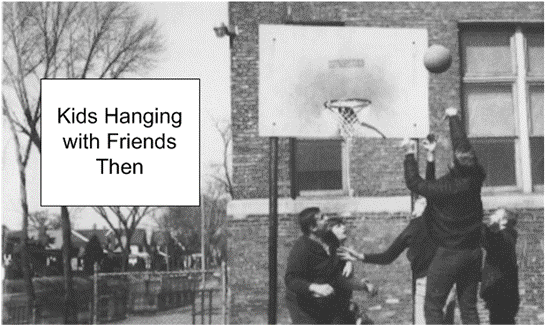
But today, there is no need to flee the house. Just flee to your bedroom, where you can use your personal phone to interact with your virtual community, and to do so at all hours.

(Thanks to Thrive Therapy and Counseling)
Besides providing knowledge and communication, phones also provide a wonderful variety of forms of entertainment—videos, music, games, etc. And as with knowledge and communication, the scope is amazing—when your video gets the tiniest bit boring, you can instantly switch to one of thousands of others, or a game, or…
The Score – Cool Virtual World One, Boring Real World Zero
All of which leads us to the where the peril lies. The phone enables kids to live in a virtual world that our boring traditional world has a tough time competing with. Which explains why kids may be “on their phones” much if not most of their waking hours. And their “waking hours” have been extended, since the phones often keep them from getting to sleep at night.
The negative impacts of the use of phones on kids has gotten worse in recent years. Part of the reason would seem to be that more kids who are older now were introduced to phones at an earlier age and have had them longer. Also, the Covid 19 pandemic period led to more intense use of phones, partly when kids were not able to attend school in person.
And the increased use of phones by kids is a contributor to their worsening mental health. In their “Youth Risk Behavior Survey Data Summary and Trends Report: 2011–2021,” the federal Centers for Disease Control and Prevention (CDC) found that, “Mental health among students overall continues to worsen, with more than 40% of high school students feeling so sad or hopeless that they could not engage in their regular activities for at least two weeks during the previous year—a possible indication of the experience of depressive symptoms.” [ii]
Note that this study stopped short of saying it is the kids’ phones that are to blame for their worsening mental health. And there are of course other factors. But it seems very safe to say that excessive phone use is a major contributor to our kids’ worsening mental health.
We should note that many adults have fallen into the same trap with their use of phones. But we’re zeroing in on the kids because we’re trying to assess what this all means for learning and how our use of technology should be making the learning experience of our kids better and not worse.
Which Leads to the Big Question – What Do We Do?
In the coming days we will do a follow-up blog post – “The Power and Peril of Phones – Part 2: What Do Our Schools Need to Do?” It’s possible you have some ideas. Or, better yet, it’s possible your district or school is already having success with measures such as different forms of phone bans. If so, please share your ideas or experiences with me at schulzj@jerryschulz.com. Or leave a comment on our blog post.
The power of our phones has put our kids in peril. But it seems we are seeing a movement to take on this challenge. I’m looking forward to discussing this in our next post.
[i] https://en.wikipedia.org/wiki/List_of_largest_libraries_in_the_United_States
[ii] https://www.cdc.gov/healthyyouth/data/yrbs/pdf/YRBS_Data-Summary-Trends_Report2023_508.pdf
 Managing Technology in K-12 Learning