Author Archives: managingtechnologyink12

Unknown's avatar

About managingtechnologyink12

Jerry Schulz is a consultant on the use of information technology in K-12 education, local government, and nonprofit organizations. He served as the Manager of Application Development for the Milwaukee Public Schools from 2007 to 2012. He has also held information technology management positions with several local governments and nonprofits. These include the Catholic Archdiocese of Milwaukee from 1999 to 2004 and Waukesha County, Wisconsin from 1993 to 1999. He is the author of Managing the New Tools in K-12 Teaching and Learning: How Technology Can Enable School Improvement, which was published by Rowman & Littlefield in February of 2018. Jerry also serves as an adjunct faculty member at the University of Wisconsin-Milwaukee and Indiana University-Purdue University Indianapolis, where he has developed and teaches online courses on the use of technology in the public sector and nonprofits. He also serves as an adjunct faculty member at Carroll University and Marquette University. Jerry began his career serving from 1972 to 1978 as an elementary school teacher and high school coach with the Chicago Public Schools.

Tony Frontier Says We Must Use AI, and Use It with “Intention”

Artificial intelligence, or “AI,” is not new. For years, our students have been using forms of what is called “narrow AI.” Maybe the best example of narrow AI is adaptive learning software, in which the technology provides personalized reading and math instruction and practice.

But generative AI products such as Google Gemini are now available. And the interest in the use of these products has exploded—especially among our students—and this school year may become the “AI moment” when this all comes together.

Except educators have tended to view the challenge of AI as figuring out how to keep students from not using it. So when students take on traditional assignments such as research papers, we tend to be concerned they will use AI to “cheat” on the assignment. And much of our energy involving AI has been devoted to blocking its use.

In his new book “AI with Intention: Principles and Action Steps for Teachers and School Leaders” Tony Frontier takes the opposite viewpoint. He urges educators to not only put AI to work in improving our students’ learning, but to do this “with intention”—to work hard to ensure that our use of AI is being effective in helping our kids learn in new and more powerful ways.

Yet to put AI to work in an effective way requires considerable change, and that is what “AI with Intention” is about. Frontier devotes the book to discussing how we can bring about the changes needed to help our students use AI more effectively.

He splits the book into two sections. The first half of the book is devoted to advice for school leaders on how to bring about the needed change. And the second half is devoted to advice for teachers.

How can school leaders provide leadership to effectively implement AI?

Frontier begins his advice for school leaders by suggesting that they “lead by learning.” He urges leaders to help all those in the organization understand the basics of how AI works and what it can do. For example, he advises leaders to help people avoid “anthropomorphizing” AI—to treat AI like it is a human, as in science fiction movies. He uses the example of the student telling the teacher that, “Google told me this.” No, AI is a tool that we use, not a person.

He then urges leaders to “take a transformational approach.” A key issue for leaders in implementing AI is recognizing the distinction between transactional and transformational change. An example of transactional change would be replacing an outdated textbook. And of course this kind of change is often needed.

But to get the greatest benefit from AI, Frontier encourages school leaders to work to bring about transformational change—to change how our students learn in a basic way. He says leaders must “Ask big, transformational questions—those that challenge long-held assumptions, invite new ways of thinking about the nature of the work at hand, and help others break free from the past.”

Although Frontier argues we must move past viewing AI as a way students might cheat, he calls on us to “emphasize integrity.” He recognizes that we must manage academic integrity, and he talks quite a bit about this.

And Frontier advises that we must put “fidelity before efficiency.” He cautions about using AI to achieve efficiency without “fidelity” to the larger goal of ensuring that our students have a rich learning experience.

How can teachers use AI to help our kids learn? How can we use AI with “intention?”

To begin his discussion of how teachers can use AI to improve how students learn, Tony encourages teachers to “stand in their shoes,” and view AI abilities as our students do.

He then calls on teachers to “know your purpose.” A very enlightening discussion is his contrast between the “culture of compliance,” in which our energy is directed to issues such as did our students submit their assignments, and the “culture of learning,” where the focus is on what might our students learn and whether this is happening.

He asks teachers to “prompt AI tools intentionally” and “use AI tools for intentional learning,” to ensure that AI tools are being used with intention and to help our students to become independent learners.

There’s more to do

 “AI with Intention” is a great contribution to understanding the role AI can play in our kids’ learning experience, how we can implement AI effectively, and how we can avoid some dangers of its use.

But there are things “AI with Intention” doesn’t do:

  • It doesn’t review specific AI tools.
  • It focuses on the use of generative AI tools such as Google Gemini and Microsoft Copilot, and it doesn’t open the door to even scarier tools such as AI tutors (e.g., Khanmigo).
  • Although it provides examples, these examples tend to relate to older kids.
  • It doesn’t provide a sample action plan for implementing AI.
  • And it doesn’t provide case studies on AI implementations in real districts and schools.

This is not a criticism of the book. “AI with Intention” provides a rich review of the issues involved in ensuring that AI is used “with intention.”

But there’s more to do. To begin, we need to consider how our districts and schools can structure their efforts to use AI and other methods to transform how learning happens with their kids. And we need to check out the actual experience of our fellow districts in how they are successfully or possibly not-so-successfully implementing AI.

And this is where you can help. Have you used AI “with intention” to help your students learn more effectively? If so, don’t be shy—this is the AI moment! This is the time to stand up and tell your story of success, to help all of us make the transformation in learning our kids need, as we enter the age of AI.

The Power and Peril of Phones – Part 3: Managing Devices at School

This is the final installment of a three-part blog entry on “The Power and Peril of Phones.” In “Part 1: The Power” we looked back at the evolution of computer and communications technology. We marveled at how this technology now provides us with the power to access all the world’s knowledge and communicate with anyone around the world. And, we looked in amazement at how we can access this power with a small portable device that we can hold in our hand.

But we also considered the peril that the very-tempting overuse of this technology and “device addiction” presents, especially for the young. This peril includes decreasing levels of face-to-face human interaction and increasing rates of mental health problems.

Then in “Part 2: What Do Our Schools Need to Do?,” we considered how schools can cope with these challenges. A major focus for schools has been considering various degrees of “bans” on the use of phones at school. The most extreme form of a ban is requiring students to either leave their phones at home or to lock them up for the school day when they arrive at school.

(Courtesy of StockCake)

But even an extreme phone ban at school doesn’t completely solve the problem. This is because we increasingly want to have our students use laptops and other computer devices during the school day to help improve their learning experience. For example, we want to use the power of technology to enable personalized learning, and this requires access to devices. An excellent New York Times article on the perilous place where we have arrived is “Get Tech Out of the Classroom Before It’s Too Late,” by Jessica Grosse. (https://www.nytimes.com/2024/04/10/opinion/schools-technology.html)

For years we foresaw a future in which we could provide our students with “1-to-1 device coverage.” Then in 2020, the Covid-19 pandemic unexpectedly provided the impetus to make this jump, and to issue each student their own device.

And now, we can use our technology to do things such as enable the giant shift from whole group instruction to a personalized learning model. A leader in this movement has been the Modern Classrooms Project (https://www.modernclassrooms.org), which provides advocacy and facilitation to “lead a movement of educators in implementing a self-paced, mastery-based instructional model that leverages technology to foster human connection, authentic learning, and social-emotional growth.”

And of course, we’re now just beginning to scratch the surface of how artificial intelligence, or AI, can provide even more powerful learning for our students. Except the use of AI runs the danger of increasing the time students spend with their devices even beyond what we have now.

So, how can schools provide technology access for our students in order to give them benefits such as access to powerful personalized learning abilities while also somehow minimizing the negative impact of too much device time? This is the tough challenge we want to address in “Part 3: Managing Devices at School.”


As we mentioned in Part 2, a start in controlling device time is to provide some level of a ban on the use of personal devices during the school day. But if the level of the ban leaves the door open for some use of personal devices during parts of the school day, such as at lunch, the school must find ways to help students to manage their device use during these periods.

To help manage the use of devices, the school and the teachers would be wise to structure the school day into use-a-device periods and no-device periods. The no-device periods would need to begin with the teacher saying something like, “OK everyone, now we are going to close our laptops, and until 9:30 we will be (for example) working with our small groups.”

Of course, we should proclaim recess and lunch periods to be no-device periods, as students are encouraged to interact and engage in unstructured play.

But we need use-a-device periods to enable students to use school-issued devices for technology-enabled learning. As noted above, a very beneficial form of technology-enabled learning is personalized learning, especially for reading and math. And increasingly, students will have access to forms of online tutoring, or possibly automated tutoring. What will continue to be challenging will be the use of devices for more open-ended activity such as research.

One way to both encourage human interaction and to minimize the harmful impact of the excessive of devices is to make use of small group sessions and multi-student projects. In these sessions, students may be accessing technology, but they are doing so as part of their interaction with their fellow students. Their human interaction should increase the benefit of the use of the technology, and it should also help to maintain the focus on the assignment.

Students can also benefit if we provide tutoring from adults in the community or older students. The Greendale (Wisconsin) Schools provides various forms of tutoring, including a “Reading Buddies” program in which each week retirement-age adults and work-at-home parents provide one-on-one reading sessions with all first graders. (https://www.greendaleschools.org/families/school-volunteer-opportunities.cfm)

And, an example of a school which uses older students to provide tutoring for younger students is Milwaukee Parkside School for the Arts. (https://mps.milwaukee.k12.wi.us/Schools/Milw-Parkside-School.htm) Note that tutoring by older students helps both the little guys and also the older students.

As valuable as technology is, especially for younger children, some concepts such as those in math can be taught better if we make use of manipulatives, which provide a tactile experience.

Technology also provides advantages in gaining access to various forms of reading material. But a disadvantage of using devices to access online reading material is that it is easier to lose focus and possibly wander into other uses such as social media (more on that below). So ideally, assignments heavy on reading would ideally favor paper books, which also provide a “tactile” experience.

And especially at the elementary level, students would benefit if we set aside a daily period for reading, in which every student in the class and the teacher quietly devotes some quiet time to doing nothing other than to read a paper book or other material of their choice.

Schools may also wish to look for ways to encourage the reading of full-length books, through activities such as student book clubs.

(I’m so old that when I started school our desks were still bolted to the floor, and we had 35 or more students in a class. When we would do an assignment, everyone would do the same thing, which meant some finished much earlier than others. Our teachers managed this challenge partly by asking us to always have a book in our desk, and to use our spare time upon finishing the assignment to read. Well, I loved to read, and I would rush through the assignment so I could get back to reading my current book.)

For many years, the federal Children’s Internet Protection Act (CIPA) has required schools to have Internet filtering technology. The main intent of this requirement was to enable schools to block content that is inappropriate for younger children. But schools can use their filtering systems to block or limit social media sites such as Facebook and TikTok. Filtering social media sites removes these sites as a distraction, and it also helps to control online bullying.

With YouTube, schools may wish to possibly establish a general ban but maintain a positive list of a library of approved YouTube pages, which teachers can constantly add to though an easy-to-use process.


Considering the amazing power that our modern technology provides for our kids, it’s frustrating that we have to put energy into working in different ways to actually keep the students from using that technology, at least for parts of their school day. But there are critical reasons why we have arrived at a point in time where we now must do this.

But if we do this well, we can have it all! We can maximize the powerful benefits our students realize from our technology, such as personalized learning and tutoring. And, we can also maximize the benefits they receive from human interaction.

Wouldn’t it be cool if we could pull this off?

The Power and Peril of Phones – Part 2: What Do Our Schools Need to Do?

In our last blog post on “The Power and Peril of Phones – Part 1: The Power,” we discussed the great power that our modern smartphones give to the users of the phones. And nowadays, those users are almost everyone.

But we also discussed how the power of the phones is causing negative impacts across our society. One example is how the increased use of phones by kids is a major cause of their worsening mental health.

And the kids cannot help but bring their problems to school. The compulsion of the students to use their phones throughout the school day can cause disruption to normal class activities. And on a higher level, the phones are a contributor to decreasing engagement with school and worsening attendance.

In this blog post, let’s consider how districts and schools are working to address the challenges presented by our kids’ use of phones. And in particular, let’s focus on the efforts of schools to control disruption through the use of various forms of bans on the use of phones at school.

* * * * * * * * *

Kids use their phones a lot—and they have been for a long time.

It is not news that our kids use their phones a lot. A 2023 study by Common Sense found that:

On a typical day, the participants in our study (11-to 17 -year-olds) used their smartphones for a median of almost four and a half hours. However, simply showing average daily smartphone duration across our sample doesn’t tell the whole story. Some participants used their phones for only a few minutes per day, while others averaged over 16 hours a day. [i]

The use of phones by kids is not new. It began with the introduction of the first smartphone, the Apple iPhone, in 2007. But as kids have come to carry their phones along with them wherever they go, and as they feel compelled to use their phones throughout the day, the phones have come to have an increasingly disruptive impact on normal classroom activities.

Banning phones at school is not a new idea, but it is suddenly getting new interest.

One way that districts and schools have sought to deal with this challenge is to implement a variety of types of “bans” on the use of phones in schools. One example is the nation’s largest school district, the New York City Schools.

New York had instituted a ban over a decade ago, but the district found it to be ineffective. The ban was lifted in 2015. Lifting the ban was a campaign promise for Mayor Bill de Blasio, who argued parents needed the phones to be able to contact their children. [ii]

Our Milwaukee Public Schools also once had a similar ban, but also lifted it, as New York did.

But interestingly, in recent months there has been a greatly renewed interest in bans on phones. The New York City Schools are now one of many districts implementing bans or considering doing so. [iii]

And at the state level, a recent analysis by Education Week found that, “As of July 2024, at least 7 states have passed laws or enacted policies that ban or restrict students’ use of cellphones in schools statewide or recommend local districts enact their own bans or restrictive policies.” [iv]

Has the book The Anxious Generation possibly focused attention on phones?

What is it that has sparked this sudden interest in this problem and the partial remedy of banning phones in schools? Part of the answer may simply be that the problem has continued to worsen, and the interest in taking needed measures to finally address the problem in an effective way has finally reached a critical mass. But part of the reason may also be the impact of a recent book, The Anxious Generation, by Jonathan Haidt.

The Anxious Generation is currently #1 on the New York Times Best Sellers Combined Print & E-Book Nonfiction List, and it has been on the list for 16 weeks. [v]

In The Anxious Generation, Jonathan Haidt discusses the forces that have led to the worsening mental health of our children. He identifies the use of phones as one of these forces, and he presents a persuasive argument for banning phones during school hours. He also presents suggestions for how families can manage the use of phones outside of school.

Phone bans can vary in intensity, and some forms of bans are more effective than others.

As we mentioned above, a district may implement a district-wide ban. And some states are even considering statewide bans. But in some situations, such as with a private school, the ban could be only for a single school.

There are several issues with bans on phones in school. These issues include:

  • Whether the bans are being decreed by the state, district, or school
  • The extent of the ban (e.g., Can the student keep their phone in their locker?)
  • How the bans are being implemented

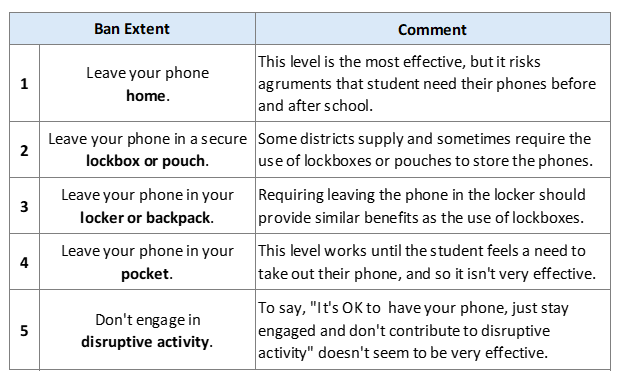
Our table below identifies five potential extents of a ban, in descending order of strictness.

Level 1, prohibiting students from even bringing their phones onto school premises, would seem to be the most effective ban. But a ban of this extent may face the most opposition from parents.

Level 2, the option of allowing a student to bring their phone to school but then to be required to store it in a lockbox during the school day, seems to be more of a compromise. An interesting technology to support this type of ban is a lockable pouch or “sock” to store the phone. Yondr is one vendor that provides these pouches.

Level 3, requiring students to simply leave their phones in their lockers seems less complicated, and probably works well for private schools and smaller campuses.

Level 4, asking students to leave their phones in their pockets probably works less well, especially since students will be tempted to take their phones out in the bathroom, etc.

And Level 5, allowing students to carry their phones about but appealing to them not to disrupt class seems hopeless—the power of the phones is simply too great.

Calling on teachers to somehow suppress the disruptive impact of the use of phones with little or no help from on high seems futile. A recent Education Week article was the tale of “Cellphones Turned My Teaching Career From ‘Awesome’ to Exhausting,” in which a veteran teacher told how his constant battles with phones wore him down and eventually motivated him to quit the profession. [vi]

Of course, the growing use of smartwatches and earbuds and the increasing “wiring” of our students will make the use of bans even more challenging.

Districts and schools have taken creative approaches to bans, and implementing these approaches requires the involvement of teachers, parents, and students.

Implementing a policy to manage the use of phones by students is a challenging undertaking. And to be successful it requires much more effort than merely announcing, “We are now banning phones.”

A recent Edutopia article on “3 Schools, 3 Principals, 3 Cell Phone Bans” provided three excellent case studies and how some schools reconsidered their policies on phones – https://www.edutopia.org/article/cell-phone-bans-schools-principals-weigh-in. [vii]

  • Newburgh Free Academy High School in Newburgh, NY found their Level 3 policy of asking students to keep their phones in their lockers or backpacks wasn’t working well, and the school moved to a Level 2 policy involving the use of pouches.
  • Rogers Park Middle School in Danbury, CT found that leaving the management of phones to teachers was working poorly, and the phones were enabling behavior such as using phones to instigate fights. Rogers Park also moved to a Level 2 policy using pouches.
  • Luxemburg-Casco Middle School in Luxemburg, WI moved to a Level 3 policy of asking students to keep their phones in their lockers.

A common theme to the stories of all three schools is that the principals and school staff members put a lot of energy into involving teachers, parents, and students into planning and implementing the new policies.

One issue they had to address was anxious parents who were concerned about their ability to communicate with their kids during the school day. A partial remedy offered by many schools is simply to ask the kids to come to the office and use the office phone if they need to reach their parents, and to invite the parents to call the office if there is an urgent need to reach the kids.

Students at Rogers Park Middle School (Laurel Golio for Edutopia)

Districts and schools need to think through and implement their policies on phones.

Districts and schools should also think through and publish a policy related to phones. Issues the policy should address include:

  • Define which devices are covered, possibly using the broad category of “personal electronic devices.”
  • Explain how the policy works, and what students need to do with their phones (e.g., Lock the phone in their lockers upon arriving).
  • Reassure students and parents of how they can handle emergencies. (e.g., Use the phone in the office.)
  • Present the consequences of not following the policy.
  • Open the door to exceptions such as using phones in class activities.
  • Provide some regulation of behavior when phones are used, such as not engaging in harassment.
  • Appeal to students to notify staff if they receive inappropriate messages.
  • Require students to not disclose personal information, or user IDs and passwords.

But what else should schools be doing to address our kids’ phone challenges?

But what should schools be doing beyond bans to address our kids’ phone addiction and other challenges with their use of phones?

In the coming days we will do another follow-up blog post – “The Power and Peril of Phones – Part 3: Addressing SEL and Phone Use at Home.” It’s possible you have some ideas. Or, better yet, it’s possible your district or school is already having success with helping kids and their families with their use of phones. If so, please share your ideas or experiences with me at schulzj@jerryschulz.com. Or leave a comment on our blog post.

I hope you have found this valuable, and I’m looking forward to continuing this discussion!


[i]       https://www.commonsensemedia.org/research/constant-companion-a-week-in-the-life-of-a-young-persons-smartphone-use

[ii]      https://www.nytimes.com/2015/01/07/nyregion/ban-on-cellphones-in-new-york-city-schools-to-be-lifted.html

[iii]      https://www.edweek.org/technology/school-cellphone-ban-is-critical-for-addicted-students-nyc-chancellor-says/2024/06

[iv]      https://www.edweek.org/technology/which-states-ban-or-restrict-cellphones-in-schools/2024/06

[v]       https://www.nytimes.com/books/best-sellers/combined-print-and-e-book-nonfiction

[vi]        https://www.edweek.org/teaching-learning/cellphones-turned-my-teaching-career-from-awesome-to-exhausting/2024/06

[vii]     https://www.edutopia.org/article/cell-phone-bans-schools-principals-weigh-in.

School Attendance Has Become a Crisis. Technology Is Part of the Cause, and It Can Also Be Part of the Cure

In the wake of the Covid-19 pandemic we have seen a very disturbing increase in student absences in our K-12 schools. It would be comforting to believe this trend is just a lingering impact of the pandemic, and that attendance will get back to the old normal over time.

Except this won’t happen, at least not all on its own. The reason is that the pandemic accelerated forces that had already been in motion for some time. And these forces are if anything intensifying, especially the increased use of devices by students and the related “disengagement” of students and parents from the life of the school. Poor attendance is the biggest symptom of this larger problem of disengagement.

Remember how in the days of the pandemic we used the phrase “the new normal?” Well, disengagement and the related increase in absences is part of that new normal. And we are now stuck with this problem—unless we work proactively to fix it.

Except our focus here is technology. So, what does battling absences have to do with technology? Well, the powerful forces the pandemic accelerated were partly related to technology, such as our kids’ increasing attachment to devices. And, some of the solutions we need to apply to address this problem also make use of technology.

Let’s briefly consider how technology helped cause this problem, and then concentrate on how technology can begin to help to fix it.

Increased “disengagement” has brought about poor attendance.

There has been plenty of attention paid to the problem of attendance in a variety of media. Education-oriented media such as Education Week have been working for some time to draw attention to this problem. And on March 29 The New York Times had a great article on “Why School Absences Have ‘Exploded’ Almost Everywhere.” [i]

Kaylee Greenlee for The New York Times

The Times reported that since the 2019-20 school year the percentage of “chronically absent” students in K-12 school nationwide has doubled, from 13% to 26%. This problem is much worse in districts serving disadvantaged populations. In our Milwaukee Public Schools (MPS), the Times reported that between 2019 and 2023 the chronically absent rate went from 37% to 50%.

The Times noted that states use different definitions of chronically absent. For example, the State of Wisconsin defines students as being chronically absent “if they miss more than 10% of school days out of the total number of school days during which they were enrolled.” [ii]

In December, Alan Borsuk and the Milwaukee Journal Sentinel featured an article on “What Are We Willing to Do about Low-Performing Schools in Milwaukee Public Schools and Beyond? Right Now, There’s No Real Plan for Change.” This article discussed the impact of disengagement and the related challenge of poor attendance. Alan used MPS’s Madison High School as a case study. [iii] 

Many kids have simply stopped going to school.

What did Alan find at Madison? He found the school was orderly, and the administrators and teachers were highly motivated. And there were attractive programs in vocational areas, something too few schools offer.

Except there were far too many students in the building. At that point in the school year (mid-December) the average daily attendance so far was 58.6%, which meant that on an average day more than four out of ten students were not in school. In recent years more than 80% of the students at Madison have been labeled chronically absent.

Mike De Sisti – Milwaukee Journal Sentinel

He also reported that enrollment at Madison had fallen from 892 in 2014-15 to 625 in November of the 2023-24 school year.

There is also quite a bit of attrition as students get older:

  • 224 of the Madison students were ninth graders, including 94 repeating their ninth-grade year.
  • 180 were tenth graders.
  • 134 were eleventh graders.
  • 86 were twelfth graders.

What are the causes of this drop in attendance?

So, what is going wrong at Madison and at too many of our districts and schools across the nation? Part of the problem is families and students are often dealing with issues at home that become a barrier to school attendance, as we will discuss below in the case of the School District of Plano, Texas.

But a big part of our challenge is that many students and their parents have lost a basic force that success in school requires. This is the compulsion to simply make yourself physically come to school each day, as part of your larger daily—and lifelong—routine. Those on the education scene use the term “engagement” to describe a traditional connection to school, and the term “disengagement” to describe the loss of this connection.

As we noted above, this disengagement preceded the Covid-19 pandemic, although the pandemic intensified it in a variety of ways. Obviously, our kids can’t be successful in school if they aren’t in the building. We need to bring all our students and their families to once again be engaged in their school experience, and part of this effort is to bring about near-perfect attendance.

But this is a complex undertaking. Let’s focus on the challenge of addressing poor attendance.

Technology can address the problem of poor attendance in three ways.

Technology can help improve attendance in three major ways:

  • The use of data analytics to help school staff and parents identify attendance problems.
  • Top-down automated communication at the district and school level to alert parents of problems and encourage better attendance.
  • Bottom-up one-on-one communication by teachers and other school staff, to intervene with parents of students with attendance problems.

Analytics can identify problem students and trends.

Student information systems (e.g., Infinite Campus, PowerSchool) contain reporting capabilities that allow districts and schools to obtain reporting on different aspects of the attendance challenge.

Examples would include:

  • Students absent today at our school, both excused and unexcused.
  • Students absent today for a second day.
  • Students who are displaying more problematic patterns of attendance.

Districts and schools also need to develop data systems to track interventions that have been attempted with problem students and analyze the effectiveness of those interventions.

Top-down communication sends automated mass alerts to parents.

Top-down automated communication has been used for many years by districts to help manage attendance issues. This communication usually uses a combination of the district’s student information system and notification system software (e.g., BrightArrow, SwiftK12).

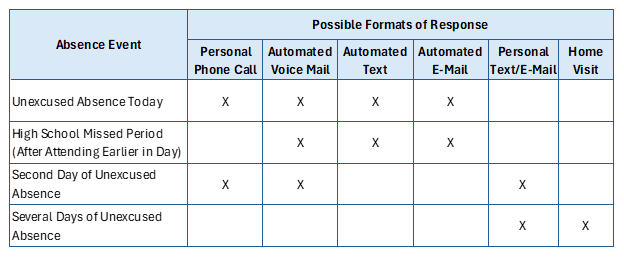
An example is that early each morning the notification system will extract data from the student information system on students with unexcused absences. The notification system will then send some combination of text, voice mail, and e-mail messages to the parents of these students. Note that these messages are generally sent in a single batch for the entire district.

Another example is to send alerts to the parents of high school students who initially were at school but have been marked absent in subsequent periods.

Additional types of alerts would include addressing multi-day absences. The chart below on “Possible Formats of Response” outlines some of these possibilities.

Bottom-up efforts make use of interpersonal communication.

But an effective solution to absences must go beyond alerting parents that their child is absent. The solution must also employ personal contacts with parents.

Such a contact may begin on the morning of the first absence, with a personal phone call from the school office in addition to the automated alerts. If attendance problems continue, calls from the child’s teacher would tend to be especially effective, due to the teacher’s personal relationship with the family. Families with persistent problems would benefit from a home visit.

Districts benefit from a comprehensive approach – Plano, Texas.

And districts would clearly benefit from a comprehensive approach to absenteeism and a unified overall management of the challenges. A good example would be the Plano Independent School District in Plano, Texas. Plano is a racially diverse district with almost 50,000 students. A recent Education Week article on “This Leader Takes a Compassionate Approach to Truancy. It’s Transforming Students’ Lives” profiled the district’s efforts to improve attendance. [iv]

Plano had been relying on the efforts of a truancy court to manage attendance. But sending families to such a court did little to address the problems underlying serious attendance issues. Sharon Bradley, a new Director of Family and Social Services, led the shift to the use of “tiered intervention strategies…to reengage students” and a shift to an attendance review board that would work with families to identify underlying causes for the absences and if needed develop a family support plan.

But there’s a larger problem, disengagement.

As the experience in Plano showed, there are often larger problems behind the attendance challenges of a family. As we noted above, part of the problem often includes a disengagement from the life of the school, and disengagement has gotten much worse in the aftermath of the pandemic.

In our next blog entry, we will try to tackle the challenge of disengagement. And as we work to maintain our technology focus, we will explore how technology contributes to disengagement, but how it may also help us in our efforts to reengage our students.

Have you had any success? What are your thoughts?

If you have any thoughts or contributions on the challenge of attendance, or on the upcoming topic of engagement, please hit “Leave a Reply” above to add a comment, or contact me at schulzj@jerryschulz.com.

And thanks to all for everything you do for our kids in these challenging times!

Jerry Schulz


[i]     Mervosh, S., and Paris, F., “Why School Absences Have ‘Exploded’ Almost Everywhere,” The New York Times, March 29, 2024 – https://www.nytimes.com/interactive/2024/03/29/us/chronic-absences.html

[ii]     https://dpi.wi.gov/wisedash/about-data/chronic-absenteeism#:~:text=Students%20are%20considered%20to%20be,through%20their%20Student%20Information%20Systems

[iii]    Borsuk, A., ““What Are We Willing to Do about Low-Performing Schools in Milwaukee Public Schools and Beyond? Right Now, There’s No Real Plan for Change,” Milwaukee Journal Sentinel, December 15, 2023 – https://www.jsonline.com/story/news/education/2023/12/15/no-apparent-play-to-help-improve-low-performing-mps-schools/71569628007

[iv]    Will, Madeline, “This Leader Takes a Compassionate Approach to Truancy. It’s Transforming Students’ Lives,” Education Week, February 5, 2024 – https://www.edweek.org/leaders/leadership/this-leader-takes-a-compassionate-approach-to-truancy-its-transforming-students-lives/2024/02

Fix Learning Loss? A Better “New Normal?” Let’s Have Both!

K-12 districts and schools must repair what we call the “learning loss” suffered by students as a result of the Covid-19 pandemic. And we still must find our way to the “new normal” of how learning will now work. But couldn’t both these challenges have a common solution?

The month of March marks the three-year anniversary of the COVID-19 pandemic. But in K-12 education, we are still struggling to address two COVID-related challenges.

Courtesy of Education Week and iStock / Getty Images Plus

The first challenge is what we have come to call learning loss. Learning loss is the problem created when the attainment of skills by our students wasn’t on its usual pace during the pandemic. And this “loss” was even more pronounced for the kids who could least afford it, those from disadvantaged families, many of whom were already struggling in school.

Now, we feel we must fix what we view as a one-time problem, that our students are behind the traditional pace for their learning, and they need to do a one-time catching up.

The second challenge is to adjust to the disruption of the K-12 system caused by the pandemic, and to migrate to what we have called a “new normal” of how K-12 learning will now work.

The COVID-19 pandemic disrupted our traditional ways of doing business in K-12 learning. But some of the disruption came in the form of beneficial transformation. At long last we were able to move to one-to-one device coverage for our students. And we introduced new technology for virtual learning (e.g., “Zoom”) and the related skills and technology. Students, teachers, and parents all gained the needed technology and skills in how to participate in virtual sessions.

Except now we are struggling with where we are at and how to get to where we want to go, that new normal. There’s some sentiment to go back to where we were in the good-old pre-2020 days of how we used to learn. And that’s not all bad—there were a lot of things we did very well in our old way of doing business.

Except we now have a wonderful opportunity to implement methods of learning that are much better than the old ones we had. Most of these new methods are enabled by technology.

But how do we address the problem of learning loss? And how do we progress to a new normal that provides our kids with better learning?

Here’s a helpful idea—the solution to both these problems might be the same.

Do we have it in our power to provide new accelerated ways of learning? If so, wouldn’t we want our learning loss kids to continue to learn in these new ways even after they catch up? And wouldn’t we want to extend these improved methods to everyone?

If the answer is yes, this simplifies the problem. The solution is to quickly move everyone and everything to the improved new normal, which should do double duty as our learning loss solution.

In a recent Education Week article, Denise Forte of The Education Trust and Thomas J. Kane of Harvard University advise that, “Districts, Now Is Not the Time To ‘Get Back to Normal.” [i] (I snitched the graphic above from Denise and Tom’s article.)

Denise and Tom suggest that as our districts address pandemic learning loss, they should invest in three key areas:

  • Tutoring
  • Summer learning
  • Core instruction

The challenge of tutoring is a great example of why we might want to fold in current learning loss solutions into our long-term progression to the new normal. A recent Associated Press article on “Many Kids Need Tutoring Help, Only a Small Fraction Get It” reported that districts are struggling to supply tutoring at anywhere near the volume that would be beneficial. So as we figure out how to best provide this tutoring in various ways, we might as well be thinking long term. [ii]

Forte’s and Kane’s suggested investments in core instruction include, “Replacing a weak reading curriculum…with one that reflects the best research on the importance of systematic phonics instruction.” And, “Professional development for current and incoming teachers on the science of reading.”

As part of replacing the reading and possibly also math curriculum, I would add what in my opinion is the single biggest thing we can do to improve learning in K-12. This is moving to a personalized learning (a.k.a. individualized learning) approach, which we would partly enable through the use of personalized learning software.

Personalized learning would address a larger issue that led to the pandemic “learning loss.” Our current system for teaching reading and math assumes all our kids march forward together in the graded structure as they acquire reading and math skills—and they never fall off the pace. Yet some kids, especially those from disadvantaged backgrounds, have trouble keeping up, and once they fall behind they are doomed.

A personalized learning approach allows each student to march forward at their own pace. This enables those who march a bit more slowly from being left at the wayside. And, it also enables the faster kids to zoom ahead instead of being doomed to stare out the window.

A personalized learning approach also addresses another important ingredient of a new normal, which is a shift to mastery learning, using a standards-based approach. A mastery approach works off a list of skills our kids need to attain, and systematically checks off their mastery of them. Of course, in the process it also draws attention to skills a student may not be mastering, so they can attain special help in this area.

The personalized learning software is in a great position to also help with the mastery approach. As it helps student learn their skills it also checks off the skills they have mastered and the standards they have met. It then either moves the students on to new skills or slows down the pace and provides extra help until the skill is attained. It may also alert the teacher to what’s going on in case extra help such as tutoring is required.

This all sounds great—so why haven’t we been using personalized learning for the last 200 years? The big reason is that once kids get onto different wavelengths it quickly becomes almost impossible for a human being teacher working with paper materials to provide each student with individualized lessons. But if we can automate the learning, the teacher is now free to spend their valuable time directing traffic and providing individual and small group help.

Forte and Kane also reference a recent report from The Education Trust on “Promising Practices: A School District Guide to Advocating for Equity in the American Rescue Plan Spending.” The report identifies five components the authors believe are the most important for district spending plans:

  • Accelerating student learning, including targeted intensive tutoring and expanded learning time
  • Student, family, and community engagement
  • Safe and equitable learning environments
  • Teacher recruitment and retention
  • Data equity and reporting transparency [iii]

Let’s consider how technology can support improved core instruction, tutoring, and other components of a new normal—many of which are also the things we need to address learning loss.

So yes, we should take the needed steps to repair learning loss. This will enable all our students to learn faster and more effectively.

But again, if these measures work well, why not implement them in a way in which we can start using them now and continue using them, well, forever? Or until we devise ways of learning that are even better.

This will work best if our district and school leaders work with our classroom teachers to quickly develop a vision for how this will work, and then develop and begin to implement a plan for this transformation.

This will all be tougher to do when the federal ESSER funds run out. But we must find ways to keep moving into that much-better new normal. The alternative is to revert back to those good old days that were not that good for our kids.


[i]     Forte, D., and Kane, T., “Districts, Now Is Not the Time To ‘Get Back to Normal’,” Education Week, February 1, 2023.

[ii]       Wall, P., and Pak-Harvey, A., “Many Kids Need Tutoring Help. Only a Small Fraction Get It.,” Associated Press, 2023.

[iii]     “Promising Practices: A School District Guide to Advocating for Equity in the American Rescue Plan Spending,” The Education Trust, 2022

How Can LMS Systems Make Teachers’ Lives Easier?

Just as with other forms of learning technology, the pandemic experience has brought about a great increase in the use of learning management system (LMS) technology. But the use of this powerful technology has not necessarily brought about more effective learning for our students. And, in some cases, it has made the lives of our teachers more difficult.

We can do better. What are some best practices in the use of LMS systems we can adopt to bring about both better learning for our students and greater productivity for our teachers?

LMS systems  were introduced back in the 1990s at the college level. The original driver for the LMS technology was to enable the new idea of online programs and courses.

This worked very well, and the use of online programs and courses in college has grown tremendously. But interestingly, the LMS technology was also embraced by college instructors teaching traditional courses. These instructors used the LMS systems to make what otherwise would have been paper readings available online in electronic form. They also posted other resources such their syllabi and Internet links.

The LMS systems at the college level also allowed students to submit their papers and other assignments electronically using the drop box technology. The professors were then out of the business of collecting large piles of papers and other written assignments, grading them in a paper form, and handing back the paper. Everything was electronic now.

It’s easy to see why making use of this technology had such appeal. Even so, K-12 districts and schools were somewhat slow to implement the LMS technology.

In recent years, however, two events greatly accelerated the use of LMS systems in K-12.

One event was the introduction of the Google Classroom product. Two things about Google Classroom made it appealing. One of course was that it was free. The other was that Classroom could be implemented in a bottom-up way by individual teachers or groups of teachers—the district did not necessarily have to adopt it.

The second event that accelerated the use of LMS technology in K-12 was the Covid-19 pandemic. Teachers suddenly needed to be able to do their work electronically, and the LMS technology was a great help.

The LMS technology obviously has great productivity benefits for learners and teachers at any level. But its use provides a bit of a two-edged sword.

The benefits LMS systems provide are increased productivity plus also enabling new learning experiences such as the ability to participate in online discussions. However, a challenge of the LMS technology at the K-12 level is it can require substantial time for the teacher to become familiar with the technology and configure it. And so, it can contribute to a problem we’re seeing across K-12 in the wake of the pandemic, what has been called technology fatigue for teachers.

There must be a way to put this powerful technology to work so that it helps both teachers and students! What are some practices districts and schools can adopt that will help achieve the benefits from learning management systems while minimizing technology fatigue and other downsides? Here are some ideas.

1.     Make the use of LMS system part of the district-wide vision and planning to transform learning. The goal of the LMS system should not be to just layer on more cool technology. The goal should be to use LMS technology to help teachers teach more effectively and help students learn much more effectively.

2.     Engage teachers in a bottom-up way. As decisions are made on which LMS product to use and how to use the product, it’s important that teachers be heavily involved. For example, the district may employ workgroups to allow teachers to work on how the LMS system is to be used.

3.     Pick one or possibly two standard LMS products to use across the district. The reason we say two products is that some districts have found it’s wise to use a paid commercial product such as Schoology or Canvas at the high school level, and then use the Google Classroom product at the K8 level.

4.     Optimize LMS, SIS, and gradebook use. The learning management system duplicates some of the functions in the SIS gradebook. It’s important that the district give some thought to how it wants to present these two products to students and parents. The district needs to decide which of the duplicative features between the two products it should emphasize or possibly turn off.

For example, as a teacher enters grades, should they be entered into the learning management system or into the SIS gradebook?

5.     Provide interfaces to ensure teachers need not reenter data. A best practice in the use of any data system is that data should only need to be entered one time. For example, data on students and class rosters has already been entered once in the SIS. It should not have to be entered again into the learning management system. Forcing teachers to do this creates extra unnecessary work for the teachers and can be a contributor to technology fatigue.

Instead, the district needs to work in a top-down way so that when student and class data is entered into the SIS it is then interfaced to the LMS system and does not need to be rekeyed by the teachers.

A second need for interfaces has to do with grades. Teachers may be encouraged to enter assignment grades into the learning management system rather than the SIS grade book. But the grade data may also need to reside in the gradebook, partly because the gradebook may be connected to the parent portal, and the parents need to be able to see these grades. To make this happen, an interface is required to copy the grade data from the LMS system into the SIS gradebook.

6.     Load a single table of standards. Grading presents a special problem when using standards-based grading grades. Ideally the LMS system can maintain a table of all the standards and their levels of achievement. Then as teachers provide a standards-based grade they can simply select the related standard and achievement.

7.     Coordinate loading curriculum materials to the LMS in a unified way. One giant benefit of the LMS system is to have it act as a warehouse for all the curriculum materials used across all the grades.

A big contribution to technology fatigue is to call on each teacher to individually load all their curriculum materials into the LMS system. Instead, the district should work in a top-down way to load curriculum resources into the LMS system for common access.

For example, some fifth-grade teachers and a district curriculum specialist can determine what the best fifth grade social studies resources are. They can then load the resources to the LMS system so they can be accessed by all the fifth-grade teachers across the district. Teachers can then go into the LMS system, and all their materials will already be there.

8.     Dedicate staff to support the use of the LMS. The district needs to dedicate staff to support the LMS product. At least on a part-time basis there needs to be an administrator with some technical ability who gets to know the product and maintains the interfaces that we’ve talked about. The district also needs staff people to provide professional development and support for the use of the system. These are people who get out in the field and act as evangelists and helpers for the teachers in their use of the product.

9.     Use the LMS system to support district professional development. Once the LMS system is in place, it would be wise to have it do double-duty to also support the district’s professional development and communication among staff.

10.   Use the LMS technology to enable new ways of learning. We have been somewhat successful in using LMS technology to automate traditional ways of learning. For example, LMS systems are great in distributing what otherwise would have been paper readings and collecting what otherwise would have been paper assignment submissions. But what are some new and improved ways of learning that would not have been possible without LMS technology?

11.   Continue to look for ways to facilitate human interaction. And although we want to use automation to improve how we learn, our pandemic experience has taught us that in some ways automation can make things worse, not better. A big problem is reducing human interaction. But can LMS systems help increase human interaction? For example, can the LMS system prescribe an assignment which says, “gather with some classmates in a face-to-face setting and…?”

But what do you think? Please comment below. Or, send me an e-mail. It would be great to publish a new and improved list of these best practice ideas that incorporates your input.

How to Make Technology Transformation Beneficial and Not Disruptive

In our last blog post on “Technology-Driven Transformation in the Pandemic Has Disrupted How Kids Learn—and Not Always in a Good Way,” we discussed how the Covid-19 pandemic accelerated technology-driven transformation in learning – https://managingtechnologyink12.wordpress.com/2022/06/10/technology-driven-transformation-in-the-pandemic-has-disrupted-how-kids-learn-and-not-always-in-a-good-way

Again, much of this acceleration was beneficial, such as hastening the movement to one-to-one device coverage.

But hastening this transformation has also caused disruption, and this disruption has had some negative impacts. These impacts include disengagement among students and “technology fatigue” among teachers.

A March Education Week article on “Tech Fatigue Is Real for Teachers and Students—Here’s How to Ease the Burden” did an excellent job of discussing these issues- https://www.edweek.org/technology/tech-fatigue-is-real-for-teachers-and-students-heres-how-to-ease-the-burden/2022/03.

(Thanks to Francis Sheehan of Education Week)

Especially for those of us who love technology, this couldn’t be more frustrating. We finally got our wish for an explosion of technology in our schools—yet now in some ways our students and teachers are worse off!

What can we do about technology-driven disruption?

What can school districts and schools do to address this situation? One option is to continue to muddle through as best as we can, and hope things somehow get better. A better idea is to proactively manage the situation to bring about the best results for our kids, and to mitigate the downsides of the pandemic and the related disruption.

But the very best thing we can do is to recognize that this is a once in a lifetime opportunity to use technology to enable a broad transformation of how our kids learn. In an earlier blog post we reflected on how in their book “Imagine If…Creating a Future for Us All,” the late Sir Ken Robinson and his daughter Kate called on us to imagine a very different way of learning for our kids, one that would prepare them for the challenging futures they face. Yet their short book left the question of how bring about that different way of learning up to us.

This is our big chance to do that imagining, and to start to make that future happen. Of course, part of the challenge is to do this is a way that makes the lives of our educators and our students better rather than crazier.

But what would it require to bring about such as transformation? Let’s consider eight issues.

1.    Move beyond incremental improvement, and work to manage broader transformation.

When we say we should use this opportunity to transform how our kids learn, some educators would justifiably take offense. “How can you say that?” they might exclaim. “We are at work every day to improve how our kids learn!”

And that’s great, but we need to call on everyone to recognize what transformation is. Transformation is activity in which we change some of the basic ways in which kids learn. Implementing a better reading series is a good thing to do, and this should improve the learning experience of the students. But transformation might be a change such as introducing adaptive learning software to enable personalized learning. More radical transformation might be something like rethinking the graded structure.

Education Week recently had an interesting article by Renee Owen on this distinction, “You Can’t Change Schools Without Changing Yourself First” – https://www.edweek.org/leadership/opinion-you-cant-change-schools-without-changing-yourself-first/2022/05.

At this point we would be wise to manage transformation in two ways.

Some technology-driven transformation has been forced on us by the pandemic. We need to work proactively to mitigate the disruptive impacts of this change on students and teachers.

But because of the way in which the pandemic has accelerated our use of technology, we would also be wise take advantage of this opportunity and determine how we can now work to continue to transform the learning experience in a beneficial way.

2.    Initiate an ongoing strategic planning effort.

Such a transformation effort requires an organized planning effort, with leadership from above. The superintendent, chief academic officer, and similar officials need to drive these efforts. A district staff member should also be appointed to play a project management role and lead the planning and facilitation of the needed activities.

3.    Engage teachers in a top-down, bottom-up planning approach.

But having the top managers in the district involved is not enough. Unlike in most industries, in education the workers—the teachers—own their work. Simply dictating changes from on high does not tend to work well.

Change in education—and especially transformative change using technology to bring about improvement—must be driven both top-down and bottom up. And this is now truer than ever, as things are changing so fast, and teachers are “fatigued” and skeptical of more change being dumped on them.

The district and then the school must work top-down to create the sense of urgency to improve and provide the needed technology components.

Teachers and other staff must also be enabled to work bottom-up with district and school staff individually and in groups to determine how to move to new models and put technology to work.

Everyone must monitor student and group improvement. And all must work to refine successful efforts and propagate them to all classrooms, and then to institutionalize this change.

Transformation Must Be Managed Both Top-Down and Bottom-Up

4.    Manage learning processes across the district and schools.

Transforming how our students learn must address our basic learning processes. Technology enables us to run the classroom in new and better ways.

The need for virtual instruction during the pandemic forced the movement to new processes. But some of these processes are not optimal for most students. In a previous blog post we discussed how districts may wish to manage virtual learning options, including home schooling – https://managingtechnologyink12.wordpress.com/2022/02/28/homeschooling-and-virtual-learning.

We are wise to move to processes that take advantage of technology but also maximize interpersonal interaction. A great example is the workshop model, in which the teacher kicks off a session with a short whole-group session, and then the students move into small-group sessions or individual work, finally concluding with a whole-group wrap-up. One advantage of the workshop model is the middle of the workshop can provide for personalized learning.

5.    Maximize student interpersonal interaction and manage device time.

Part of the blame for our students’ disengagement from learning lies in the loss during the Covid-19 pandemic of the structure of the traditional school day and the interaction with teachers and fellow students that drives the day.

Maybe the toughest challenge in transforming learning is taking advantage of technology while not losing the power of the interaction with our fellow human beings. An advantage of the workshop model is it addresses this challenge. It provides the opportunity for the use of technology within the structure of interpersonal interaction.

And sometimes we simply need to turn off the technology, such as scheduling a time when everyone reads using paper books.

6.    Curate technology resources and implement a district-wide menu.

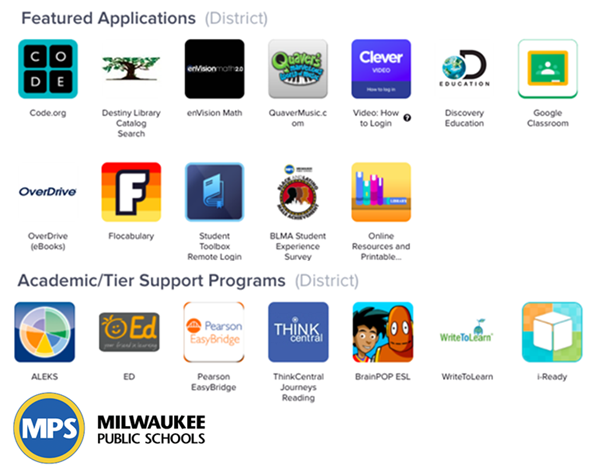
One issue that contributes to teacher technology fatigue is the demand on teachers to research technology options for their students. A better way to work is for the district to work with teachers to identify (“curate”) a limited set of technology offerings tied to the curriculum and to make these technology products easily accessible for teachers, students, and parents. One way to do this is to make use of a software product that provides a district-wide menu of the selected products and enables a “single sign-on” in which students can use the same ID and password to access all products.

An example of such a software product is Clever. Here is part of the Clever menu used by the Milwaukee Public Schools.

Milwaukee Public Schools Clever Menu

7.    Use learning management system (LMS) technology to manage resources.

Learning management system (LMS) software was introduced in higher education back in the 1990s to support online classes. But professors teaching traditional college classes quickly also embraced LMS technology due to its ability to automate functions such as distributing readings and submitting assignments.

The pandemic-driven move to one-to-one device coverage has now also made the use of LMS systems more viable in K12. And LMS systems have the potential to be a great productivity booster. As at the college level, one big benefit is to use LMS systems to provide electronic versions of readings and assignments.

But if teachers are stuck having to work on their own to figure out how to use their LMS systems, and if processes such as assigning student IDs and passwords don’t work well, the pressure to use LMS systems can contribute to technology fatigue.

So here is another area that benefits from top-down and bottom-up management. The district needs to work with teachers to select and install a single LMS product, or possibly one product for high school and another for K-8. Ideally the district will also develop interfaces between the LMS system and the class rosters and grading modules in the student information system (SIS). And the need to use often-complex LMS systems is a great example of why transformation needs powerful professional development support.

8.    Provide energetic professional development and staff interaction to guide transformation and reduce fatigue.

Transformation requires all educators to change how they teach. And this isn’t going to work well if each teacher is left to figure out on their own how the new transformed world works. Implementing transformation requires an energetic professional development program for all staff members.

The professional development sessions need to provide how-to information but also interaction with peers. And the same concepts that apply to the kids also apply to the teachers—the professional development needs to take advantage of technology abilities such as learning management systems, but it also needs to continue to take advantage of human interaction.

. . . . . . . . . . . . . . .

In our next blog entry, we’ll focus in on the use of learning management system technology. We’ll discuss some of the issues involved in managing LMS use and gaining the benefits of this powerful technology.

Until then, do you have any ideas on what districts and schools can be doing to manage this transformation? Leave a comment below under “Leave a Reply.” Or send me an e-mail at schulzj@jerryschulz.com.

Technology-Driven Transformation in the Pandemic Has Disrupted How Kids Learn—and Not Always in a Good Way

Jerry Schulz – June 10, 2022

There are two related concepts that help to understand where the Covid-19 pandemic has quickly taken us in our use of technology in learning. These are the concepts of transformation and disruption.

The adoption of technology has the power to transform human activities and especially learning. And this has been going on for thousands of years. For example, in around 1450 Johannes Gutenberg invented the printing press, which made it much easier and cheaper to print books. This new technology greatly transformed how we could acquire knowledge.

A more recent example was the introduction of word processing technology in the late 1970s and early 1980s. If you are old enough, you will remember how challenging it was to simply produce a page of text before then. You had to write out your draft in longhand, revise it, and then use a typewriter to type it onto a sheet of paper. And any error was a crisis, possibly requiring starting over with a new sheet.

The transformative technology of word processing couldn’t have been an easier sell. Once you were exposed to it, there was no going back, and within a few years the old typewriters became museum pieces. But although this transformation was extremely beneficial, there still was quite a bit of related disruption. The office workers had to be outfitted with the new technology and learn to use it. Of course, typewriter manufacturers such as Smith Corona and Olivetti had to adopt new product lines or go out of business.

And in the office, there were crews of typists and stenographers whose skills were no longer needed. The office processes had to be redone (e.g., younger lawyers preferred to key their own documents), and the typists and stenographers had to adopt new roles.

Thanks to Education Week for the photo.

Technology-Driven Transformation in Learning Has Been Slow

For decades the use of technology in learning has also been driving some transformation. And, it has also brought about some related disruption. But our education world has been a tough target for transformation. This is partly due to our graded structure, and how learning happens in the classroom.

The need for virtual learning in the Covid-19 pandemic has at last greatly accelerated technology-driven transformation. And the pandemic also caused quite a bit of related disruption.

The Pandemic Accelerated Technology-Driven Transformation in Several Ways

There is plenty of good news. Students and educators acquired new hardware, software, and other technology tools. The technology quickly got better and became easier to use (e.g., Google Meet, MS Teams, Zoom). And teachers and students acquired the skills needed to put the technology to work.

Acceleration of existing trends included these shifts:

  • Districts and schools providing one-on-one device coverage for students quickly went from a little over 50% in early 2020 to almost 100% today. In 2020, an Education Week survey reported about 57 percent of educators said each student in their schools had a device.[i] A similar survey conducted in late March and early April of 2022 found this number is now 85%—and  I presume the other 15% are mostly schools who simply haven’t given devices to kids in all grades.[ii]
  • Wireless Internet connectivity within school buildings became ubiquitous, and districts and nonprofits worked to ensure families in rural areas and disadvantaged families in urban areas had connectivity at home.
  • There was a great expansion in the use of virtual learning options to enable students to connect from home. And although almost all schools and families have returned to in-person models, everyone now can use the virtual learning technology and has the related skills.
  • Schools increased their use of learning management systems (LMS) such as Google classroom and similar technology, to automate interactions and provide and distribute electronic resources.
  • Resources that were shifted to electronic form included electronic curriculum and texts.
  • There was also an increase in the use of academic software, especially products that support personalized learning.

In the process the pandemic also provided better support for virtual learning models such as the flipped classroom. And it provided improved technology support for personalized learning and project-based learning.

But This Transformation Brought Some Harmful Disruption

So, what’s not to like? That’s where transformation and disruption come in.

In the spring of 2020, the pandemic forced a move to virtual learning in almost all school districts. There seemed to be little choice at the time. Most schools coped with this challenge by using technology to support home learners through virtual learning sessions and other methods. By the fall of 2020 most schools began returning to in-person models for most students.

As noted above, the use of technology accelerated a number of forms of transformation. But the combination of this transformation and the virtual learning it enabled also caused quite a bit of disruption. And in some cases, this was partly responsible for lessening student achievement.

A big thing we learned the hard way is that students are the most engaged when they learn using in-person models. And the challenge of a virtual model is the students tend to become disengaged in a number of ways. By disengaged we mean not being as involved in the class activities, and in time not caring as much for school in general.

The older students are, the less of an issue this may be. And it would not seem to be a big an issue for college students, who have used virtual models for many years, but we’ll talk about college in a future blog posting.

The pandemic also brought a greater appreciation of how the structure of the school day and the physical presence of the school staff helps kids to focus and be engaged.

All these issues resulted in what is being called the “academic slide,” as students didn’t achieve at the normal rates, and now they are behind expected levels.

The worst impact was some detachment from school as an institution, and in some cases the actual loss of students who have somehow disappeared from the school world. All these problems are more severe among students from disadvantaged backgrounds.

The increased use of technology has also increased student screen time. An annual report by Common Sense Media on “The Common Sense Census: Media Use by Tweens and Teens, 2021,” reported that by 2021 screen use had increased to the point that, “On average, 8-to 12-year-olds use about five and a half hours of screen media per day (5:33), while 13- to 18-year-olds use about eight and a half hours of screen media (8:39).” [iii]

These figures include some television viewing, but they don’t include screen time in school. And the figures are up 17% in just the two years from 2019 to 2021. The 8:39 figure is particularly scary, since the kids must also spend some time in school and sleeping, and there are only 24 hours in the day.

Technology transformation has also disrupted the lives of teachers.  An article in Education Week reported that “Nearly two-thirds of teachers, principals, and district leaders who participated in a survey conducted by the EdWeek Research Center in December said they were experiencing technology fatigue. And 79 percent said they felt their teacher colleagues were tired of all the tech use they have experienced over the past two years.” [iv]

We Can Fix This!

This is all very discouraging, especially for those who have successfully put technology to work and who continue to believe that if used properly technology has the power to increase our kids’ achievement and help prepare them for the challenging future they face.

But how can we mitigate these disruptive impacts and now turn this transformation into a positive force for our kids?

Let’s catch our breath, give this some thought, and consider these issues in our next blog entry on “How to Make Technology Transformation Beneficial and Not Disruptive.”

Until then, do you have any ideas on how we might manage this transformation? Leave a comment below under “Leave a Reply.” Or send me an e-mail at schulzj@jerryschulz.com.


[i]       Bushweller, K. (2020, June 4). How COVID-19 Is Shaping Tech Use; What That Means When Schools Reopen. Education Week.

[ii]       Klein, A. (2022, May 17). Case Study: The Hard Transition to 1-to-1 Computing Continues. Education Week.

[iii]      Rideout, V., Peebles, A., Mann, S., & Robb, M. B. (2022). The Common Sense Census: Media Use by Tweens and Teens, 2021. Common Sense Media.

[iv]      Sparks, S. (2022, April 12). Students Are Behaving Badly in Class. Excessive Screen Time Might Be to Blame. Education Week.

The Late Sir Ken Robinson Asks Us to Imagine the Future of Education

Sir Ken Robinson, who died in 2020, was one of the world’s leading advocates for change in education. In his final days he was able to begin work on a book coalescing his philosophy and calling on us to imagine a better world of education for our children. His daughter, Kate Robinson, was able to complete his work, and the book was published in March. The book is “Imagine If…Creating a Future for Us All.”

Sir Ken’s Book Calls on Us to Build Abilities Such as Creativity

Sir Ken argues that technology has made our world evolve much faster. And this evolution has created great challenges for educators and for our children.

The world our kids will be entering as adults will be more challenging than the world we have known. As they face climate change and other crises, they will be inheriting a messed-up world they will need to fix. And they will need new and more sophisticated skills to help manage this world.

Sir Ken calls for a “global reimagining” of not just education but of how our world works. He argues that the stakes couldn’t be higher—our kids will be called on to literally save the world.

He argues we need to move on from how our schools are still using the traditional graded system to intensely focus on teaching reading, writing, and math skills, and to measure progress using standardized tests.

Certainly, in the future our kids will need these skills more than ever, won’t they? But he argues our kids will also need a new set of skills to function in a more sophisticated world and to effectively battle a new set of problems. For example, he discusses eight “core competencies” students should attain, all happening to start with the letter “C:”

  • Curiosity
  • Creativity
  • Criticism
  • Communication
  • Collaboration
  • Compassion
  • Composure
  • Citizenship

Sir Ken also argues we need to move to a system in which students are freer to pursue their interests. For these and other reasons he says we should move away from our highly structured school day and grades. In an interesting analogy, he argues we need to move from the existing “factory” model of education to more of a “farm” model.

In conclusion, he calls on educators, parents, and all of us to imagine this new world of education, and to “be the change” to make it happen.

The Book Does an Exceptional Job

The book does an excellent job of sketching out a much different future world of education and calling on us to “imagine” how we might bring this new world about.

This vision couldn’t be grander. Our world is broken, Sir Ken says, and problems such as climate change will get worse. But we can get onto a better road by radically changing schools, and in the process equipping a new generation of soon-to-be adults with the skills to make a better world.

One possible criticism of the book is that it is too short, at only 113 pages. Another possible criticism is the book does not prescribe more specific solutions.

But Sir Ken realized that in education change must be driven by our educators, in a bottom-up way. He asks us to imagine a better future, and he identifies the critical strategies we need to bring about this world. But then he winds down, and he calls on principals and teachers to work out the details of what we must do to make what we’ve imagined a reality.

Imagine How Technology Can Make It Happen

The scope of Sir Ken’s book couldn’t be wider, as he appeals to us to reimagine in a basic way how our kids could learn. But where does technology fit in as we imagine this future?

Again, Sir Ken urges us to move beyond spending so much of our time teaching reading, writing, and math skills, I understand why he wants us to free up more time for things like creativity and the other “C” skills. Except even with today’s emphasis on basic skills, too many students are failing to master these skills, and this is especially so for students from disadvantaged backgrounds. And in our more-demanding future there will be even less room for those who lack these skills. We must do better in lifting up all of our kids.

The first thing I would imagine for our future world is to adopt more of a personalized learning approach, and to use technology to enable personalized reading and math instruction so all students could continually proceed at their own pace. Personalized learning technology provides ongoing assessment of the students’ progress, and so it can also offer an alternative to the several-times-a-year standardized tests.

But I would join with Sir Ken in imagining a future in which we carefully monitor screen time. In his future world, students would have much more interpersonal interaction, but I don’t think calling for that conflicts with a future in which we also make more effective use of technology.

For example, he asks us to consider more use of what is sometimes called differentiated learning, in which individuals and small groups learn through studying different topics and working on different projects that are of special interest to them. Many of these activities would naturally involve working with technology. Part of the role of the teachers and other school staff would be to ensure that the students had the needed technology, and to help them in its use.

But the teachers would also need to work to ensure that every project didn’t degenerate into a pure technology project, which would be a danger for many kids. In the future that I imagine, every school day would include technology-free time, including simply some reading of paper books. And differentiated projects would include technology-light projects and especially projects involving face-to-face interaction among students.

What Now?

Sir Ken’s imagining of his bold future might be frightening for many teachers, who feel overwhelmed with even the current system—how, they may ask, could I orchestrate the kind of learning environment he is talking about?

I’m not sure he had the answer to that question, other than his faith that our teachers could work this out. But certainly, the creative use of technology needs to be part of the solution.

What do you think? If you have any thoughts on this, leave a comment below. Or e-mail me at schulzj@jerryschilz.com.

Sir Ken did not live to see our most recent development, which is how the Covid-19 pandemic fast-forwarded our trends for the use of technology in learning. In our next blog posting in a few weeks, let’s look at how the pandemic has advanced these trends, how the impact of the pandemic has been positive and how it has not, and what we might want to do now.

Homeschooling and Virtual Learning – How Can They Help? Can They Hurt? What Should Districts Do?

The COVID-19 pandemic brought about great advances in the use of technology to support virtual learning. And the pandemic also increased interest by parents in homeschooling. The pandemic is now easing, but many parents are for now continuing to choose homeschooling as an option for their children.

Homeschooling is beneficial for some students, but it is not the best form of schooling for most kids. Districts need to support parents who choose homeschooling. But they also must work now to get most students back into their school buildings, because most students simply learn better in in-person settings.

The quick shift to virtual learning during the pandemic is an example of what is called “the disruptive impact of technology.” Often disruption is necessary, as it was for the need to use virtual learning in the pandemic. And we expect it to have a positive impact, as much of our use of virtual learning did.

But technology-driven change can often also be disruptive to a world that previously existed. A good example was how the universal adoption of word processing put typewriter companies out of business. This couldn’t have been helped.

But sometimes these disruptions create unintended impacts we would like to avoid or at least mitigate. For example, the near-universal adoption of smartphones benefits us in many ways. Except the power of our phones has also brought about disruptive negative impacts, such as device addiction.

Of course, homeschooling predates the pandemic. Homeschooling was once rare, but interest in homeschooling has increased since the 1970s, partly driven by a national homeschooling movement. A U.S. Census Bureau study found that for the years prior to the COVID-19 pandemic, homeschooling across the U.S. “remained steady at around 3.3%” of students.” But by the fall of 2020, 11.1% of households surveyed by the Census Bureau reported that they were homeschooling their children. The Census Bureau worded the survey carefully “to make sure households were reporting true homeschooling rather than virtual learning through a public or private school.” [i] And of course, most students have experienced virtual learning in that way during the pandemic.

A related trend that predates the pandemic is an increase in students attending virtual schools. Students may attend virtual schools sponsored by their own districts, or even those sponsored by other districts if their states allow this. Again, this type of virtual school is something different that the virtual schooling that was used during the pandemic.

Most virtual schools offer “asynchronous” classes in which students do not need to be continually interacting online with their teachers and fellow students. These are unlike the “synchronous” online classes most districts used during the pandemic.

Parents considering homeschooling for their child have tough decisions to make. Two big questions regarding homeschooling are:

  • Why should students participate in homeschooling?
  • How can parents provide their homeschooled children with the needed curriculum and oversight?

As for why parents and students would prefer homeschooling, some reasons are:

  • Students are struggling with the overall school environment, due to problems such as bullying.
  • Students have health issues, especially being immunocompromised during the pandemic.
  • Parents prefer homeschooling for religious reasons.
  • Parents are unhappy with the school alternatives in their district.

And how can and/or should parents provide their homeschooled children with the needed curriculum and oversight? One alternative is to participate in a virtual school program. For many families seeking to provide homeschooling this would be a good idea. Yet during the pandemic one more reason some parents chose to homeschool was they felt the daylong virtual learning programs that districts has shifted to involved too much screentime and/or were unable to provide enough content.

An interesting case study of one family’s experience with homeschooling over the course of the pandemic was recently published in the Milwaukee Journal Sentinel. [ii] The author, Amy Schwabe, is a reporter for the paper on family issues. She told of the experience of her own middle school-aged daughter, Wendy. Prior to the pandemic, Wendy “begged to stay home from school. She cried nearly every morning, and she seemed to have constant stomachaches and nausea.” Her parents sought medical help, but to no avail.

Artwork by Dani Cherchio, the Milwaukee Journal Sentinel

Yet when the pandemic struck and Wendy began attending school virtually, these symptoms went away. When in-person schooling resumed Wendy was eager to see her friends again, but the old symptoms returned.

Her parents considered their options, and they decided to homeschool Amy for her eighth-grade year.

We should note two things about how Wendy’s story provides an example of how parents address the two big questions on homeschooling. As to why should a student seek homeschooling, Wendy’s story is an example of how parents may choose homeschooling because their student is struggling with the school environment, for reasons that are not easily fixed.

And as for how to provide for the student’s instruction, it’s interesting that in the middle of our boom in virtual learning Wendy’s parents decided not to take advantage of a virtual learning program. Instead, Amy reports that, “Reading and writing are my strengths, so I’ve become Wendy’s history and English teacher. My engineer husband excels at math and science, so he’s taken on those subjects.” So, Wendy found herself in a very beneficial situation.

Here is a link to this article – https://www.jsonline.com/story/life/wisconsin-family/2022/01/28/wisconsin-mom-homeschools-child-during-covid-pandemic/6559691001. And here is a link to a follow-up article, with an emphasis on children’s mental health – https://www.jsonline.com/story/life/wisconsin-family/2022/02/23/childrens-mental-health-suffering-during-pandemic/6872425001.

This article helps to show how homeschooling and virtual learning are related but different concepts—homeschooling does not necessarily require virtual learning technology. And although during the pandemic most students have at some time studied at home, they mostly have done this as part of their school’s program rather than at their parents’ direction—so this would probably not be considered to be true “homeschooling.”

Where homeschooling and virtual learning intersect is when parents determine that they will have their children learn at home, but they also will seek the help of a virtual learning program, possibly through their own school district, another district, a charter school, or a commercial provider. Should this be classified as homeschooling? Clarifying this fuzzy boundary is a one of the challenges school districts must address.

Homeschooling and Virtual Learning Intersect When Homeschool Parents Enroll in Virtual Learning Programs

In a previous blog post on June 27, 2021, we discussed several ways to provide virtual learning.  (“To Be Synchronous, or to Be Asynchronous—or, Maybe, to Be Neither. That Is the Question.” – https://managingtechnologyink12.wordpress.com/2021/06/27/to-be-synchronous-or-to-be-asynchronous-or-maybe-to-be-neither-that-is-the-question.)

We discussed how districts seem to have at least four alternative ways to support homeschooling using virtual learning technology:

  • Continue to offer a synchronous concurrent option, in which online students can attend in-person classes along with the students who are at school and in the classroom. Synchronous means the class is live. Concurrent means online and in-person students both attend at the same time.
  • Offer special synchronous classes for virtual learners only, grouping together online learners from across the district. So, everyone in the class is virtual.
  • Offer an “asynchronous” virtual option, in which students use technology to access learning materials but don’t necessarily join together at the same time with fellow students in an online class.
  • Decline to offer any virtual option, either synchronous or asynchronous.

Except we’re arguing that in-person schooling is better for most students. Why is this? In-person schooling:

  • Provides normal in-person social interaction with fellow students and caring adults.
  • Structures the student’s school day and provides oversight of their activity.
  • Controls and limits device time, while also hopefully ensuring an optimal use of the most effective current and emerging technology.

Our school districts have been experiencing the impact of technology-driven disruption. This was happening anyway, but it was expedited and was made more pronounced by the impact of the pandemic.

So, life has become more challenging for our districts and schools. But what should they be doing to manage virtual learning and address the increased demand for homeschooling?

  • Work energetically to bring students back into in-person classroom settings, and diplomatically discourage homeschooling for most students.
  • But address the demand for homeschooling by providing either or both of two options: synchronous classes for virtual learners only and/or an asynchronous virtual program. These programs could serve only the district’s students, they could be offered through a partnership with other districts, or they could be contracted out to providers.
  • And, to the extent that the district sponsors homeschool and virtual learning programs, work to ensure that these programs are high quality and are comparable to the programs for in-person learning.
  • Work to include homeschool students within the larger student population. For example, welcome homeschool students to participate on sports teams and in other school activities.
  • Possibly provide a synchronous concurrent option so students who must temporarily attend from home can continue with their regular teacher and in-person classmates, but…
  • For the most part, avoid using synchronous concurrent classes that mix full-time homeschool and in-person students.
  • Provide homeschool parents with virtual and in-person services, and energetically monitor homeschool students to ensure that they are enjoying success.
  • Monitor all students in the district to ensure that all are successfully attending in some way.

It’s hard to tell where the homeschool and virtual learning world is going, other than it is someplace very different than the past. Districts and schools will be wise to adopt flexible plans and work to provide an excellent experience for all their students.

Technology-driven disruption has complicated our world in other ways. Although we have put beneficial technology to work to improve the learning of our children, this has created situations in which students arguably spend too much of their school days working with computer devices. And so they spend too little of their time interacting with their fellow human beings and being involved in ways to learn that are more hands-on, such as simply using traditional paper books.

How do we cope this disruption? What are some ways to balance virtual and traditional learning? We’ll discuss this in our next blog posting. Until then, let me know if you have any thoughts on this, or post a comment below.


[i] Eggleson, C., and Fields, J., “Census Bureau’s Household Pulse Survey Shows Significant Increase in Homeschooling Rates in Fall 2020,” United States Census Bureau, 2021.

[ii] Schwabe, A., “My husband and I have been homeschooling our eighth grader this school year. She’s taught us some important lessons.,” Milwaukee Journal Sentinel, 2022

New Book on “EdTech Essentials” Identifies Ten Strategies

Many books have been written about the use of technology in learning. Most of these books provide advice to teachers in their use of technology in the classroom. But a bit of a missing piece is a perspective on how technology can change the learning experience in a basic way.

Educators must continue to provide students with the traditional “3Rs” skills. But our job is now tougher. We now also need to provide our students with technology skills. And we need to take advantage of technology to help our students learn more effectively. Of course, making this all happen creates new challenges for teachers.

In her new ASCD book EdTech Essentials, Monica Burns works to make sense of this complex picture. She spotlights these ten “essential” strategies for how students can use technology to learn and how teachers can enable their learning.

  • Help students navigate online spaces effectively
  • Curate resources to support all students
  • Introduce opportunities for students to explore the world
  • Develop structures to give students the ability to collaborate
  • Give students time and space to create products of learning
  • Assess students to check for understanding and pivot instruction
  • Provide opportunities for students to share what they have learned
  • Connect student work to a relevant and authentic audience
  • Help students develop skills they can transfer across digital spaces
  • Plan for tech-rich learning experiences

Monica then gives examples of how these strategies can be used across K-12 grade levels. And she provides a list of over 100 related tools for the ten strategies.

Monica has also posted this “Sneak Peek” inside the book, including an audio podcast – https://classtechtips.com/2021/10/14/edtech-essentials.

This book provides a great starting point in making sense of the basics of technology in learning.

How to Improve Learning? Many Small Improvements? Or Top-Down “Transformation?”

What if you had been struggling for years to improve how effectively your children learn? Then suddenly, you were provided with an almost-unlimited amount of money? But you only had a few years to spend it. What would you do?

This is exactly the challenge being faced right now by school districts across the U.S., and they must decide how to spend millions of dollars in federal Covid-19 ESSER relief funds. You could of course easily compile a list of many items that would benefit your kids. But would you also use this as a one-time opportunity to bring about a major transformation in how effectively your kids learn?

Here’s a letter to the editor I wrote that was in the print edition of the Milwaukee Journal Sentinel on Sunday, July 25.

An Opportunity for MPS

Milwaukee Public Schools will receive more than $500 million in federal stimulus funds. (“MPS making plans for more than $500 million in federal stimulus,” July 21).

The district is now making plans on how to spend this money over the next three years. MPS recently held listening sessions and has developed a list of ideas. Items on the list include tutoring for students and training for teachers. And these are worthy ideas.

But I believe there is one best use of these funds. This is to fund an effort across the district to transform how students learn, with the goal to greatly increase student achievement. One likely emphasis in the transformation would be on the use of personalized learning and the enabling technology. Another would be more movement to the community schools concept.

This won’t be easy. Many similar efforts here and in other cities have failed. But what’s different now is the availability of this funding, along with a forced time window.

And coming off our pandemic experience, do we now also have a motivation that is more intense than in the past? Or are we content to have our children continue to fail to learn? This is a once in a lifetime opportunity. We can’t pass it up.

To Be Synchronous, or to Be Asynchronous—or, Maybe, to Be Neither. That Is the Question.

This fall we should all finally be able to return to a “new normal” school experience, in the traditional in-person way.

Except one way we were changed by the pandemic is almost all students and their parents have been exposed to some sort of virtual school experience. And some parents will want their districts to continue to offer virtual options for attending school.

(Thanks to Education Week and Andrew Rus/Pittsburgh Post-Gazette via AP.)

For some, this will be because of lingering concerns of infection from COVID-19. But other parents may have come to feel that attending virtually is simply a better way for their children to go to school.

And so, districts will need to make decisions on which models they will—or will not—choose to offer. These decisions won’t be easy. Districts may need to decide not to offer virtual models that students and parents prefer but which the districts determine to not be in the best interest of the students seeking these options, plus also their teachers and the other students.

The biggest issue has to do with the concurrent model.

Alternatives for Providing a Virtual Option

Districts seem to have at least four alternative ways to address expectations for virtual school:

  • Continue to offer a synchronous concurrent option, in which online students can attend in-person classes along with the students who are at school and in the classroom. Synchronous means the class is live. Concurrent means online and in-person students both attend at the same time.
  • Offer special synchronous classes for virtual learners only, grouping together online learners from across the district. So, everyone in the class is virtual.
  • Offer an “asynchronous” virtual option, in which students use technology to access learning materials but don’t necessarily join together at the same time with fellow students in an online class.
  • Decline to offer any virtual option, either synchronous or asynchronous.

Only a year ago, most districts did not offer a virtual option. But with the explosion of the pandemic in March of 2020 districts had to quickly work to keep school going, despite not being able to allow students to be in the building.

Some districts distributed paper texts and materials to their students—kind of “asynchronous,” but without the technology. But most districts adopted virtual solutions. What helped is that many districts had already implemented 1-to-1 device coverage, and others were well on the road there. And districts worked quickly to issue devices to any students who needed them.

This enabled a conversion of existing classes to virtual classes. There was some use of asynchronous virtual classes. But most districts went to synchronous classes—students attended virtually from home, using products such as Google Meet or Zoom, interacting with their teachers who also joined remotely.

In the fall of 2020, most districts returned to face-to-face classes. But many districts also provided a synchronous concurrent option, in which some students could join the class virtually. This accommodated situations such as students having to be out temporarily due to COVID-19 exposure.

But how about the fall of 2021? Why not just continue to allow a synchronous concurrent option?

Not a Good Idea?

There are several reasons why continuing to offer the synchronous concurrent option may not be a good idea.

  • For most students, attending school virtually is just not as effective as attending face-to-face. With traditional schools, students enjoy the structure imposed by the facility and the scheduled school day. And their teachers are on the scene and can more easily ensure that students are engaged throughout the day.
  • The synchronous virtual option requires extra work from our already-overworked teachers, who among other things must ensure there is a virtual alternative for at least some lessons. And they must manage the technology for the virtual sessions.
  • Concurrent classes also provide distractions and possible lost time for everyone—the in-person students, the virtual students, and especially the teachers, as they work to orchestrate the whole scene.
  • And, trying to learn through a virtual session works the most poorly for disadvantaged students and those with special needs.

This is not to say we shouldn’t use technology. The pandemic greatly increased our technology expertise. And providing every student with their own device has opened the door to many effective uses of technology. These uses include supporting personalized learning through the use of powerful adaptive learning software.

And so, the pandemic will hopefully advance our use of technology in learning—except this will work best for children in structured in-school settings.

But if it is not wise to continue synchronous concurrent classes, how can districts satisfy parents seeking a virtual option for their children? One alternative is to group virtual students together into special synchronous-only classes.

Asynchronous Classes—The Most Manageable Option?

But possibly the most manageable alternative is to offer an asynchronous virtual option.

Asynchronous online courses had their start at the college level in the 1990s. Some K-12 districts then began to offer asynchronous virtual programs to appeal to parents who wanted to home school their children, or to accommodate students who were uncomfortable in the traditional school setting. An example is the School District of Waukesha Wisconsin’s eAchieve Academy, which was founded in 2004.

In the 2019-20 school year, 34 of the 50 states allowed districts and charter schools to offer asynchronous virtual school options. And 293,717 of the 50,453,111 students in the U.S., about 0.6%, attended school programs that were fully virtual. [i]

Districts currently without an asynchronous program might be wise to not attempt to build their own program from scratch. An alternative would be to partner with a commercial provider. An example is the School District of Greenfield Wisconsin, which is partnering with the Edmentum provider while also using a district teacher as a digital learning coach. Another alternative would be to collaborate with another district.

Students in Wisconsin also have the option to attend a virtual school in another district through the State’s Open Enrollment program. But they must apply by April 30 for an upcoming school year.

Let’s Think This Through

Some parents and students will reasonably expect their school districts to continue to offer virtual options like those they enjoyed during the pandemic. But districts would be wise to think through which options would be best for all their students.

See also the Education Week article on “Forbidding Remote Learning: Why Some Schools Won’t Offer a Virtual Option This Fall,” at https://www.edweek.org/leadership/forbidding-remote-learning-why-some-schools-wont-offer-a-virtual-option-this-fall/2021/06. The photo above of Tanya Holyfield, a 2nd grade teacher at Manchester Academic Charter School in Pittsburgh, is from this article.


[i]           https://nces.ed.gov/ccd/tables/201920_Virtual_Schools_table_3.asp

Virtual Learning Will Make the New Normal Better. But We Must Still Value Our Human Interactions.

The New York Times recently ran two articles with different opinions on the value of virtual learning.

In his February 15th article on “Lessons from Virtual Kindergarten,” [i] David Saks talked about how his four-year-old son Kyle will benefit from a return to face-to-face kindergarten.

But in his February 16th article on “I Actually Like Teaching on Zoom,” [ii] Viet Thanh Nguyen argued that continuing the changes brought about by the pandemic will enable his college students to learn more effectively.

They’re both right.

Three things happened to us during the pandemic.

We needed to make more use of technology and tools, and we did. We acquired new devices and other technology.

We all acquired new technology skills, even four-year-olds like Kyle.

And our culture changed. We began interacting in new ways at work, at school, and at home.

We would be wise to realize these are transformative changes. We need to proactively manage them to get their benefits but also to avoid the downsides. Our technology tools can help us to be more productive and connect better with each other. And we can benefit from our experience with virtual learning during the pandemic.

But we also need to cherish all that was best about the old normal—we must be especially vigilant not to let our alluring technology diminish our ability to have normal human interactions. And how this works will vary depending on the age of the humans involved.

Mr. Saks was right on the money regarding Kyle—four-year-old children need intense human interaction, and their screen time, although somewhat inevitable today, needs to be carefully controlled.

Professor Nguyen’s college students are towards the other end of the education age spectrum. They grew up with screens, and they can benefit from virtual learning in some ways. But whether we’re four or one hundred and four, we need to prioritize those face-to-face human interactions.


[i]    https://www.nytimes.com/2021/02/15/opinion/kindergarten-remote-learning-covid.html.

[ii]   https://www.nytimes.com/2021/02/15/opinion/zoom-video-school-teaching.html#:~:text=And%20much%20is%20horrible%3A%20teachers,the%20human%20connection%20attenuated%20online

When We Provide Learning Technology to Disadvantaged Kids, “Just OK” Is Not OK Anymore

The Covid-19 shift to school-at-home since last spring has helped us see how far we have progressed in our use of technology for learning—and where we must do better.

Many districts quickly issued computer devices to students for use at home. But other districts struggled to supply devices to their students. This was especially so in urban districts that serve many disadvantaged students.

So, what to do?

To start, let’s stop being content to just wring our hands over how disadvantaged kids consistently get short-changed in the provision of technology. Instead, let’s take inspiration from the TV ads that declare, “Just OK is not OK anymore.” We must insist that all our kids now need to enjoy a basic standard of learning technology.

But what are the basics that every student needs to have?

All students must have an appropriate computer device for use at school and at home. We have had computers in our schools since the early 1980s. But for years we rationed time in computer labs at the end of the hall. It was only recently that the falling prices of laptops and tablets made it feasible to give students easy access to devices.

Some districts had moved to “1-to-1” coverage and assigned each student their own device, sometimes letting them take the devices home. Education Week reported that, “In February (2020) … the EdWeek Research Center surveyed teachers (and found) about 57 percent said each student in their schools had a device. That percentage increased slightly, to 59 percent, when teachers were surveyed again in May.” [i]

But this coverage was more common in districts with fewer disadvantaged kids. We must now ensure every student has a device for school and home. And as students are returning this fall it seems that we are close to 100 percent—the expectation now is simply that the district issues each student a device.

If students do not have Internet access the district must issue them an Internet hotspot—and ideally provide wired access for the home. But we may not yet be quite to 100 percent in ensuring that all students have the Internet connectivity needed to make those devices work. Here again, disadvantaged kids have been losing out. In an analysis of 2015 Census data, the Pew Research Center found that, “roughly one-third (35%) of households with children ages 6 to 17 and an annual income below $30,000 a year do not have a high-speed internet connection at home, compared with just 6% of such households earning $75,000 or more a year. These broadband gaps are particularly pronounced in black and Hispanic households.” [ii]

A model of how to address this challenge is the Des Moines Public Schools, where 76.8% of the 32,545 students qualify for Free and Reduced Meals. [iii] Last spring DMPS issued Internet hotspots to quickly provide access at homes for those who needed them. The district then worked with an Internet provider to “install wiring and activate high-speed internet service for families designated by DMPS.” [iv]

This access incurs new costs. Federal E-Rate funds can help. In Milwaukee, the Milwaukee Public Schools’ private foundation and the City Forward Collective nonprofit worked to raise private funds. [v] And the recently introduced “Emergency Educational Connections Act” could provide up to $4 billion in federal funds. [vi]

But districts can’t wait to ensure Internet access until the feds or others fund this. As with all the other necessary parts of a child’s education, ensuring Internet access for kids who otherwise lack it now needs to be part of the job of every school district.

This still leaves the tough problem of a lack of broadband access in rural areas.

School-issued devices need to be pure business. Devices can also provide a powerful distraction. They must be carefully configured so they can only be used for learning functions.

The devices need all the right learning “stuff.” These devices must be set up to access the educational content and software that gives them their power. This begins with the Google G Suite or Microsoft Office 365 productivity suites. But possibly the most valuable use of the devices is to provide adaptive learning software that enables personalized learning for reading and math.

Districts must have integrated SIS and LMS systems. Teachers need to post resources and assignments and communicate with students. This requires some combination of student information system (SIS) gradebook and learning management system (LMS) software. LMS products such as Schoology provide district-wide, top-down support. One advantage of the LMS products is the district can work to integrate student, class, assignment, and grade data between the district’s SIS (and gradebook) and LMS. So teachers shouldn’t have to labor to key this data in or, worse yet, key things like assignments and grades into both systems.

An alternative to products like Schoology is the Google Classroom LMS, which is popular with teachers partly because it can be independently implemented in a bottom-up way. Also, it’s free.

In any event, the Covid-19 experience has raised the bar for LMS use, and districts that until now made do without a district-wide LMS will need to concentrate energy and funds in this area.

Schools need to use technology to engage modern parents. Schools and teachers need SIS portals, LMS systems, and notification technology such as BrightArrow to engage parents. And teachers need the technology to text parents without using their personal phones. Here again, the bar for communication has been permanently raised.

Districts must manage their larger technology picture and provide professional learning for teachers. Teachers already has the toughest job in town—and since last spring it has become tougher yet. Districts must work with their teachers to develop a unified technology approach with components such as standard software tied to the curriculum. They then must provide professional learning and one-on-one coaches to help each teacher put these resources to work. And of course, our teachers need deluxe devices.

. . . . . . . . . .

We’re trying to figure out the post-Covid-19 “new normal.” The new normal for learning technology must be that all our students get the same advanced level of technology.

In the midst of the pandemic we also found ourselves amid the Black Lives Matter demonstrations. These demonstrations are about things in addition to education. But our country has arrived at a place where all our people—and certainly all our children—must share in the same benefits of living in the wealthiest and most technologically advanced nation in history. We must equip all our kids for the challenging future they face. The best learning technology along with our great teachers can help us do that. Just OK is no longer OK.

[i]    Bushweller, K., “How COVID-19 Is Shaping Tech Use. What That Means When Schools Reopen,” Education Week, June 4, 2020

[ii]   Auxier, B., and Anderson, M., “As Schools Close Due to the Coronavirus, Some U.S. Students Face a Digital ‘Homework Gap’,” Pew Research Center, March 16, 2020.

[iii] https://www.dmschools.org/about/facts-figures.

[iv]   https://www.dmschools.org/2020/04/dmps-mediacom-connect-students-for-distance-learning.

[v]   St. Onge, N., “MPS Foundation and City Forward Collective Trying to Bridge Technology Gap for Milwaukee Students,” Milwaukee Journal Sentinel, June 8, 2020.

[vi]   https://www.baldwin.senate.gov/press-releases/emergency-educational-connections-act.

Pushback Against Summit Learning Implementation in Kansas – “Start of a Rebellion,” or a Learning Experience?

On April 21 the New York Times published an interesting story on “Silicon Valley Came to Kansas Schools; That Started a Rebellion” (https://www.nytimes.com/2019/04/21/technology/silicon-valley-kansas-schools.html). The article talks about the recent implementation of the Summit Learning product in two Kansas school districts, the McPherson Unified School District and the Wellington Public Schools. The implementation has experienced some significant push-back by parents, students, and teachers.

Summit Learning

The article seems to have hit a nerve; it generated over 1,300 comments, and the most popular comment had 2,444 likes. Most commenters agreed with the tone of the article, that the current direction of the use of technology in our schools is ill-advised.

School district officials have disputed some of the facts reported in the article, and it’s unclear how accurate the article may be. But at minimum it’s fair to say that there is unhappiness in Kansas with the way that the product was implemented, or even that the product is being used at all.

Not knowing more, what can we observe?

First, the single biggest power of technology in K-12 education is to enable personalized learning. Without that, the use of traditional large group instruction may work well for the average kids in the middle, but the kids who struggle to stay on the pace are doomed, and the sharpest kids who we need to be our leaders in the future are left to stare out the window. Personalized learning has always had the potential to fix this, but it’s never been practical on a large scale without the enabling software. Note also that personalized learning has a special value for disadvantaged kids, who are the most at risk of falling behind and being doomed.

So products like Summit are not the problem. The problem may be how it was implemented here, in what seems to have been a top-down way. And, it sounds as though the scope of the project immediately went all the way to the extreme of a school experience for all students that was heavily virtual. Plus the implementation didn’t seem to target tasks such as math exercises that benefit the most from personalized learning, but instead it tried to automate many if not most learning tasks.

A big gripe about the implementation was a great reduction in teacher and student interaction. The article reported that, “Summit’s program asks schools to commit to having students meet weekly in person with teachers for at least ten minutes; some children said the sessions lasted around two minutes or did not happen.”

But even if the ten minute goal was achieved, that’s not much of an accomplishment. To me, one of the goals of the use of technology in learning should be to automate mundane tasks so as to free the teacher to provide more and better human interaction. The use of technology shouldn’t have to be a choice between computer interaction and human interaction.

Hundreds of districts have very successfully implemented products like Summit, but they did it in a “top-down/bottom-up” way, maintaining a district-wide and school-wide focus, while also working intensely with the teachers to gain their help in designing the solution and helping them to change their teaching practices.

Pessimists might tend to look at the experience in McPherson Unified School District and the Wellington as some sort of milestone point on a movement away from implementation of technology to enable personalized learning. But I’d like to take the optimistic view, that this implementation can act as a learning experience on the problems such an implementation can encounter. And, we can hopefully learn from this experience to help manage future implementations in a more effective way.

Charters Seem to Work Well in New Orleans – So Should ALL Schools Be Charter Schools?

On July 15 the New York Times ran an opinion piece by David Leonhardt on “A Better Way to Run Schools: The New Orleans turnaround shows the power of giving more freedom to teachers and principals — and then holding them accountable for their performance” (https://www.nytimes.com/2018/07/15/opinion/columnists/new-orleans-charter-schools-education-reform.html). At the risk of oversimplifying, the article noted the success after the Katrina Hurricane of setting up each of the New Orleans schools as a somewhat autonomous charter school, and then argued that this model might possibly be applied to all schools across the country. There is also a current book with a very similar theme, Reinventing America’s Schools: Creating a 21st Century Education System by David Osborne (https://www.bloomsbury.com/us/reinventing-americas-schools-9781632869913). Osborne also uses New Orleans and a few similar sites as examples, and then like Leonhardt concludes that our simple answer is to make every school in the U.S. a charter school.

(New York Times)

All we need to do is X?

Certainly there are valuable lessons to be learned from the experiences of the New Orleans schools. But we need to be very careful of taking that next step and saying, “Hey, this has always been easier than we thought—all we need to do is X!” A particular danger of this article is it implies that one of those “all we need to do” things to improve our schools is to eliminate those bureaucratic district offices. This is kind of like teenagers saying my life would be so cool if only I could divorce my parents. District offices do the hard work of helping to implement curriculum and the related resources, so schools can be freed from having to do this individually and possibly not doing it well. That doesn’t mean principals and teachers shouldn’t ALSO be involved, and in fact you get the best results when everyone is engaged in this work and it is done in both a top-down and bottom-up way. I believe this is particularly true when using technology to bring about improvement, as I argue in “We Must Manage Technology Both Top-Down and Bottom-Up” (https://managingtechnologyink12.wordpress.com/blog-posts/we-must-manage-technology-both-top-down-and-bottom-up).

We need everyone – schools, teachers, and the district office

Maybe the best example of the positive influence of the district office is with the implementation of technology to enable new teaching models such as personalized learning. In 30 plus years since the days of the Apple II we really haven’t gotten much value from the use of technology in our schools. That’s finally starting to change, except that won’t work well if implementation of technology can’t be done efficiently from the district level and instead is expected to be taken on by individual schools and already-overworked teachers. And I suspect that isn’t what’s going on in New Orleans.

For example, one of the principals quoted in the article is from KIPP Renaissance High School. KIPP is a nationwide charter school chain with 224 schools, as big a “district” as almost any public school district in the country. This principal, Ms. Towana Pierre-Floyd, says “decisions (are) really close to the school site and the students.” That’s great, but I’m certain she also gets valuable services from the KIPP “district.” So let’s not draw the wrong conclusion from the New Orleans experience that we’ll get the best experience if we set up each school in the U.S. as some sort of little island.

We Must Manage Technology Both Top-Down and Bottom-Up

We have been using technology in our schools since the Apple II days of the 1980s. Yet for decades our use of technology seemed to be doing little to help improve how well our children learned.

In recent years we finally seem to be enjoying more success in using technology to improve learning. One thing that enables this, of course, is that mobile devices are now so inexpensive that each student can have ready access to one.

But another reason for this success lies in how districts are managing technology—they are managing the use of technology in both a top-down and a bottom-up way.

Photo by rawpixel on Unsplash

Private sector businesses use top-down management—but the nature of their work is different

When private sector businesses use technology to improve how well they work they tend to manage their efforts in a mostly top-down way. So when a bank works to improve their data systems these efforts are planned and implemented top-down. The line workers simply adhere to new procedures for how the new system works—and in fact they must, because tellers and other workers can’t interact with the system in other than a standard way.

That’s what makes education so different. In education the work of the line workers—the teachers—is very complex, and it can’t be reduced to simple common procedures. And, different teachers need to have the latitude to do their work in somewhat different ways. We can’t simply “automate” the work of our teachers in the way that industries like banking or manufacturing can.

Bottom-up “technology integration” has been slow in bringing about improvement in learning

Partly for these reasons, for many years education has mostly taken the opposite approach of private sector industries. We have tended to manage our use of technology not in a top-down but in a bottom-up way, through a strategy of “technology integration.”

With technology integration, we called on individual teachers to keep doing what they were doing but to each find ways to employ technology in their own ways of working. But this simply hasn’t produced the kinds of results we need.

A problem with the technology integration strategy is that it dumped most of the burden of implementing technology on the already-overworked teachers. And although over the years many teachers produced great results, most did not have the time or the resources to accomplish what was needed.

Districts are now managing technology in more of a top-down way

We now realize that if we want technology to bring about major improvements in learning we must manage our activity in a top-down way as well as bottom-up.

In our book on Managing the New Tools in K-12 Teaching and Learning: How Technology Can Enable School Improvement we looked at case studies of five school districts. Each district was managing their use of technology in both a top-down and a bottom-up way.

What does top-down management include?

The top-down aspect of technology management in these districts typically included these components:

  • Developing and evolving a district-wide vision of how technology can improve learning.
  • Creating a sense of urgency to improve learning and to determine how technology can help make this happen.
  • Identifying new learning models such as personalized learning and the technology that can enable these.
  • Ensuring that students and staff have the needed technology devices and network connectivity.
  • Providing a standard set of electronic texts and online resources that support the district’s curriculum.
  • Providing a standard set of student productivity tools, such as Google Apps.
  • Providing a learning management system, such as Canvas or Schoology.
  • Providing professional development and other resources.
  • And providing various forms of technology support, and to doing so in ways that remove this burden from teachers.

But we must simultaneously also manage in a bottom-up way

Yet even if we manage technology in such a top-down way this still won’t work if teachers don’t embrace the need for the change and aren’t able to use technology to change how they teach. And so each of our case study districts also worked with principals and teachers in a bottom-up way.

What does bottom-up management include?

Bottom-up management typically includes these components:

  • Involving teachers in setting the district’s vision and planning the technology initiatives.
  • Calling on teachers to adopt new models of learning, such as personalized learning.
  • Mandating that teachers implement some critical initiatives, but giving them latitude on whether to implement other initiatives.
  • Helping teachers to put the district’s standard electronic resources and tools to work.
  • Providing full-time technology coaches to work individually with teachers to help them adopt the new models and technology into their teaching practices.
  • Establishing a team dynamic to allow teachers to support each other.
  • Gaining feedback from individual teachers and groups and working with them to improve practices and refine the mix of district-wide resources.

Then we must keep refining the system

Teachers must then use assessment and analytics tools to measure student progress and provide the students with appropriate resources.

Ongoing management efforts include monitoring student progress, evolving the technology vision, refining practices and resources, propagating successful efforts to all classrooms, and institutionalizing these changes.

The chart below on Technology Change Efforts Must Be Driven Top-Down and Bottom-Up provides a high-level view of these concepts.

What do you think?

But how is this working in your district? Are you successfully using a combination of top-down and bottom-up management? Or, are you managing the use of technology in a somewhat different way? What have been your successes? What have been your frustrations? What would you advise others? Please share any thoughts you might have.