Tag Archives: learning

We Need to Rethink How Our Schools Work. And the Resulting Change Needs to Be a “Transformation.”

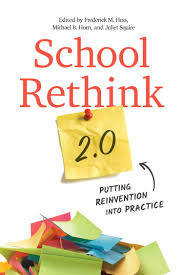
We are at a point where we need to rethink the basics of how our K-12 schools work. And based on this rethinking, we need to transform the learning experience we provide for our kids. The somewhat-unnoticed 2025 book School Rethink 2.0: Putting Reinvention into Practice provides some great thoughts on the potential pieces of the challenging transformation puzzle.

In our schools, achievement is down, graduation rates are down, attendance is down, and anxiety and other forms of mental illness are up. And the students who continue to fare the worst are those who need our help the most, those from disadvantaged backgrounds.

Our schools have been using the same basic model for over 100 years. But this model no longer works as well, due to changes in our society and in our kids themselves.

Except as we face our increasingly challenging future, we now need our schools to work even better than they ever have.

One approach to bring about the needed improvement would be to try to fine-tune the existing system. But a more courageous approach would be what in the private sector is called “transformation.”

In a transformational approach, we would develop a vision of a much-improved future. Then, we would work in a systematic way to make that vision happen.

And we can nod our heads and agree that such a transformation is what we need. Except, it simply isn’t happening yet, at least not very quickly.

So what is holding us back from starting on the transformation, at the speed and scale that would make a difference?

One obstacle is the failure to recognize the extent of the problems we face. And a related obstacle is the belief that we can address our challenges with incremental improvement—little fixes here and there—rather than an overall transformation.

But maybe the biggest thing holding us back is the great difficulty in K-12 districts and schools of bringing about change that is truly transformative. The system is complex, the scope is huge, and we don’t have staff dedicated to the effort needed to make this change happen.

So, how can we transcend these obstacles?

A start would be for school leaders at every level, especially districts and individual schools, to convene their people and gain a consensus that what is needed is nothing less than transformation. The next step would be to develop a preliminary vision of what the transformed system will look like.

Except this leaves the tremendous challenge of traveling from the entrenched present to the transformed future. How do we get from here to there?

A start is to accept that it’s OK to give ourselves some time, and to not feel compelled to try to put our completely transformed world in place for the start of school in September. We first need to identify the components of our vision of transformation. Then, we can prioritize the order in which we want to work to implement these components over time.

But what are the common components of transformation that we should consider?

A great asset here is the 2025 book School Rethink 2.0: Putting Reinvention into Practice. Somehow this book flew under the radar when it came out. For example, it has exactly one rating on Amazon.

The book breaks school transformation into several themes. It then provides an excellent discussion of each of these themes. For each discussion it brings in one or more of the top experts on the issue. In this way, School Rethink 2.0 provides something of a panel discussion on what rethinking consists of and how we can make it happen.

The book and its contributors suggest several themes for rethinking.

  • Maybe the biggest benefit of rethinking can come from a shift to personalized learning. Larry Berger and Alexandra Walsh discuss how a personalized approach can be integrated into curriculum products through the inclusion of personalized learning software and other approaches.
  • Besides personalized learning software, a technology that would also support personalized learning would be AI-driven tutoring. Sal Khan, Kristen DiCerbo, and Rachel Borditsky of Khan Academy discuss their efforts to develop their Khanmigo tutoring product.
  • Scott Ellis discusses how a shift to mastery or standards-based learning can ensure students are successfully mastering the hundreds of skills involved in their learning experience.
  • Arthur VanderVeen discusses how we need forms of assessment that move beyond the historic annual test. This would enable us to provide students and teachers with constantly updated data on how the students are progressing
  • One form of personalization that is not new is Career and Technical Education (CTE). But Corey Mohn argues we need to take a next step to Profession-Based Learning (PBL), in which all students can work individually and in teams on projects drawn from the workplace.
  • Factors such as the increased emphasis on personalized learning will change the role of the teacher. Brent Maddin discusses how one change will be an increased use of teacher teams, in which the teacher members play different roles.
  • Maddin also discusses how the use of teacher teams opens new possibilities for the use of time and space at school. For more than a century, classes of 20 to 30 students or more have been scheduled into traditional-sized classrooms for fixed periods. But teacher teams are one of several breakthroughs that can create new options for how the students’ school days are structured and for the physical layout of the school.
  • Frederick “Rick” Hess, Michael B. Horn, and Juliet Squire serve as editors of the book. They provide guidance on the challenge of bringing about the transformation that the extensive rethinking calls for.

The journey from today to our transformed system will be challenging—but it will also be exciting. And it’s a journey we must undertake. Our kids deserve no less.

The Power and Peril of Phones – Part 3: Managing Devices at School

This is the final installment of a three-part blog entry on “The Power and Peril of Phones.” In “Part 1: The Power” we looked back at the evolution of computer and communications technology. We marveled at how this technology now provides us with the power to access all the world’s knowledge and communicate with anyone around the world. And, we looked in amazement at how we can access this power with a small portable device that we can hold in our hand.

But we also considered the peril that the very-tempting overuse of this technology and “device addiction” presents, especially for the young. This peril includes decreasing levels of face-to-face human interaction and increasing rates of mental health problems.

Then in “Part 2: What Do Our Schools Need to Do?,” we considered how schools can cope with these challenges. A major focus for schools has been considering various degrees of “bans” on the use of phones at school. The most extreme form of a ban is requiring students to either leave their phones at home or to lock them up for the school day when they arrive at school.

(Courtesy of StockCake)

But even an extreme phone ban at school doesn’t completely solve the problem. This is because we increasingly want to have our students use laptops and other computer devices during the school day to help improve their learning experience. For example, we want to use the power of technology to enable personalized learning, and this requires access to devices. An excellent New York Times article on the perilous place where we have arrived is “Get Tech Out of the Classroom Before It’s Too Late,” by Jessica Grosse. (https://www.nytimes.com/2024/04/10/opinion/schools-technology.html)

For years we foresaw a future in which we could provide our students with “1-to-1 device coverage.” Then in 2020, the Covid-19 pandemic unexpectedly provided the impetus to make this jump, and to issue each student their own device.

And now, we can use our technology to do things such as enable the giant shift from whole group instruction to a personalized learning model. A leader in this movement has been the Modern Classrooms Project (https://www.modernclassrooms.org), which provides advocacy and facilitation to “lead a movement of educators in implementing a self-paced, mastery-based instructional model that leverages technology to foster human connection, authentic learning, and social-emotional growth.”

And of course, we’re now just beginning to scratch the surface of how artificial intelligence, or AI, can provide even more powerful learning for our students. Except the use of AI runs the danger of increasing the time students spend with their devices even beyond what we have now.

So, how can schools provide technology access for our students in order to give them benefits such as access to powerful personalized learning abilities while also somehow minimizing the negative impact of too much device time? This is the tough challenge we want to address in “Part 3: Managing Devices at School.”


As we mentioned in Part 2, a start in controlling device time is to provide some level of a ban on the use of personal devices during the school day. But if the level of the ban leaves the door open for some use of personal devices during parts of the school day, such as at lunch, the school must find ways to help students to manage their device use during these periods.

To help manage the use of devices, the school and the teachers would be wise to structure the school day into use-a-device periods and no-device periods. The no-device periods would need to begin with the teacher saying something like, “OK everyone, now we are going to close our laptops, and until 9:30 we will be (for example) working with our small groups.”

Of course, we should proclaim recess and lunch periods to be no-device periods, as students are encouraged to interact and engage in unstructured play.

But we need use-a-device periods to enable students to use school-issued devices for technology-enabled learning. As noted above, a very beneficial form of technology-enabled learning is personalized learning, especially for reading and math. And increasingly, students will have access to forms of online tutoring, or possibly automated tutoring. What will continue to be challenging will be the use of devices for more open-ended activity such as research.

One way to both encourage human interaction and to minimize the harmful impact of the excessive of devices is to make use of small group sessions and multi-student projects. In these sessions, students may be accessing technology, but they are doing so as part of their interaction with their fellow students. Their human interaction should increase the benefit of the use of the technology, and it should also help to maintain the focus on the assignment.

Students can also benefit if we provide tutoring from adults in the community or older students. The Greendale (Wisconsin) Schools provides various forms of tutoring, including a “Reading Buddies” program in which each week retirement-age adults and work-at-home parents provide one-on-one reading sessions with all first graders. (https://www.greendaleschools.org/families/school-volunteer-opportunities.cfm)

And, an example of a school which uses older students to provide tutoring for younger students is Milwaukee Parkside School for the Arts. (https://mps.milwaukee.k12.wi.us/Schools/Milw-Parkside-School.htm) Note that tutoring by older students helps both the little guys and also the older students.

As valuable as technology is, especially for younger children, some concepts such as those in math can be taught better if we make use of manipulatives, which provide a tactile experience.

Technology also provides advantages in gaining access to various forms of reading material. But a disadvantage of using devices to access online reading material is that it is easier to lose focus and possibly wander into other uses such as social media (more on that below). So ideally, assignments heavy on reading would ideally favor paper books, which also provide a “tactile” experience.

And especially at the elementary level, students would benefit if we set aside a daily period for reading, in which every student in the class and the teacher quietly devotes some quiet time to doing nothing other than to read a paper book or other material of their choice.

Schools may also wish to look for ways to encourage the reading of full-length books, through activities such as student book clubs.

(I’m so old that when I started school our desks were still bolted to the floor, and we had 35 or more students in a class. When we would do an assignment, everyone would do the same thing, which meant some finished much earlier than others. Our teachers managed this challenge partly by asking us to always have a book in our desk, and to use our spare time upon finishing the assignment to read. Well, I loved to read, and I would rush through the assignment so I could get back to reading my current book.)

For many years, the federal Children’s Internet Protection Act (CIPA) has required schools to have Internet filtering technology. The main intent of this requirement was to enable schools to block content that is inappropriate for younger children. But schools can use their filtering systems to block or limit social media sites such as Facebook and TikTok. Filtering social media sites removes these sites as a distraction, and it also helps to control online bullying.

With YouTube, schools may wish to possibly establish a general ban but maintain a positive list of a library of approved YouTube pages, which teachers can constantly add to though an easy-to-use process.


Considering the amazing power that our modern technology provides for our kids, it’s frustrating that we have to put energy into working in different ways to actually keep the students from using that technology, at least for parts of their school day. But there are critical reasons why we have arrived at a point in time where we now must do this.

But if we do this well, we can have it all! We can maximize the powerful benefits our students realize from our technology, such as personalized learning and tutoring. And, we can also maximize the benefits they receive from human interaction.

Wouldn’t it be cool if we could pull this off?