We are at a point where we need to rethink the basics of how our K-12 schools work. And based on this rethinking, we need to transform the learning experience we provide for our kids. The somewhat-unnoticed 2025 book School Rethink 2.0: Putting Reinvention into Practice provides some great thoughts on the potential pieces of the challenging transformation puzzle.
In our schools, achievement is down, graduation rates are down, attendance is down, and anxiety and other forms of mental illness are up. And the students who continue to fare the worst are those who need our help the most, those from disadvantaged backgrounds.
Our schools have been using the same basic model for over 100 years. But this model no longer works as well, due to changes in our society and in our kids themselves.
Except as we face our increasingly challenging future, we now need our schools to work even better than they ever have.
One approach to bring about the needed improvement would be to try to fine-tune the existing system. But a more courageous approach would be what in the private sector is called “transformation.”
In a transformational approach, we would develop a vision of a much-improved future. Then, we would work in a systematic way to make that vision happen.
And we can nod our heads and agree that such a transformation is what we need. Except, it simply isn’t happening yet, at least not very quickly.
So what is holding us back from starting on the transformation, at the speed and scale that would make a difference?
One obstacle is the failure to recognize the extent of the problems we face. And a related obstacle is the belief that we can address our challenges with incremental improvement—little fixes here and there—rather than an overall transformation.
But maybe the biggest thing holding us back is the great difficulty in K-12 districts and schools of bringing about change that is truly transformative. The system is complex, the scope is huge, and we don’t have staff dedicated to the effort needed to make this change happen.
So, how can we transcend these obstacles?
A start would be for school leaders at every level, especially districts and individual schools, to convene their people and gain a consensus that what is needed is nothing less than transformation. The next step would be to develop a preliminary vision of what the transformed system will look like.
Except this leaves the tremendous challenge of traveling from the entrenched present to the transformed future. How do we get from here to there?
A start is to accept that it’s OK to give ourselves some time, and to not feel compelled to try to put our completely transformed world in place for the start of school in September. We first need to identify the components of our vision of transformation. Then, we can prioritize the order in which we want to work to implement these components over time.
But what are the common components of transformation that we should consider?
A great asset here is the 2025 book School Rethink 2.0: Putting Reinvention into Practice. Somehow this book flew under the radar when it came out. For example, it has exactly one rating on Amazon.
The book breaks school transformation into several themes. It then provides an excellent discussion of each of these themes. For each discussion it brings in one or more of the top experts on the issue. In this way, School Rethink 2.0 provides something of a panel discussion on what rethinking consists of and how we can make it happen.
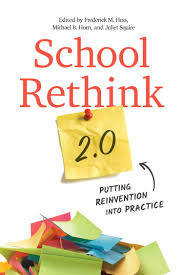
The book and its contributors suggest several themes for rethinking.
- Maybe the biggest benefit of rethinking can come from a shift to personalized learning. Larry Berger and Alexandra Walsh discuss how a personalized approach can be integrated into curriculum products through the inclusion of personalized learning software and other approaches.
- Besides personalized learning software, a technology that would also support personalized learning would be AI-driven tutoring. Sal Khan, Kristen DiCerbo, and Rachel Borditsky of Khan Academy discuss their efforts to develop their Khanmigo tutoring product.
- Scott Ellis discusses how a shift to mastery or standards-based learning can ensure students are successfully mastering the hundreds of skills involved in their learning experience.
- Arthur VanderVeen discusses how we need forms of assessment that move beyond the historic annual test. This would enable us to provide students and teachers with constantly updated data on how the students are progressing
- One form of personalization that is not new is Career and Technical Education (CTE). But Corey Mohn argues we need to take a next step to Profession-Based Learning (PBL), in which all students can work individually and in teams on projects drawn from the workplace.
- Factors such as the increased emphasis on personalized learning will change the role of the teacher. Brent Maddin discusses how one change will be an increased use of teacher teams, in which the teacher members play different roles.
- Maddin also discusses how the use of teacher teams opens new possibilities for the use of time and space at school. For more than a century, classes of 20 to 30 students or more have been scheduled into traditional-sized classrooms for fixed periods. But teacher teams are one of several breakthroughs that can create new options for how the students’ school days are structured and for the physical layout of the school.
- Frederick “Rick” Hess, Michael B. Horn, and Juliet Squire serve as editors of the book. They provide guidance on the challenge of bringing about the transformation that the extensive rethinking calls for.
The journey from today to our transformed system will be challenging—but it will also be exciting. And it’s a journey we must undertake. Our kids deserve no less.

