Tag Archives: New York Times

The Power and Peril of Phones – Part 3: Managing Devices at School

This is the final installment of a three-part blog entry on “The Power and Peril of Phones.” In “Part 1: The Power” we looked back at the evolution of computer and communications technology. We marveled at how this technology now provides us with the power to access all the world’s knowledge and communicate with anyone around the world. And, we looked in amazement at how we can access this power with a small portable device that we can hold in our hand.

But we also considered the peril that the very-tempting overuse of this technology and “device addiction” presents, especially for the young. This peril includes decreasing levels of face-to-face human interaction and increasing rates of mental health problems.

Then in “Part 2: What Do Our Schools Need to Do?,” we considered how schools can cope with these challenges. A major focus for schools has been considering various degrees of “bans” on the use of phones at school. The most extreme form of a ban is requiring students to either leave their phones at home or to lock them up for the school day when they arrive at school.
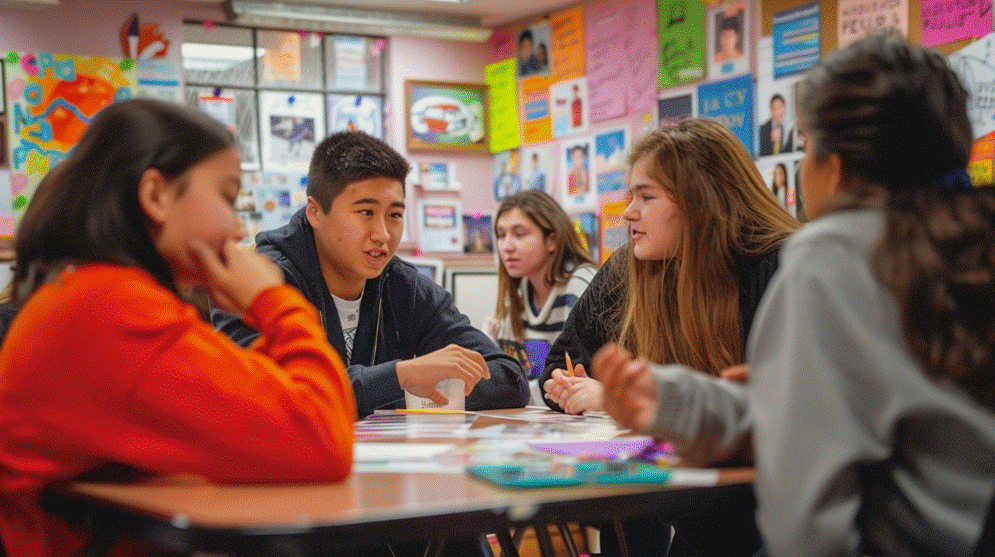
(Courtesy of StockCake)

But even an extreme phone ban at school doesn’t completely solve the problem. This is because we increasingly want to have our students use laptops and other computer devices during the school day to help improve their learning experience. For example, we want to use the power of technology to enable personalized learning, and this requires access to devices. An excellent New York Times article on the perilous place where we have arrived is “Get Tech Out of the Classroom Before It’s Too Late,” by Jessica Grosse. (https://www.nytimes.com/2024/04/10/opinion/schools-technology.html)

For years we foresaw a future in which we could provide our students with “1-to-1 device coverage.” Then in 2020, the Covid-19 pandemic unexpectedly provided the impetus to make this jump, and to issue each student their own device.

And now, we can use our technology to do things such as enable the giant shift from whole group instruction to a personalized learning model. A leader in this movement has been the Modern Classrooms Project (https://www.modernclassrooms.org), which provides advocacy and facilitation to “lead a movement of educators in implementing a self-paced, mastery-based instructional model that leverages technology to foster human connection, authentic learning, and social-emotional growth.”

And of course, we’re now just beginning to scratch the surface of how artificial intelligence, or AI, can provide even more powerful learning for our students. Except the use of AI runs the danger of increasing the time students spend with their devices even beyond what we have now.

So, how can schools provide technology access for our students in order to give them benefits such as access to powerful personalized learning abilities while also somehow minimizing the negative impact of too much device time? This is the tough challenge we want to address in “Part 3: Managing Devices at School.”


As we mentioned in Part 2, a start in controlling device time is to provide some level of a ban on the use of personal devices during the school day. But if the level of the ban leaves the door open for some use of personal devices during parts of the school day, such as at lunch, the school must find ways to help students to manage their device use during these periods.

To help manage the use of devices, the school and the teachers would be wise to structure the school day into use-a-device periods and no-device periods. The no-device periods would need to begin with the teacher saying something like, “OK everyone, now we are going to close our laptops, and until 9:30 we will be (for example) working with our small groups.”

Of course, we should proclaim recess and lunch periods to be no-device periods, as students are encouraged to interact and engage in unstructured play.

But we need use-a-device periods to enable students to use school-issued devices for technology-enabled learning. As noted above, a very beneficial form of technology-enabled learning is personalized learning, especially for reading and math. And increasingly, students will have access to forms of online tutoring, or possibly automated tutoring. What will continue to be challenging will be the use of devices for more open-ended activity such as research.

One way to both encourage human interaction and to minimize the harmful impact of the excessive of devices is to make use of small group sessions and multi-student projects. In these sessions, students may be accessing technology, but they are doing so as part of their interaction with their fellow students. Their human interaction should increase the benefit of the use of the technology, and it should also help to maintain the focus on the assignment.

Students can also benefit if we provide tutoring from adults in the community or older students. The Greendale (Wisconsin) Schools provides various forms of tutoring, including a “Reading Buddies” program in which each week retirement-age adults and work-at-home parents provide one-on-one reading sessions with all first graders. (https://www.greendaleschools.org/families/school-volunteer-opportunities.cfm)

And, an example of a school which uses older students to provide tutoring for younger students is Milwaukee Parkside School for the Arts. (https://mps.milwaukee.k12.wi.us/Schools/Milw-Parkside-School.htm) Note that tutoring by older students helps both the little guys and also the older students.

As valuable as technology is, especially for younger children, some concepts such as those in math can be taught better if we make use of manipulatives, which provide a tactile experience.

Technology also provides advantages in gaining access to various forms of reading material. But a disadvantage of using devices to access online reading material is that it is easier to lose focus and possibly wander into other uses such as social media (more on that below). So ideally, assignments heavy on reading would ideally favor paper books, which also provide a “tactile” experience.

And especially at the elementary level, students would benefit if we set aside a daily period for reading, in which every student in the class and the teacher quietly devotes some quiet time to doing nothing other than to read a paper book or other material of their choice.

Schools may also wish to look for ways to encourage the reading of full-length books, through activities such as student book clubs.

(I’m so old that when I started school our desks were still bolted to the floor, and we had 35 or more students in a class. When we would do an assignment, everyone would do the same thing, which meant some finished much earlier than others. Our teachers managed this challenge partly by asking us to always have a book in our desk, and to use our spare time upon finishing the assignment to read. Well, I loved to read, and I would rush through the assignment so I could get back to reading my current book.)

For many years, the federal Children’s Internet Protection Act (CIPA) has required schools to have Internet filtering technology. The main intent of this requirement was to enable schools to block content that is inappropriate for younger children. But schools can use their filtering systems to block or limit social media sites such as Facebook and TikTok. Filtering social media sites removes these sites as a distraction, and it also helps to control online bullying.

With YouTube, schools may wish to possibly establish a general ban but maintain a positive list of a library of approved YouTube pages, which teachers can constantly add to though an easy-to-use process.


Considering the amazing power that our modern technology provides for our kids, it’s frustrating that we have to put energy into working in different ways to actually keep the students from using that technology, at least for parts of their school day. But there are critical reasons why we have arrived at a point in time where we now must do this.

But if we do this well, we can have it all! We can maximize the powerful benefits our students realize from our technology, such as personalized learning and tutoring. And, we can also maximize the benefits they receive from human interaction.

Wouldn’t it be cool if we could pull this off?

School Attendance Has Become a Crisis. Technology Is Part of the Cause, and It Can Also Be Part of the Cure

In the wake of the Covid-19 pandemic we have seen a very disturbing increase in student absences in our K-12 schools. It would be comforting to believe this trend is just a lingering impact of the pandemic, and that attendance will get back to the old normal over time.

Except this won’t happen, at least not all on its own. The reason is that the pandemic accelerated forces that had already been in motion for some time. And these forces are if anything intensifying, especially the increased use of devices by students and the related “disengagement” of students and parents from the life of the school. Poor attendance is the biggest symptom of this larger problem of disengagement.

Remember how in the days of the pandemic we used the phrase “the new normal?” Well, disengagement and the related increase in absences is part of that new normal. And we are now stuck with this problem—unless we work proactively to fix it.

Except our focus here is technology. So, what does battling absences have to do with technology? Well, the powerful forces the pandemic accelerated were partly related to technology, such as our kids’ increasing attachment to devices. And, some of the solutions we need to apply to address this problem also make use of technology.

Let’s briefly consider how technology helped cause this problem, and then concentrate on how technology can begin to help to fix it.

Increased “disengagement” has brought about poor attendance.

There has been plenty of attention paid to the problem of attendance in a variety of media. Education-oriented media such as Education Week have been working for some time to draw attention to this problem. And on March 29 The New York Times had a great article on “Why School Absences Have ‘Exploded’ Almost Everywhere.” [i]

Kaylee Greenlee for The New York Times

The Times reported that since the 2019-20 school year the percentage of “chronically absent” students in K-12 school nationwide has doubled, from 13% to 26%. This problem is much worse in districts serving disadvantaged populations. In our Milwaukee Public Schools (MPS), the Times reported that between 2019 and 2023 the chronically absent rate went from 37% to 50%.

The Times noted that states use different definitions of chronically absent. For example, the State of Wisconsin defines students as being chronically absent “if they miss more than 10% of school days out of the total number of school days during which they were enrolled.” [ii]

In December, Alan Borsuk and the Milwaukee Journal Sentinel featured an article on “What Are We Willing to Do about Low-Performing Schools in Milwaukee Public Schools and Beyond? Right Now, There’s No Real Plan for Change.” This article discussed the impact of disengagement and the related challenge of poor attendance. Alan used MPS’s Madison High School as a case study. [iii] 

Many kids have simply stopped going to school.

What did Alan find at Madison? He found the school was orderly, and the administrators and teachers were highly motivated. And there were attractive programs in vocational areas, something too few schools offer.

Except there were far too many students in the building. At that point in the school year (mid-December) the average daily attendance so far was 58.6%, which meant that on an average day more than four out of ten students were not in school. In recent years more than 80% of the students at Madison have been labeled chronically absent.

Mike De Sisti – Milwaukee Journal Sentinel

He also reported that enrollment at Madison had fallen from 892 in 2014-15 to 625 in November of the 2023-24 school year.

There is also quite a bit of attrition as students get older:

  • 224 of the Madison students were ninth graders, including 94 repeating their ninth-grade year.
  • 180 were tenth graders.
  • 134 were eleventh graders.
  • 86 were twelfth graders.

What are the causes of this drop in attendance?

So, what is going wrong at Madison and at too many of our districts and schools across the nation? Part of the problem is families and students are often dealing with issues at home that become a barrier to school attendance, as we will discuss below in the case of the School District of Plano, Texas.

But a big part of our challenge is that many students and their parents have lost a basic force that success in school requires. This is the compulsion to simply make yourself physically come to school each day, as part of your larger daily—and lifelong—routine. Those on the education scene use the term “engagement” to describe a traditional connection to school, and the term “disengagement” to describe the loss of this connection.

As we noted above, this disengagement preceded the Covid-19 pandemic, although the pandemic intensified it in a variety of ways. Obviously, our kids can’t be successful in school if they aren’t in the building. We need to bring all our students and their families to once again be engaged in their school experience, and part of this effort is to bring about near-perfect attendance.

But this is a complex undertaking. Let’s focus on the challenge of addressing poor attendance.

Technology can address the problem of poor attendance in three ways.

Technology can help improve attendance in three major ways:

  • The use of data analytics to help school staff and parents identify attendance problems.
  • Top-down automated communication at the district and school level to alert parents of problems and encourage better attendance.
  • Bottom-up one-on-one communication by teachers and other school staff, to intervene with parents of students with attendance problems.

Analytics can identify problem students and trends.

Student information systems (e.g., Infinite Campus, PowerSchool) contain reporting capabilities that allow districts and schools to obtain reporting on different aspects of the attendance challenge.

Examples would include:

  • Students absent today at our school, both excused and unexcused.
  • Students absent today for a second day.
  • Students who are displaying more problematic patterns of attendance.

Districts and schools also need to develop data systems to track interventions that have been attempted with problem students and analyze the effectiveness of those interventions.

Top-down communication sends automated mass alerts to parents.

Top-down automated communication has been used for many years by districts to help manage attendance issues. This communication usually uses a combination of the district’s student information system and notification system software (e.g., BrightArrow, SwiftK12).

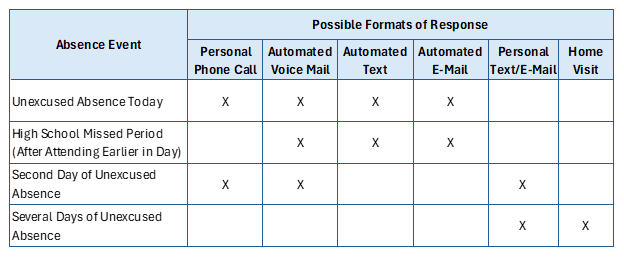
An example is that early each morning the notification system will extract data from the student information system on students with unexcused absences. The notification system will then send some combination of text, voice mail, and e-mail messages to the parents of these students. Note that these messages are generally sent in a single batch for the entire district.

Another example is to send alerts to the parents of high school students who initially were at school but have been marked absent in subsequent periods.

Additional types of alerts would include addressing multi-day absences. The chart below on “Possible Formats of Response” outlines some of these possibilities.

Bottom-up efforts make use of interpersonal communication.

But an effective solution to absences must go beyond alerting parents that their child is absent. The solution must also employ personal contacts with parents.

Such a contact may begin on the morning of the first absence, with a personal phone call from the school office in addition to the automated alerts. If attendance problems continue, calls from the child’s teacher would tend to be especially effective, due to the teacher’s personal relationship with the family. Families with persistent problems would benefit from a home visit.

Districts benefit from a comprehensive approach – Plano, Texas.

And districts would clearly benefit from a comprehensive approach to absenteeism and a unified overall management of the challenges. A good example would be the Plano Independent School District in Plano, Texas. Plano is a racially diverse district with almost 50,000 students. A recent Education Week article on “This Leader Takes a Compassionate Approach to Truancy. It’s Transforming Students’ Lives” profiled the district’s efforts to improve attendance. [iv]

Plano had been relying on the efforts of a truancy court to manage attendance. But sending families to such a court did little to address the problems underlying serious attendance issues. Sharon Bradley, a new Director of Family and Social Services, led the shift to the use of “tiered intervention strategies…to reengage students” and a shift to an attendance review board that would work with families to identify underlying causes for the absences and if needed develop a family support plan.

But there’s a larger problem, disengagement.

As the experience in Plano showed, there are often larger problems behind the attendance challenges of a family. As we noted above, part of the problem often includes a disengagement from the life of the school, and disengagement has gotten much worse in the aftermath of the pandemic.

In our next blog entry, we will try to tackle the challenge of disengagement. And as we work to maintain our technology focus, we will explore how technology contributes to disengagement, but how it may also help us in our efforts to reengage our students.

Have you had any success? What are your thoughts?

If you have any thoughts or contributions on the challenge of attendance, or on the upcoming topic of engagement, please hit “Leave a Reply” above to add a comment, or contact me at schulzj@jerryschulz.com.

And thanks to all for everything you do for our kids in these challenging times!

Jerry Schulz


[i]     Mervosh, S., and Paris, F., “Why School Absences Have ‘Exploded’ Almost Everywhere,” The New York Times, March 29, 2024 – https://www.nytimes.com/interactive/2024/03/29/us/chronic-absences.html

[ii]     https://dpi.wi.gov/wisedash/about-data/chronic-absenteeism#:~:text=Students%20are%20considered%20to%20be,through%20their%20Student%20Information%20Systems

[iii]    Borsuk, A., ““What Are We Willing to Do about Low-Performing Schools in Milwaukee Public Schools and Beyond? Right Now, There’s No Real Plan for Change,” Milwaukee Journal Sentinel, December 15, 2023 – https://www.jsonline.com/story/news/education/2023/12/15/no-apparent-play-to-help-improve-low-performing-mps-schools/71569628007

[iv]    Will, Madeline, “This Leader Takes a Compassionate Approach to Truancy. It’s Transforming Students’ Lives,” Education Week, February 5, 2024 – https://www.edweek.org/leaders/leadership/this-leader-takes-a-compassionate-approach-to-truancy-its-transforming-students-lives/2024/02

Pushback Against Summit Learning Implementation in Kansas – “Start of a Rebellion,” or a Learning Experience?

On April 21 the New York Times published an interesting story on “Silicon Valley Came to Kansas Schools; That Started a Rebellion” (https://www.nytimes.com/2019/04/21/technology/silicon-valley-kansas-schools.html). The article talks about the recent implementation of the Summit Learning product in two Kansas school districts, the McPherson Unified School District and the Wellington Public Schools. The implementation has experienced some significant push-back by parents, students, and teachers.

Summit Learning

The article seems to have hit a nerve; it generated over 1,300 comments, and the most popular comment had 2,444 likes. Most commenters agreed with the tone of the article, that the current direction of the use of technology in our schools is ill-advised.

School district officials have disputed some of the facts reported in the article, and it’s unclear how accurate the article may be. But at minimum it’s fair to say that there is unhappiness in Kansas with the way that the product was implemented, or even that the product is being used at all.

Not knowing more, what can we observe?

First, the single biggest power of technology in K-12 education is to enable personalized learning. Without that, the use of traditional large group instruction may work well for the average kids in the middle, but the kids who struggle to stay on the pace are doomed, and the sharpest kids who we need to be our leaders in the future are left to stare out the window. Personalized learning has always had the potential to fix this, but it’s never been practical on a large scale without the enabling software. Note also that personalized learning has a special value for disadvantaged kids, who are the most at risk of falling behind and being doomed.

So products like Summit are not the problem. The problem may be how it was implemented here, in what seems to have been a top-down way. And, it sounds as though the scope of the project immediately went all the way to the extreme of a school experience for all students that was heavily virtual. Plus the implementation didn’t seem to target tasks such as math exercises that benefit the most from personalized learning, but instead it tried to automate many if not most learning tasks.

A big gripe about the implementation was a great reduction in teacher and student interaction. The article reported that, “Summit’s program asks schools to commit to having students meet weekly in person with teachers for at least ten minutes; some children said the sessions lasted around two minutes or did not happen.”

But even if the ten minute goal was achieved, that’s not much of an accomplishment. To me, one of the goals of the use of technology in learning should be to automate mundane tasks so as to free the teacher to provide more and better human interaction. The use of technology shouldn’t have to be a choice between computer interaction and human interaction.

Hundreds of districts have very successfully implemented products like Summit, but they did it in a “top-down/bottom-up” way, maintaining a district-wide and school-wide focus, while also working intensely with the teachers to gain their help in designing the solution and helping them to change their teaching practices.

Pessimists might tend to look at the experience in McPherson Unified School District and the Wellington as some sort of milestone point on a movement away from implementation of technology to enable personalized learning. But I’d like to take the optimistic view, that this implementation can act as a learning experience on the problems such an implementation can encounter. And, we can hopefully learn from this experience to help manage future implementations in a more effective way.