Tag Archives: technology

Tony Frontier Says We Must Use AI, and Use It with “Intention”

Artificial intelligence, or “AI,” is not new. For years, our students have been using forms of what is called “narrow AI.” Maybe the best example of narrow AI is adaptive learning software, in which the technology provides personalized reading and math instruction and practice.

But generative AI products such as Google Gemini are now available. And the interest in the use of these products has exploded—especially among our students—and this school year may become the “AI moment” when this all comes together.

Except educators have tended to view the challenge of AI as figuring out how to keep students from not using it. So when students take on traditional assignments such as research papers, we tend to be concerned they will use AI to “cheat” on the assignment. And much of our energy involving AI has been devoted to blocking its use.

In his new book “AI with Intention: Principles and Action Steps for Teachers and School Leaders” Tony Frontier takes the opposite viewpoint. He urges educators to not only put AI to work in improving our students’ learning, but to do this “with intention”—to work hard to ensure that our use of AI is being effective in helping our kids learn in new and more powerful ways.

Yet to put AI to work in an effective way requires considerable change, and that is what “AI with Intention” is about. Frontier devotes the book to discussing how we can bring about the changes needed to help our students use AI more effectively.

He splits the book into two sections. The first half of the book is devoted to advice for school leaders on how to bring about the needed change. And the second half is devoted to advice for teachers.

How can school leaders provide leadership to effectively implement AI?

Frontier begins his advice for school leaders by suggesting that they “lead by learning.” He urges leaders to help all those in the organization understand the basics of how AI works and what it can do. For example, he advises leaders to help people avoid “anthropomorphizing” AI—to treat AI like it is a human, as in science fiction movies. He uses the example of the student telling the teacher that, “Google told me this.” No, AI is a tool that we use, not a person.

He then urges leaders to “take a transformational approach.” A key issue for leaders in implementing AI is recognizing the distinction between transactional and transformational change. An example of transactional change would be replacing an outdated textbook. And of course this kind of change is often needed.

But to get the greatest benefit from AI, Frontier encourages school leaders to work to bring about transformational change—to change how our students learn in a basic way. He says leaders must “Ask big, transformational questions—those that challenge long-held assumptions, invite new ways of thinking about the nature of the work at hand, and help others break free from the past.”

Although Frontier argues we must move past viewing AI as a way students might cheat, he calls on us to “emphasize integrity.” He recognizes that we must manage academic integrity, and he talks quite a bit about this.

And Frontier advises that we must put “fidelity before efficiency.” He cautions about using AI to achieve efficiency without “fidelity” to the larger goal of ensuring that our students have a rich learning experience.

How can teachers use AI to help our kids learn? How can we use AI with “intention?”

To begin his discussion of how teachers can use AI to improve how students learn, Tony encourages teachers to “stand in their shoes,” and view AI abilities as our students do.

He then calls on teachers to “know your purpose.” A very enlightening discussion is his contrast between the “culture of compliance,” in which our energy is directed to issues such as did our students submit their assignments, and the “culture of learning,” where the focus is on what might our students learn and whether this is happening.

He asks teachers to “prompt AI tools intentionally” and “use AI tools for intentional learning,” to ensure that AI tools are being used with intention and to help our students to become independent learners.

There’s more to do

 “AI with Intention” is a great contribution to understanding the role AI can play in our kids’ learning experience, how we can implement AI effectively, and how we can avoid some dangers of its use.

But there are things “AI with Intention” doesn’t do:

  • It doesn’t review specific AI tools.
  • It focuses on the use of generative AI tools such as Google Gemini and Microsoft Copilot, and it doesn’t open the door to even scarier tools such as AI tutors (e.g., Khanmigo).
  • Although it provides examples, these examples tend to relate to older kids.
  • It doesn’t provide a sample action plan for implementing AI.
  • And it doesn’t provide case studies on AI implementations in real districts and schools.

This is not a criticism of the book. “AI with Intention” provides a rich review of the issues involved in ensuring that AI is used “with intention.”

But there’s more to do. To begin, we need to consider how our districts and schools can structure their efforts to use AI and other methods to transform how learning happens with their kids. And we need to check out the actual experience of our fellow districts in how they are successfully or possibly not-so-successfully implementing AI.

And this is where you can help. Have you used AI “with intention” to help your students learn more effectively? If so, don’t be shy—this is the AI moment! This is the time to stand up and tell your story of success, to help all of us make the transformation in learning our kids need, as we enter the age of AI.
The Power and Peril of Phones – Part 3: Managing Devices at School

This is the final installment of a three-part blog entry on “The Power and Peril of Phones.” In “Part 1: The Power” we looked back at the evolution of computer and communications technology. We marveled at how this technology now provides us with the power to access all the world’s knowledge and communicate with anyone around the world. And, we looked in amazement at how we can access this power with a small portable device that we can hold in our hand.

But we also considered the peril that the very-tempting overuse of this technology and “device addiction” presents, especially for the young. This peril includes decreasing levels of face-to-face human interaction and increasing rates of mental health problems.

Then in “Part 2: What Do Our Schools Need to Do?,” we considered how schools can cope with these challenges. A major focus for schools has been considering various degrees of “bans” on the use of phones at school. The most extreme form of a ban is requiring students to either leave their phones at home or to lock them up for the school day when they arrive at school.

(Courtesy of StockCake)

But even an extreme phone ban at school doesn’t completely solve the problem. This is because we increasingly want to have our students use laptops and other computer devices during the school day to help improve their learning experience. For example, we want to use the power of technology to enable personalized learning, and this requires access to devices. An excellent New York Times article on the perilous place where we have arrived is “Get Tech Out of the Classroom Before It’s Too Late,” by Jessica Grosse. (https://www.nytimes.com/2024/04/10/opinion/schools-technology.html)

For years we foresaw a future in which we could provide our students with “1-to-1 device coverage.” Then in 2020, the Covid-19 pandemic unexpectedly provided the impetus to make this jump, and to issue each student their own device.

And now, we can use our technology to do things such as enable the giant shift from whole group instruction to a personalized learning model. A leader in this movement has been the Modern Classrooms Project (https://www.modernclassrooms.org), which provides advocacy and facilitation to “lead a movement of educators in implementing a self-paced, mastery-based instructional model that leverages technology to foster human connection, authentic learning, and social-emotional growth.”

And of course, we’re now just beginning to scratch the surface of how artificial intelligence, or AI, can provide even more powerful learning for our students. Except the use of AI runs the danger of increasing the time students spend with their devices even beyond what we have now.

So, how can schools provide technology access for our students in order to give them benefits such as access to powerful personalized learning abilities while also somehow minimizing the negative impact of too much device time? This is the tough challenge we want to address in “Part 3: Managing Devices at School.”


As we mentioned in Part 2, a start in controlling device time is to provide some level of a ban on the use of personal devices during the school day. But if the level of the ban leaves the door open for some use of personal devices during parts of the school day, such as at lunch, the school must find ways to help students to manage their device use during these periods.

To help manage the use of devices, the school and the teachers would be wise to structure the school day into use-a-device periods and no-device periods. The no-device periods would need to begin with the teacher saying something like, “OK everyone, now we are going to close our laptops, and until 9:30 we will be (for example) working with our small groups.”

Of course, we should proclaim recess and lunch periods to be no-device periods, as students are encouraged to interact and engage in unstructured play.

But we need use-a-device periods to enable students to use school-issued devices for technology-enabled learning. As noted above, a very beneficial form of technology-enabled learning is personalized learning, especially for reading and math. And increasingly, students will have access to forms of online tutoring, or possibly automated tutoring. What will continue to be challenging will be the use of devices for more open-ended activity such as research.

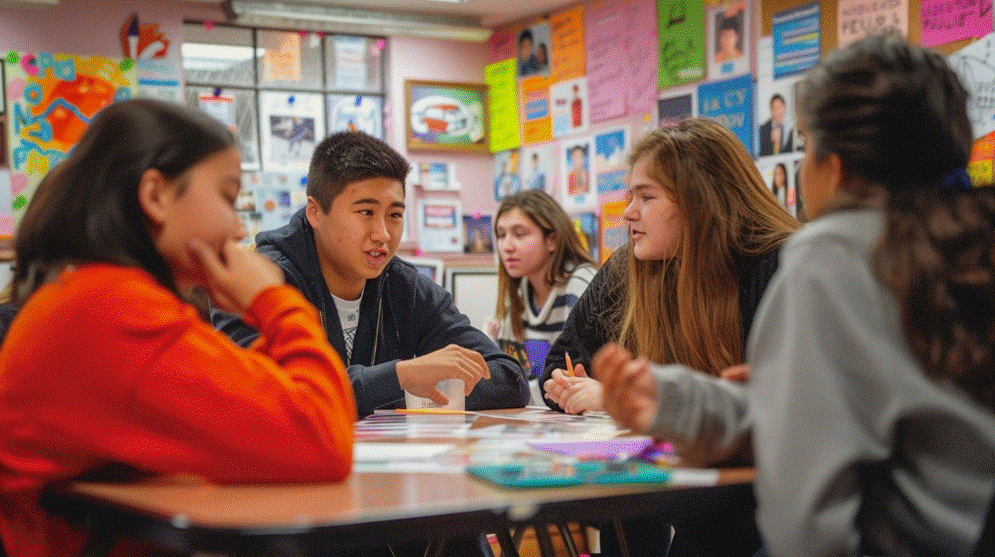
One way to both encourage human interaction and to minimize the harmful impact of the excessive of devices is to make use of small group sessions and multi-student projects. In these sessions, students may be accessing technology, but they are doing so as part of their interaction with their fellow students. Their human interaction should increase the benefit of the use of the technology, and it should also help to maintain the focus on the assignment.

Students can also benefit if we provide tutoring from adults in the community or older students. The Greendale (Wisconsin) Schools provides various forms of tutoring, including a “Reading Buddies” program in which each week retirement-age adults and work-at-home parents provide one-on-one reading sessions with all first graders. (https://www.greendaleschools.org/families/school-volunteer-opportunities.cfm)

And, an example of a school which uses older students to provide tutoring for younger students is Milwaukee Parkside School for the Arts. (https://mps.milwaukee.k12.wi.us/Schools/Milw-Parkside-School.htm) Note that tutoring by older students helps both the little guys and also the older students.

As valuable as technology is, especially for younger children, some concepts such as those in math can be taught better if we make use of manipulatives, which provide a tactile experience.

Technology also provides advantages in gaining access to various forms of reading material. But a disadvantage of using devices to access online reading material is that it is easier to lose focus and possibly wander into other uses such as social media (more on that below). So ideally, assignments heavy on reading would ideally favor paper books, which also provide a “tactile” experience.

And especially at the elementary level, students would benefit if we set aside a daily period for reading, in which every student in the class and the teacher quietly devotes some quiet time to doing nothing other than to read a paper book or other material of their choice.

Schools may also wish to look for ways to encourage the reading of full-length books, through activities such as student book clubs.

(I’m so old that when I started school our desks were still bolted to the floor, and we had 35 or more students in a class. When we would do an assignment, everyone would do the same thing, which meant some finished much earlier than others. Our teachers managed this challenge partly by asking us to always have a book in our desk, and to use our spare time upon finishing the assignment to read. Well, I loved to read, and I would rush through the assignment so I could get back to reading my current book.)

For many years, the federal Children’s Internet Protection Act (CIPA) has required schools to have Internet filtering technology. The main intent of this requirement was to enable schools to block content that is inappropriate for younger children. But schools can use their filtering systems to block or limit social media sites such as Facebook and TikTok. Filtering social media sites removes these sites as a distraction, and it also helps to control online bullying.

With YouTube, schools may wish to possibly establish a general ban but maintain a positive list of a library of approved YouTube pages, which teachers can constantly add to though an easy-to-use process.


Considering the amazing power that our modern technology provides for our kids, it’s frustrating that we have to put energy into working in different ways to actually keep the students from using that technology, at least for parts of their school day. But there are critical reasons why we have arrived at a point in time where we now must do this.

But if we do this well, we can have it all! We can maximize the powerful benefits our students realize from our technology, such as personalized learning and tutoring. And, we can also maximize the benefits they receive from human interaction.

Wouldn’t it be cool if we could pull this off?