Tag Archives: transformation

Tony Frontier Says We Must Use AI, and Use It with “Intention”

Artificial intelligence, or “AI,” is not new. For years, our students have been using forms of what is called “narrow AI.” Maybe the best example of narrow AI is adaptive learning software, in which the technology provides personalized reading and math instruction and practice.

But generative AI products such as Google Gemini are now available. And the interest in the use of these products has exploded—especially among our students—and this school year may become the “AI moment” when this all comes together.

Except educators have tended to view the challenge of AI as figuring out how to keep students from not using it. So when students take on traditional assignments such as research papers, we tend to be concerned they will use AI to “cheat” on the assignment. And much of our energy involving AI has been devoted to blocking its use.

In his new book “AI with Intention: Principles and Action Steps for Teachers and School Leaders” Tony Frontier takes the opposite viewpoint. He urges educators to not only put AI to work in improving our students’ learning, but to do this “with intention”—to work hard to ensure that our use of AI is being effective in helping our kids learn in new and more powerful ways.

Yet to put AI to work in an effective way requires considerable change, and that is what “AI with Intention” is about. Frontier devotes the book to discussing how we can bring about the changes needed to help our students use AI more effectively.

He splits the book into two sections. The first half of the book is devoted to advice for school leaders on how to bring about the needed change. And the second half is devoted to advice for teachers.

How can school leaders provide leadership to effectively implement AI?

Frontier begins his advice for school leaders by suggesting that they “lead by learning.” He urges leaders to help all those in the organization understand the basics of how AI works and what it can do. For example, he advises leaders to help people avoid “anthropomorphizing” AI—to treat AI like it is a human, as in science fiction movies. He uses the example of the student telling the teacher that, “Google told me this.” No, AI is a tool that we use, not a person.

He then urges leaders to “take a transformational approach.” A key issue for leaders in implementing AI is recognizing the distinction between transactional and transformational change. An example of transactional change would be replacing an outdated textbook. And of course this kind of change is often needed.

But to get the greatest benefit from AI, Frontier encourages school leaders to work to bring about transformational change—to change how our students learn in a basic way. He says leaders must “Ask big, transformational questions—those that challenge long-held assumptions, invite new ways of thinking about the nature of the work at hand, and help others break free from the past.”

Although Frontier argues we must move past viewing AI as a way students might cheat, he calls on us to “emphasize integrity.” He recognizes that we must manage academic integrity, and he talks quite a bit about this.

And Frontier advises that we must put “fidelity before efficiency.” He cautions about using AI to achieve efficiency without “fidelity” to the larger goal of ensuring that our students have a rich learning experience.

How can teachers use AI to help our kids learn? How can we use AI with “intention?”

To begin his discussion of how teachers can use AI to improve how students learn, Tony encourages teachers to “stand in their shoes,” and view AI abilities as our students do.

He then calls on teachers to “know your purpose.” A very enlightening discussion is his contrast between the “culture of compliance,” in which our energy is directed to issues such as did our students submit their assignments, and the “culture of learning,” where the focus is on what might our students learn and whether this is happening.

He asks teachers to “prompt AI tools intentionally” and “use AI tools for intentional learning,” to ensure that AI tools are being used with intention and to help our students to become independent learners.

There’s more to do

 “AI with Intention” is a great contribution to understanding the role AI can play in our kids’ learning experience, how we can implement AI effectively, and how we can avoid some dangers of its use.

But there are things “AI with Intention” doesn’t do:

  • It doesn’t review specific AI tools.
  • It focuses on the use of generative AI tools such as Google Gemini and Microsoft Copilot, and it doesn’t open the door to even scarier tools such as AI tutors (e.g., Khanmigo).
  • Although it provides examples, these examples tend to relate to older kids.
  • It doesn’t provide a sample action plan for implementing AI.
  • And it doesn’t provide case studies on AI implementations in real districts and schools.

This is not a criticism of the book. “AI with Intention” provides a rich review of the issues involved in ensuring that AI is used “with intention.”

But there’s more to do. To begin, we need to consider how our districts and schools can structure their efforts to use AI and other methods to transform how learning happens with their kids. And we need to check out the actual experience of our fellow districts in how they are successfully or possibly not-so-successfully implementing AI.

And this is where you can help. Have you used AI “with intention” to help your students learn more effectively? If so, don’t be shy—this is the AI moment! This is the time to stand up and tell your story of success, to help all of us make the transformation in learning our kids need, as we enter the age of AI.
The Power and Peril of Phones – Part 3: Managing Devices at School

This is the final installment of a three-part blog entry on “The Power and Peril of Phones.” In “Part 1: The Power” we looked back at the evolution of computer and communications technology. We marveled at how this technology now provides us with the power to access all the world’s knowledge and communicate with anyone around the world. And, we looked in amazement at how we can access this power with a small portable device that we can hold in our hand.

But we also considered the peril that the very-tempting overuse of this technology and “device addiction” presents, especially for the young. This peril includes decreasing levels of face-to-face human interaction and increasing rates of mental health problems.

Then in “Part 2: What Do Our Schools Need to Do?,” we considered how schools can cope with these challenges. A major focus for schools has been considering various degrees of “bans” on the use of phones at school. The most extreme form of a ban is requiring students to either leave their phones at home or to lock them up for the school day when they arrive at school.

(Courtesy of StockCake)

But even an extreme phone ban at school doesn’t completely solve the problem. This is because we increasingly want to have our students use laptops and other computer devices during the school day to help improve their learning experience. For example, we want to use the power of technology to enable personalized learning, and this requires access to devices. An excellent New York Times article on the perilous place where we have arrived is “Get Tech Out of the Classroom Before It’s Too Late,” by Jessica Grosse. (https://www.nytimes.com/2024/04/10/opinion/schools-technology.html)

For years we foresaw a future in which we could provide our students with “1-to-1 device coverage.” Then in 2020, the Covid-19 pandemic unexpectedly provided the impetus to make this jump, and to issue each student their own device.

And now, we can use our technology to do things such as enable the giant shift from whole group instruction to a personalized learning model. A leader in this movement has been the Modern Classrooms Project (https://www.modernclassrooms.org), which provides advocacy and facilitation to “lead a movement of educators in implementing a self-paced, mastery-based instructional model that leverages technology to foster human connection, authentic learning, and social-emotional growth.”

And of course, we’re now just beginning to scratch the surface of how artificial intelligence, or AI, can provide even more powerful learning for our students. Except the use of AI runs the danger of increasing the time students spend with their devices even beyond what we have now.

So, how can schools provide technology access for our students in order to give them benefits such as access to powerful personalized learning abilities while also somehow minimizing the negative impact of too much device time? This is the tough challenge we want to address in “Part 3: Managing Devices at School.”


As we mentioned in Part 2, a start in controlling device time is to provide some level of a ban on the use of personal devices during the school day. But if the level of the ban leaves the door open for some use of personal devices during parts of the school day, such as at lunch, the school must find ways to help students to manage their device use during these periods.

To help manage the use of devices, the school and the teachers would be wise to structure the school day into use-a-device periods and no-device periods. The no-device periods would need to begin with the teacher saying something like, “OK everyone, now we are going to close our laptops, and until 9:30 we will be (for example) working with our small groups.”

Of course, we should proclaim recess and lunch periods to be no-device periods, as students are encouraged to interact and engage in unstructured play.

But we need use-a-device periods to enable students to use school-issued devices for technology-enabled learning. As noted above, a very beneficial form of technology-enabled learning is personalized learning, especially for reading and math. And increasingly, students will have access to forms of online tutoring, or possibly automated tutoring. What will continue to be challenging will be the use of devices for more open-ended activity such as research.

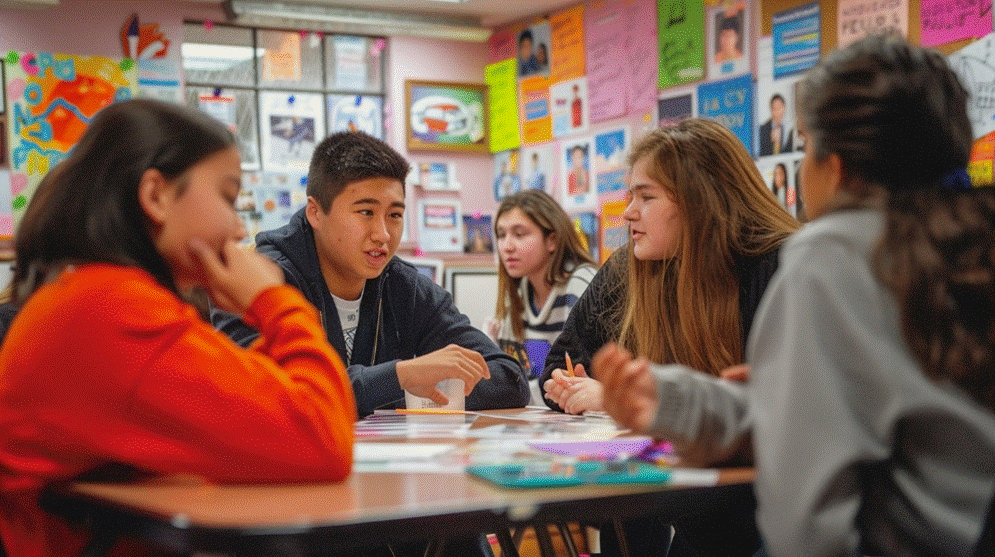
One way to both encourage human interaction and to minimize the harmful impact of the excessive of devices is to make use of small group sessions and multi-student projects. In these sessions, students may be accessing technology, but they are doing so as part of their interaction with their fellow students. Their human interaction should increase the benefit of the use of the technology, and it should also help to maintain the focus on the assignment.

Students can also benefit if we provide tutoring from adults in the community or older students. The Greendale (Wisconsin) Schools provides various forms of tutoring, including a “Reading Buddies” program in which each week retirement-age adults and work-at-home parents provide one-on-one reading sessions with all first graders. (https://www.greendaleschools.org/families/school-volunteer-opportunities.cfm)

And, an example of a school which uses older students to provide tutoring for younger students is Milwaukee Parkside School for the Arts. (https://mps.milwaukee.k12.wi.us/Schools/Milw-Parkside-School.htm) Note that tutoring by older students helps both the little guys and also the older students.

As valuable as technology is, especially for younger children, some concepts such as those in math can be taught better if we make use of manipulatives, which provide a tactile experience.

Technology also provides advantages in gaining access to various forms of reading material. But a disadvantage of using devices to access online reading material is that it is easier to lose focus and possibly wander into other uses such as social media (more on that below). So ideally, assignments heavy on reading would ideally favor paper books, which also provide a “tactile” experience.

And especially at the elementary level, students would benefit if we set aside a daily period for reading, in which every student in the class and the teacher quietly devotes some quiet time to doing nothing other than to read a paper book or other material of their choice.

Schools may also wish to look for ways to encourage the reading of full-length books, through activities such as student book clubs.

(I’m so old that when I started school our desks were still bolted to the floor, and we had 35 or more students in a class. When we would do an assignment, everyone would do the same thing, which meant some finished much earlier than others. Our teachers managed this challenge partly by asking us to always have a book in our desk, and to use our spare time upon finishing the assignment to read. Well, I loved to read, and I would rush through the assignment so I could get back to reading my current book.)

For many years, the federal Children’s Internet Protection Act (CIPA) has required schools to have Internet filtering technology. The main intent of this requirement was to enable schools to block content that is inappropriate for younger children. But schools can use their filtering systems to block or limit social media sites such as Facebook and TikTok. Filtering social media sites removes these sites as a distraction, and it also helps to control online bullying.

With YouTube, schools may wish to possibly establish a general ban but maintain a positive list of a library of approved YouTube pages, which teachers can constantly add to though an easy-to-use process.


Considering the amazing power that our modern technology provides for our kids, it’s frustrating that we have to put energy into working in different ways to actually keep the students from using that technology, at least for parts of their school day. But there are critical reasons why we have arrived at a point in time where we now must do this.

But if we do this well, we can have it all! We can maximize the powerful benefits our students realize from our technology, such as personalized learning and tutoring. And, we can also maximize the benefits they receive from human interaction.

Wouldn’t it be cool if we could pull this off?

How to Make Technology Transformation Beneficial and Not Disruptive

In our last blog post on “Technology-Driven Transformation in the Pandemic Has Disrupted How Kids Learn—and Not Always in a Good Way,” we discussed how the Covid-19 pandemic accelerated technology-driven transformation in learning – https://managingtechnologyink12.wordpress.com/2022/06/10/technology-driven-transformation-in-the-pandemic-has-disrupted-how-kids-learn-and-not-always-in-a-good-way

Again, much of this acceleration was beneficial, such as hastening the movement to one-to-one device coverage.

But hastening this transformation has also caused disruption, and this disruption has had some negative impacts. These impacts include disengagement among students and “technology fatigue” among teachers.

A March Education Week article on “Tech Fatigue Is Real for Teachers and Students—Here’s How to Ease the Burden” did an excellent job of discussing these issues- https://www.edweek.org/technology/tech-fatigue-is-real-for-teachers-and-students-heres-how-to-ease-the-burden/2022/03.

(Thanks to Francis Sheehan of Education Week)

Especially for those of us who love technology, this couldn’t be more frustrating. We finally got our wish for an explosion of technology in our schools—yet now in some ways our students and teachers are worse off!

What can we do about technology-driven disruption?

What can school districts and schools do to address this situation? One option is to continue to muddle through as best as we can, and hope things somehow get better. A better idea is to proactively manage the situation to bring about the best results for our kids, and to mitigate the downsides of the pandemic and the related disruption.

But the very best thing we can do is to recognize that this is a once in a lifetime opportunity to use technology to enable a broad transformation of how our kids learn. In an earlier blog post we reflected on how in their book “Imagine If…Creating a Future for Us All,” the late Sir Ken Robinson and his daughter Kate called on us to imagine a very different way of learning for our kids, one that would prepare them for the challenging futures they face. Yet their short book left the question of how bring about that different way of learning up to us.

This is our big chance to do that imagining, and to start to make that future happen. Of course, part of the challenge is to do this is a way that makes the lives of our educators and our students better rather than crazier.

But what would it require to bring about such as transformation? Let’s consider eight issues.

1.    Move beyond incremental improvement, and work to manage broader transformation.

When we say we should use this opportunity to transform how our kids learn, some educators would justifiably take offense. “How can you say that?” they might exclaim. “We are at work every day to improve how our kids learn!”

And that’s great, but we need to call on everyone to recognize what transformation is. Transformation is activity in which we change some of the basic ways in which kids learn. Implementing a better reading series is a good thing to do, and this should improve the learning experience of the students. But transformation might be a change such as introducing adaptive learning software to enable personalized learning. More radical transformation might be something like rethinking the graded structure.

Education Week recently had an interesting article by Renee Owen on this distinction, “You Can’t Change Schools Without Changing Yourself First” – https://www.edweek.org/leadership/opinion-you-cant-change-schools-without-changing-yourself-first/2022/05.

At this point we would be wise to manage transformation in two ways.

Some technology-driven transformation has been forced on us by the pandemic. We need to work proactively to mitigate the disruptive impacts of this change on students and teachers.

But because of the way in which the pandemic has accelerated our use of technology, we would also be wise take advantage of this opportunity and determine how we can now work to continue to transform the learning experience in a beneficial way.

2.    Initiate an ongoing strategic planning effort.

Such a transformation effort requires an organized planning effort, with leadership from above. The superintendent, chief academic officer, and similar officials need to drive these efforts. A district staff member should also be appointed to play a project management role and lead the planning and facilitation of the needed activities.

3.    Engage teachers in a top-down, bottom-up planning approach.

But having the top managers in the district involved is not enough. Unlike in most industries, in education the workers—the teachers—own their work. Simply dictating changes from on high does not tend to work well.

Change in education—and especially transformative change using technology to bring about improvement—must be driven both top-down and bottom up. And this is now truer than ever, as things are changing so fast, and teachers are “fatigued” and skeptical of more change being dumped on them.

The district and then the school must work top-down to create the sense of urgency to improve and provide the needed technology components.

Teachers and other staff must also be enabled to work bottom-up with district and school staff individually and in groups to determine how to move to new models and put technology to work.

Everyone must monitor student and group improvement. And all must work to refine successful efforts and propagate them to all classrooms, and then to institutionalize this change.

Transformation Must Be Managed Both Top-Down and Bottom-Up

4.    Manage learning processes across the district and schools.

Transforming how our students learn must address our basic learning processes. Technology enables us to run the classroom in new and better ways.

The need for virtual instruction during the pandemic forced the movement to new processes. But some of these processes are not optimal for most students. In a previous blog post we discussed how districts may wish to manage virtual learning options, including home schooling – https://managingtechnologyink12.wordpress.com/2022/02/28/homeschooling-and-virtual-learning.

We are wise to move to processes that take advantage of technology but also maximize interpersonal interaction. A great example is the workshop model, in which the teacher kicks off a session with a short whole-group session, and then the students move into small-group sessions or individual work, finally concluding with a whole-group wrap-up. One advantage of the workshop model is the middle of the workshop can provide for personalized learning.

5.    Maximize student interpersonal interaction and manage device time.

Part of the blame for our students’ disengagement from learning lies in the loss during the Covid-19 pandemic of the structure of the traditional school day and the interaction with teachers and fellow students that drives the day.

Maybe the toughest challenge in transforming learning is taking advantage of technology while not losing the power of the interaction with our fellow human beings. An advantage of the workshop model is it addresses this challenge. It provides the opportunity for the use of technology within the structure of interpersonal interaction.

And sometimes we simply need to turn off the technology, such as scheduling a time when everyone reads using paper books.

6.    Curate technology resources and implement a district-wide menu.

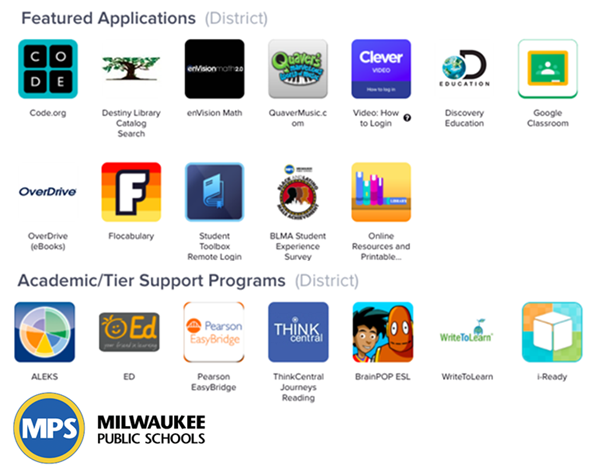
One issue that contributes to teacher technology fatigue is the demand on teachers to research technology options for their students. A better way to work is for the district to work with teachers to identify (“curate”) a limited set of technology offerings tied to the curriculum and to make these technology products easily accessible for teachers, students, and parents. One way to do this is to make use of a software product that provides a district-wide menu of the selected products and enables a “single sign-on” in which students can use the same ID and password to access all products.

An example of such a software product is Clever. Here is part of the Clever menu used by the Milwaukee Public Schools.

Milwaukee Public Schools Clever Menu

7.    Use learning management system (LMS) technology to manage resources.

Learning management system (LMS) software was introduced in higher education back in the 1990s to support online classes. But professors teaching traditional college classes quickly also embraced LMS technology due to its ability to automate functions such as distributing readings and submitting assignments.

The pandemic-driven move to one-to-one device coverage has now also made the use of LMS systems more viable in K12. And LMS systems have the potential to be a great productivity booster. As at the college level, one big benefit is to use LMS systems to provide electronic versions of readings and assignments.

But if teachers are stuck having to work on their own to figure out how to use their LMS systems, and if processes such as assigning student IDs and passwords don’t work well, the pressure to use LMS systems can contribute to technology fatigue.

So here is another area that benefits from top-down and bottom-up management. The district needs to work with teachers to select and install a single LMS product, or possibly one product for high school and another for K-8. Ideally the district will also develop interfaces between the LMS system and the class rosters and grading modules in the student information system (SIS). And the need to use often-complex LMS systems is a great example of why transformation needs powerful professional development support.

8.    Provide energetic professional development and staff interaction to guide transformation and reduce fatigue.

Transformation requires all educators to change how they teach. And this isn’t going to work well if each teacher is left to figure out on their own how the new transformed world works. Implementing transformation requires an energetic professional development program for all staff members.

The professional development sessions need to provide how-to information but also interaction with peers. And the same concepts that apply to the kids also apply to the teachers—the professional development needs to take advantage of technology abilities such as learning management systems, but it also needs to continue to take advantage of human interaction.

. . . . . . . . . . . . . . .

In our next blog entry, we’ll focus in on the use of learning management system technology. We’ll discuss some of the issues involved in managing LMS use and gaining the benefits of this powerful technology.

Until then, do you have any ideas on what districts and schools can be doing to manage this transformation? Leave a comment below under “Leave a Reply.” Or send me an e-mail at schulzj@jerryschulz.com.

How to Improve Learning? Many Small Improvements? Or Top-Down “Transformation?”

What if you had been struggling for years to improve how effectively your children learn? Then suddenly, you were provided with an almost-unlimited amount of money? But you only had a few years to spend it. What would you do?

This is exactly the challenge being faced right now by school districts across the U.S., and they must decide how to spend millions of dollars in federal Covid-19 ESSER relief funds. You could of course easily compile a list of many items that would benefit your kids. But would you also use this as a one-time opportunity to bring about a major transformation in how effectively your kids learn?

Here’s a letter to the editor I wrote that was in the print edition of the Milwaukee Journal Sentinel on Sunday, July 25.

An Opportunity for MPS

Milwaukee Public Schools will receive more than $500 million in federal stimulus funds. (“MPS making plans for more than $500 million in federal stimulus,” July 21).

The district is now making plans on how to spend this money over the next three years. MPS recently held listening sessions and has developed a list of ideas. Items on the list include tutoring for students and training for teachers. And these are worthy ideas.

But I believe there is one best use of these funds. This is to fund an effort across the district to transform how students learn, with the goal to greatly increase student achievement. One likely emphasis in the transformation would be on the use of personalized learning and the enabling technology. Another would be more movement to the community schools concept.

This won’t be easy. Many similar efforts here and in other cities have failed. But what’s different now is the availability of this funding, along with a forced time window.

And coming off our pandemic experience, do we now also have a motivation that is more intense than in the past? Or are we content to have our children continue to fail to learn? This is a once in a lifetime opportunity. We can’t pass it up.