Tag Archives: virtual learning

The Power and Peril of Phones – Part 3: Managing Devices at School

This is the final installment of a three-part blog entry on “The Power and Peril of Phones.” In “Part 1: The Power” we looked back at the evolution of computer and communications technology. We marveled at how this technology now provides us with the power to access all the world’s knowledge and communicate with anyone around the world. And, we looked in amazement at how we can access this power with a small portable device that we can hold in our hand.

But we also considered the peril that the very-tempting overuse of this technology and “device addiction” presents, especially for the young. This peril includes decreasing levels of face-to-face human interaction and increasing rates of mental health problems.

Then in “Part 2: What Do Our Schools Need to Do?,” we considered how schools can cope with these challenges. A major focus for schools has been considering various degrees of “bans” on the use of phones at school. The most extreme form of a ban is requiring students to either leave their phones at home or to lock them up for the school day when they arrive at school.
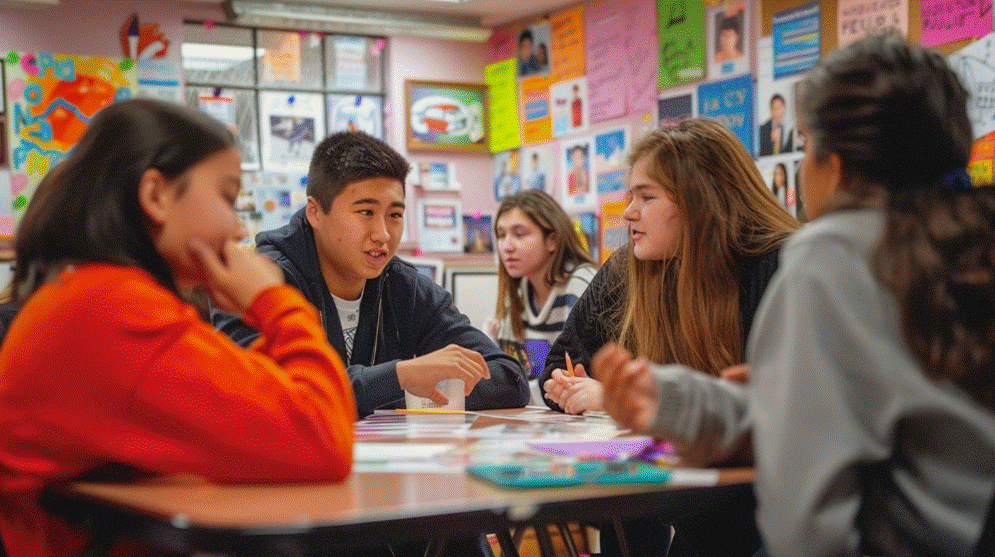
(Courtesy of StockCake)

But even an extreme phone ban at school doesn’t completely solve the problem. This is because we increasingly want to have our students use laptops and other computer devices during the school day to help improve their learning experience. For example, we want to use the power of technology to enable personalized learning, and this requires access to devices. An excellent New York Times article on the perilous place where we have arrived is “Get Tech Out of the Classroom Before It’s Too Late,” by Jessica Grosse. (https://www.nytimes.com/2024/04/10/opinion/schools-technology.html)

For years we foresaw a future in which we could provide our students with “1-to-1 device coverage.” Then in 2020, the Covid-19 pandemic unexpectedly provided the impetus to make this jump, and to issue each student their own device.

And now, we can use our technology to do things such as enable the giant shift from whole group instruction to a personalized learning model. A leader in this movement has been the Modern Classrooms Project (https://www.modernclassrooms.org), which provides advocacy and facilitation to “lead a movement of educators in implementing a self-paced, mastery-based instructional model that leverages technology to foster human connection, authentic learning, and social-emotional growth.”

And of course, we’re now just beginning to scratch the surface of how artificial intelligence, or AI, can provide even more powerful learning for our students. Except the use of AI runs the danger of increasing the time students spend with their devices even beyond what we have now.

So, how can schools provide technology access for our students in order to give them benefits such as access to powerful personalized learning abilities while also somehow minimizing the negative impact of too much device time? This is the tough challenge we want to address in “Part 3: Managing Devices at School.”


As we mentioned in Part 2, a start in controlling device time is to provide some level of a ban on the use of personal devices during the school day. But if the level of the ban leaves the door open for some use of personal devices during parts of the school day, such as at lunch, the school must find ways to help students to manage their device use during these periods.

To help manage the use of devices, the school and the teachers would be wise to structure the school day into use-a-device periods and no-device periods. The no-device periods would need to begin with the teacher saying something like, “OK everyone, now we are going to close our laptops, and until 9:30 we will be (for example) working with our small groups.”

Of course, we should proclaim recess and lunch periods to be no-device periods, as students are encouraged to interact and engage in unstructured play.

But we need use-a-device periods to enable students to use school-issued devices for technology-enabled learning. As noted above, a very beneficial form of technology-enabled learning is personalized learning, especially for reading and math. And increasingly, students will have access to forms of online tutoring, or possibly automated tutoring. What will continue to be challenging will be the use of devices for more open-ended activity such as research.

One way to both encourage human interaction and to minimize the harmful impact of the excessive of devices is to make use of small group sessions and multi-student projects. In these sessions, students may be accessing technology, but they are doing so as part of their interaction with their fellow students. Their human interaction should increase the benefit of the use of the technology, and it should also help to maintain the focus on the assignment.

Students can also benefit if we provide tutoring from adults in the community or older students. The Greendale (Wisconsin) Schools provides various forms of tutoring, including a “Reading Buddies” program in which each week retirement-age adults and work-at-home parents provide one-on-one reading sessions with all first graders. (https://www.greendaleschools.org/families/school-volunteer-opportunities.cfm)

And, an example of a school which uses older students to provide tutoring for younger students is Milwaukee Parkside School for the Arts. (https://mps.milwaukee.k12.wi.us/Schools/Milw-Parkside-School.htm) Note that tutoring by older students helps both the little guys and also the older students.

As valuable as technology is, especially for younger children, some concepts such as those in math can be taught better if we make use of manipulatives, which provide a tactile experience.

Technology also provides advantages in gaining access to various forms of reading material. But a disadvantage of using devices to access online reading material is that it is easier to lose focus and possibly wander into other uses such as social media (more on that below). So ideally, assignments heavy on reading would ideally favor paper books, which also provide a “tactile” experience.

And especially at the elementary level, students would benefit if we set aside a daily period for reading, in which every student in the class and the teacher quietly devotes some quiet time to doing nothing other than to read a paper book or other material of their choice.

Schools may also wish to look for ways to encourage the reading of full-length books, through activities such as student book clubs.

(I’m so old that when I started school our desks were still bolted to the floor, and we had 35 or more students in a class. When we would do an assignment, everyone would do the same thing, which meant some finished much earlier than others. Our teachers managed this challenge partly by asking us to always have a book in our desk, and to use our spare time upon finishing the assignment to read. Well, I loved to read, and I would rush through the assignment so I could get back to reading my current book.)

For many years, the federal Children’s Internet Protection Act (CIPA) has required schools to have Internet filtering technology. The main intent of this requirement was to enable schools to block content that is inappropriate for younger children. But schools can use their filtering systems to block or limit social media sites such as Facebook and TikTok. Filtering social media sites removes these sites as a distraction, and it also helps to control online bullying.

With YouTube, schools may wish to possibly establish a general ban but maintain a positive list of a library of approved YouTube pages, which teachers can constantly add to though an easy-to-use process.


Considering the amazing power that our modern technology provides for our kids, it’s frustrating that we have to put energy into working in different ways to actually keep the students from using that technology, at least for parts of their school day. But there are critical reasons why we have arrived at a point in time where we now must do this.

But if we do this well, we can have it all! We can maximize the powerful benefits our students realize from our technology, such as personalized learning and tutoring. And, we can also maximize the benefits they receive from human interaction.

Wouldn’t it be cool if we could pull this off?

Homeschooling and Virtual Learning – How Can They Help? Can They Hurt? What Should Districts Do?

The COVID-19 pandemic brought about great advances in the use of technology to support virtual learning. And the pandemic also increased interest by parents in homeschooling. The pandemic is now easing, but many parents are for now continuing to choose homeschooling as an option for their children.

Homeschooling is beneficial for some students, but it is not the best form of schooling for most kids. Districts need to support parents who choose homeschooling. But they also must work now to get most students back into their school buildings, because most students simply learn better in in-person settings.

The quick shift to virtual learning during the pandemic is an example of what is called “the disruptive impact of technology.” Often disruption is necessary, as it was for the need to use virtual learning in the pandemic. And we expect it to have a positive impact, as much of our use of virtual learning did.

But technology-driven change can often also be disruptive to a world that previously existed. A good example was how the universal adoption of word processing put typewriter companies out of business. This couldn’t have been helped.

But sometimes these disruptions create unintended impacts we would like to avoid or at least mitigate. For example, the near-universal adoption of smartphones benefits us in many ways. Except the power of our phones has also brought about disruptive negative impacts, such as device addiction.

Of course, homeschooling predates the pandemic. Homeschooling was once rare, but interest in homeschooling has increased since the 1970s, partly driven by a national homeschooling movement. A U.S. Census Bureau study found that for the years prior to the COVID-19 pandemic, homeschooling across the U.S. “remained steady at around 3.3%” of students.” But by the fall of 2020, 11.1% of households surveyed by the Census Bureau reported that they were homeschooling their children. The Census Bureau worded the survey carefully “to make sure households were reporting true homeschooling rather than virtual learning through a public or private school.” [i] And of course, most students have experienced virtual learning in that way during the pandemic.

A related trend that predates the pandemic is an increase in students attending virtual schools. Students may attend virtual schools sponsored by their own districts, or even those sponsored by other districts if their states allow this. Again, this type of virtual school is something different that the virtual schooling that was used during the pandemic.

Most virtual schools offer “asynchronous” classes in which students do not need to be continually interacting online with their teachers and fellow students. These are unlike the “synchronous” online classes most districts used during the pandemic.

Parents considering homeschooling for their child have tough decisions to make. Two big questions regarding homeschooling are:

  • Why should students participate in homeschooling?
  • How can parents provide their homeschooled children with the needed curriculum and oversight?

As for why parents and students would prefer homeschooling, some reasons are:

  • Students are struggling with the overall school environment, due to problems such as bullying.
  • Students have health issues, especially being immunocompromised during the pandemic.
  • Parents prefer homeschooling for religious reasons.
  • Parents are unhappy with the school alternatives in their district.

And how can and/or should parents provide their homeschooled children with the needed curriculum and oversight? One alternative is to participate in a virtual school program. For many families seeking to provide homeschooling this would be a good idea. Yet during the pandemic one more reason some parents chose to homeschool was they felt the daylong virtual learning programs that districts has shifted to involved too much screentime and/or were unable to provide enough content.

An interesting case study of one family’s experience with homeschooling over the course of the pandemic was recently published in the Milwaukee Journal Sentinel. [ii] The author, Amy Schwabe, is a reporter for the paper on family issues. She told of the experience of her own middle school-aged daughter, Wendy. Prior to the pandemic, Wendy “begged to stay home from school. She cried nearly every morning, and she seemed to have constant stomachaches and nausea.” Her parents sought medical help, but to no avail.

Artwork by Dani Cherchio, the Milwaukee Journal Sentinel

Yet when the pandemic struck and Wendy began attending school virtually, these symptoms went away. When in-person schooling resumed Wendy was eager to see her friends again, but the old symptoms returned.

Her parents considered their options, and they decided to homeschool Amy for her eighth-grade year.

We should note two things about how Wendy’s story provides an example of how parents address the two big questions on homeschooling. As to why should a student seek homeschooling, Wendy’s story is an example of how parents may choose homeschooling because their student is struggling with the school environment, for reasons that are not easily fixed.

And as for how to provide for the student’s instruction, it’s interesting that in the middle of our boom in virtual learning Wendy’s parents decided not to take advantage of a virtual learning program. Instead, Amy reports that, “Reading and writing are my strengths, so I’ve become Wendy’s history and English teacher. My engineer husband excels at math and science, so he’s taken on those subjects.” So, Wendy found herself in a very beneficial situation.

Here is a link to this article – https://www.jsonline.com/story/life/wisconsin-family/2022/01/28/wisconsin-mom-homeschools-child-during-covid-pandemic/6559691001. And here is a link to a follow-up article, with an emphasis on children’s mental health – https://www.jsonline.com/story/life/wisconsin-family/2022/02/23/childrens-mental-health-suffering-during-pandemic/6872425001.

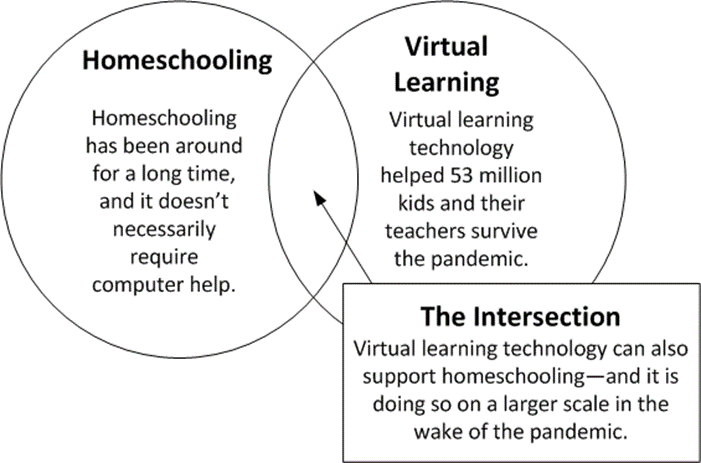
This article helps to show how homeschooling and virtual learning are related but different concepts—homeschooling does not necessarily require virtual learning technology. And although during the pandemic most students have at some time studied at home, they mostly have done this as part of their school’s program rather than at their parents’ direction—so this would probably not be considered to be true “homeschooling.”

Where homeschooling and virtual learning intersect is when parents determine that they will have their children learn at home, but they also will seek the help of a virtual learning program, possibly through their own school district, another district, a charter school, or a commercial provider. Should this be classified as homeschooling? Clarifying this fuzzy boundary is a one of the challenges school districts must address.

Homeschooling and Virtual Learning Intersect When Homeschool Parents Enroll in Virtual Learning Programs

In a previous blog post on June 27, 2021, we discussed several ways to provide virtual learning.  (“To Be Synchronous, or to Be Asynchronous—or, Maybe, to Be Neither. That Is the Question.” – https://managingtechnologyink12.wordpress.com/2021/06/27/to-be-synchronous-or-to-be-asynchronous-or-maybe-to-be-neither-that-is-the-question.)

We discussed how districts seem to have at least four alternative ways to support homeschooling using virtual learning technology:

  • Continue to offer a synchronous concurrent option, in which online students can attend in-person classes along with the students who are at school and in the classroom. Synchronous means the class is live. Concurrent means online and in-person students both attend at the same time.
  • Offer special synchronous classes for virtual learners only, grouping together online learners from across the district. So, everyone in the class is virtual.
  • Offer an “asynchronous” virtual option, in which students use technology to access learning materials but don’t necessarily join together at the same time with fellow students in an online class.
  • Decline to offer any virtual option, either synchronous or asynchronous.

Except we’re arguing that in-person schooling is better for most students. Why is this? In-person schooling:

  • Provides normal in-person social interaction with fellow students and caring adults.
  • Structures the student’s school day and provides oversight of their activity.
  • Controls and limits device time, while also hopefully ensuring an optimal use of the most effective current and emerging technology.

Our school districts have been experiencing the impact of technology-driven disruption. This was happening anyway, but it was expedited and was made more pronounced by the impact of the pandemic.

So, life has become more challenging for our districts and schools. But what should they be doing to manage virtual learning and address the increased demand for homeschooling?

  • Work energetically to bring students back into in-person classroom settings, and diplomatically discourage homeschooling for most students.
  • But address the demand for homeschooling by providing either or both of two options: synchronous classes for virtual learners only and/or an asynchronous virtual program. These programs could serve only the district’s students, they could be offered through a partnership with other districts, or they could be contracted out to providers.
  • And, to the extent that the district sponsors homeschool and virtual learning programs, work to ensure that these programs are high quality and are comparable to the programs for in-person learning.
  • Work to include homeschool students within the larger student population. For example, welcome homeschool students to participate on sports teams and in other school activities.
  • Possibly provide a synchronous concurrent option so students who must temporarily attend from home can continue with their regular teacher and in-person classmates, but…
  • For the most part, avoid using synchronous concurrent classes that mix full-time homeschool and in-person students.
  • Provide homeschool parents with virtual and in-person services, and energetically monitor homeschool students to ensure that they are enjoying success.
  • Monitor all students in the district to ensure that all are successfully attending in some way.

It’s hard to tell where the homeschool and virtual learning world is going, other than it is someplace very different than the past. Districts and schools will be wise to adopt flexible plans and work to provide an excellent experience for all their students.

Technology-driven disruption has complicated our world in other ways. Although we have put beneficial technology to work to improve the learning of our children, this has created situations in which students arguably spend too much of their school days working with computer devices. And so they spend too little of their time interacting with their fellow human beings and being involved in ways to learn that are more hands-on, such as simply using traditional paper books.

How do we cope this disruption? What are some ways to balance virtual and traditional learning? We’ll discuss this in our next blog posting. Until then, let me know if you have any thoughts on this, or post a comment below.


[i] Eggleson, C., and Fields, J., “Census Bureau’s Household Pulse Survey Shows Significant Increase in Homeschooling Rates in Fall 2020,” United States Census Bureau, 2021.

[ii] Schwabe, A., “My husband and I have been homeschooling our eighth grader this school year. She’s taught us some important lessons.,” Milwaukee Journal Sentinel, 2022

To Be Synchronous, or to Be Asynchronous—or, Maybe, to Be Neither. That Is the Question.

This fall we should all finally be able to return to a “new normal” school experience, in the traditional in-person way.

Except one way we were changed by the pandemic is almost all students and their parents have been exposed to some sort of virtual school experience. And some parents will want their districts to continue to offer virtual options for attending school.

(Thanks to Education Week and Andrew Rus/Pittsburgh Post-Gazette via AP.)

For some, this will be because of lingering concerns of infection from COVID-19. But other parents may have come to feel that attending virtually is simply a better way for their children to go to school.

And so, districts will need to make decisions on which models they will—or will not—choose to offer. These decisions won’t be easy. Districts may need to decide not to offer virtual models that students and parents prefer but which the districts determine to not be in the best interest of the students seeking these options, plus also their teachers and the other students.

The biggest issue has to do with the concurrent model.

Alternatives for Providing a Virtual Option

Districts seem to have at least four alternative ways to address expectations for virtual school:

  • Continue to offer a synchronous concurrent option, in which online students can attend in-person classes along with the students who are at school and in the classroom. Synchronous means the class is live. Concurrent means online and in-person students both attend at the same time.
  • Offer special synchronous classes for virtual learners only, grouping together online learners from across the district. So, everyone in the class is virtual.
  • Offer an “asynchronous” virtual option, in which students use technology to access learning materials but don’t necessarily join together at the same time with fellow students in an online class.
  • Decline to offer any virtual option, either synchronous or asynchronous.

Only a year ago, most districts did not offer a virtual option. But with the explosion of the pandemic in March of 2020 districts had to quickly work to keep school going, despite not being able to allow students to be in the building.

Some districts distributed paper texts and materials to their students—kind of “asynchronous,” but without the technology. But most districts adopted virtual solutions. What helped is that many districts had already implemented 1-to-1 device coverage, and others were well on the road there. And districts worked quickly to issue devices to any students who needed them.

This enabled a conversion of existing classes to virtual classes. There was some use of asynchronous virtual classes. But most districts went to synchronous classes—students attended virtually from home, using products such as Google Meet or Zoom, interacting with their teachers who also joined remotely.

In the fall of 2020, most districts returned to face-to-face classes. But many districts also provided a synchronous concurrent option, in which some students could join the class virtually. This accommodated situations such as students having to be out temporarily due to COVID-19 exposure.

But how about the fall of 2021? Why not just continue to allow a synchronous concurrent option?

Not a Good Idea?

There are several reasons why continuing to offer the synchronous concurrent option may not be a good idea.

  • For most students, attending school virtually is just not as effective as attending face-to-face. With traditional schools, students enjoy the structure imposed by the facility and the scheduled school day. And their teachers are on the scene and can more easily ensure that students are engaged throughout the day.
  • The synchronous virtual option requires extra work from our already-overworked teachers, who among other things must ensure there is a virtual alternative for at least some lessons. And they must manage the technology for the virtual sessions.
  • Concurrent classes also provide distractions and possible lost time for everyone—the in-person students, the virtual students, and especially the teachers, as they work to orchestrate the whole scene.
  • And, trying to learn through a virtual session works the most poorly for disadvantaged students and those with special needs.

This is not to say we shouldn’t use technology. The pandemic greatly increased our technology expertise. And providing every student with their own device has opened the door to many effective uses of technology. These uses include supporting personalized learning through the use of powerful adaptive learning software.

And so, the pandemic will hopefully advance our use of technology in learning—except this will work best for children in structured in-school settings.

But if it is not wise to continue synchronous concurrent classes, how can districts satisfy parents seeking a virtual option for their children? One alternative is to group virtual students together into special synchronous-only classes.

Asynchronous Classes—The Most Manageable Option?

But possibly the most manageable alternative is to offer an asynchronous virtual option.

Asynchronous online courses had their start at the college level in the 1990s. Some K-12 districts then began to offer asynchronous virtual programs to appeal to parents who wanted to home school their children, or to accommodate students who were uncomfortable in the traditional school setting. An example is the School District of Waukesha Wisconsin’s eAchieve Academy, which was founded in 2004.

In the 2019-20 school year, 34 of the 50 states allowed districts and charter schools to offer asynchronous virtual school options. And 293,717 of the 50,453,111 students in the U.S., about 0.6%, attended school programs that were fully virtual. [i]

Districts currently without an asynchronous program might be wise to not attempt to build their own program from scratch. An alternative would be to partner with a commercial provider. An example is the School District of Greenfield Wisconsin, which is partnering with the Edmentum provider while also using a district teacher as a digital learning coach. Another alternative would be to collaborate with another district.

Students in Wisconsin also have the option to attend a virtual school in another district through the State’s Open Enrollment program. But they must apply by April 30 for an upcoming school year.

Let’s Think This Through

Some parents and students will reasonably expect their school districts to continue to offer virtual options like those they enjoyed during the pandemic. But districts would be wise to think through which options would be best for all their students.

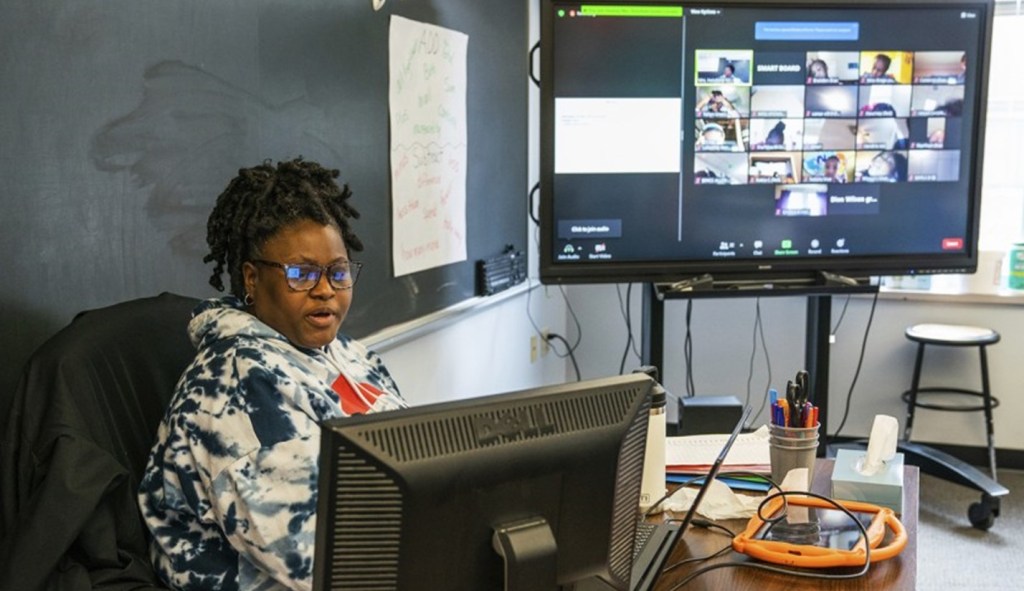
See also the Education Week article on “Forbidding Remote Learning: Why Some Schools Won’t Offer a Virtual Option This Fall,” at https://www.edweek.org/leadership/forbidding-remote-learning-why-some-schools-wont-offer-a-virtual-option-this-fall/2021/06. The photo above of Tanya Holyfield, a 2nd grade teacher at Manchester Academic Charter School in Pittsburgh, is from this article.


[i]           https://nces.ed.gov/ccd/tables/201920_Virtual_Schools_table_3.asp

Virtual Learning Will Make the New Normal Better. But We Must Still Value Our Human Interactions.

The New York Times recently ran two articles with different opinions on the value of virtual learning.

In his February 15th article on “Lessons from Virtual Kindergarten,” [i] David Saks talked about how his four-year-old son Kyle will benefit from a return to face-to-face kindergarten.

But in his February 16th article on “I Actually Like Teaching on Zoom,” [ii] Viet Thanh Nguyen argued that continuing the changes brought about by the pandemic will enable his college students to learn more effectively.

They’re both right.

Three things happened to us during the pandemic.

We needed to make more use of technology and tools, and we did. We acquired new devices and other technology.

We all acquired new technology skills, even four-year-olds like Kyle.

And our culture changed. We began interacting in new ways at work, at school, and at home.

We would be wise to realize these are transformative changes. We need to proactively manage them to get their benefits but also to avoid the downsides. Our technology tools can help us to be more productive and connect better with each other. And we can benefit from our experience with virtual learning during the pandemic.

But we also need to cherish all that was best about the old normal—we must be especially vigilant not to let our alluring technology diminish our ability to have normal human interactions. And how this works will vary depending on the age of the humans involved.

Mr. Saks was right on the money regarding Kyle—four-year-old children need intense human interaction, and their screen time, although somewhat inevitable today, needs to be carefully controlled.

Professor Nguyen’s college students are towards the other end of the education age spectrum. They grew up with screens, and they can benefit from virtual learning in some ways. But whether we’re four or one hundred and four, we need to prioritize those face-to-face human interactions.


[i]    https://www.nytimes.com/2021/02/15/opinion/kindergarten-remote-learning-covid.html.

[ii]   https://www.nytimes.com/2021/02/15/opinion/zoom-video-school-teaching.html#:~:text=And%20much%20is%20horrible%3A%20teachers,the%20human%20connection%20attenuated%20online